
What changed
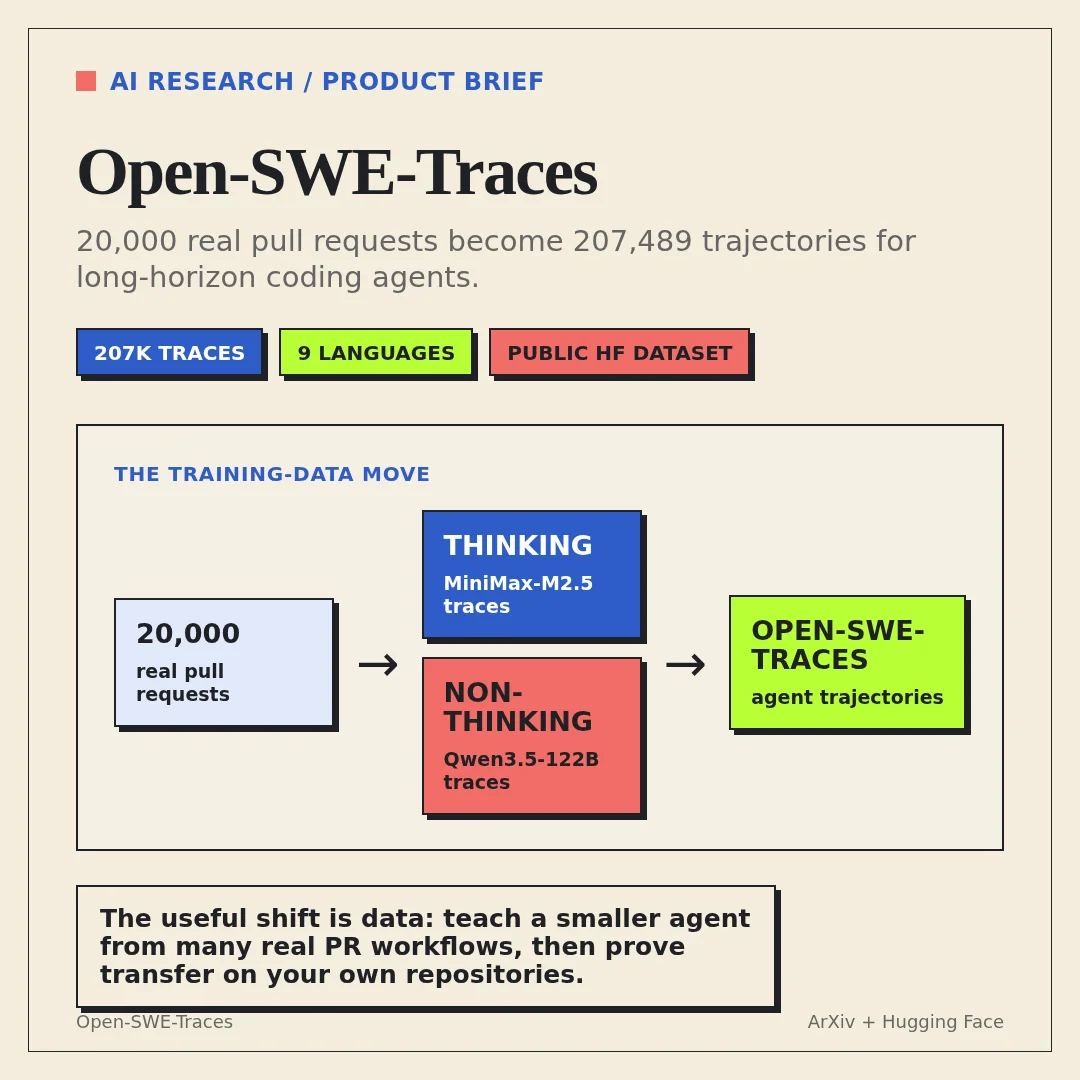
Open-SWE-Traces is a public dataset of 207,489 agentic software-engineering trajectories built from 20,000 real-world pull requests across nine programming languages. 1
The paper pairs traces with explicit reasoning from MiniMax-M2.5 and non-thinking traces from Qwen3.5-122B, then uses them to distill Qwen3-30B-A3B variants. 1
The product problem
Coding agents need trajectories that survive many steps: inspect an issue, edit code, run tests, and produce a patch. More examples help, but the paper reports two hard limits: multilingual data matters, while transfer between execution harnesses is imperfect; student models also inherit teacher errors. 1
The authors' best reported model reaches 61.7% on SWE-bench Verified, 57.1% on SWE-bench Multilingual, and 36.8% on SWE-bench Pro. Those are benchmark results, not a forecast for your repositories. 1
First build
Start with the public Open-SWE-Traces collection on Hugging Face, which lists the
nvidia/Open-SWE-Traces dataset. 2 Sample a language-balanced slice for an offline replay or small adapter experiment, hold out repositories, and compare it with your current agent on the same tools and prompts.Gate the result on patch success, test pass rate, valid tool calls, p95 latency, and regressions. Keep the current agent as rollback; dataset scale is useful only when it transfers to the work you ship.
References
- 1
- 2Open-SWE-Traces collection
huggingface.co
Comments