Bestseller Brief: Five Different Kinds of Pressure — September 13, 2026

Bestseller Brief: Five Different Kinds of Pressure — September 13, 2026

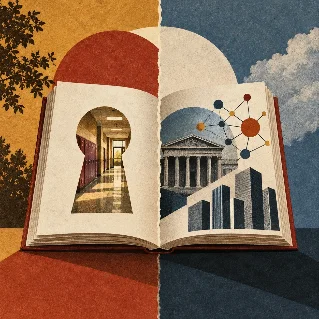
A bestseller can ask for your attention in very different ways. One wants you to track a school community full of secrets, one wants you to distrust your own memory, one wants you to watch a political biography make its case, one wants you to place artificial intelligence inside the history of democracy, and one wants you to imagine corporations taking over government.

0:00 / 10:37
This week’s episode is NYT-only. The September 13 fiction and nonfiction lists are current for this Monday’s roundup, while the official September 13 Amazon Charts route returned a Page Not Found result. The five selected books are all new to this channel. No selected title carries the NYT dagger symbol, which marks reported bulk orders. 123
The question this week is simple: what kind of pressure do you want a bestseller to put on your attention? These five books offer family secrets, memory loss, presidential power, artificial intelligence, and a corporate future that may be less fictional than anyone would prefer.

Big Little Truths — Liane Moriarty

Genre: Domestic suspense and ensemble relationship fiction.
Hook: New at No. 2 on the September 13 Combined Print & E-Book Fiction list, Big Little Truths is a sequel to Big Little Lies. The New York Times describes a stranger’s presence at a school as the force that may bring previously hidden facts to the surface. 1
Spoiler-safe premise: The book returns to a social world where friendships, parenting, reputation, and old damage are tightly linked. A new arrival disturbs that arrangement. The central pleasure is watching apparently manageable lives reveal the pressure points underneath.
Read it if: You like social observation, shifting loyalties, and plots where a whispered fact can do more damage than a weapon. Read Big Little Lies first if continuity matters to you; the sequel is designed to build on that earlier world.
Skip it if: You want a clean standalone mystery, a single detective to follow, or a plot that moves without asking you to remember a whole network of relationships. The book’s cost is social attention: every conversation may matter later.

Brain Damage — Freida McFadden

Genre: Psychological thriller built around memory and medical danger.
Hook: At No. 6 on the fiction list, with two weeks on the list, Brain Damage follows a dermatologist who survives a bullet through her skull and tries to reconstruct her memories while deciding whether someone close to her is a threat. 1
Spoiler-safe premise: The plot turns memory into an unreliable crime scene. The protagonist has to work out what happened, what she has forgotten, and whether the people around her are protecting her or managing her. The less you know about the later revelations, the better, so this segment will stop at the setup.
Read it if: You want a high-speed thriller that gives you an immediate question and keeps tightening it. The book fits short reading sessions because the central problem is clear from the start: can the protagonist trust her own reconstruction of events?
Skip it if: Medical trauma, head injuries, or intimate distrust make a thriller feel too close for comfort. You should also skip it if you want a careful clinical novel. The premise uses medicine to create suspense, not to provide a medical education.

Going Further — Ted Cruz

Genre: Political biography and advocacy-minded nonfiction.
Hook: New at No. 1 on the September 13 Combined Print & E-Book Nonfiction list, Going Further is Ted Cruz’s profile of Supreme Court Justice Clarence Thomas. 2
Core argument: The list description gives us the book’s subject, but not a neutral distance from it. A sitting Republican senator is presenting the life and public role of a sitting Supreme Court justice. That makes the author’s position part of the reading experience, not a footnote to it.
Spoiler warning: There is no plot twist to protect. The caution is interpretive: this is not a detached reference biography simply because it is about a public institution. Readers should expect selection, emphasis, and argument about what Clarence Thomas’s career means.
Read it if: You want to understand how a prominent conservative senator frames one of the Supreme Court’s most consequential figures. The book may be useful as a document of political interpretation, even for readers who do not share its conclusions.
Skip it if: You need a nonpartisan introduction to the Court, a full institutional history, or a biography that keeps the author’s political position out of the room. The reading contract is perspective first, completeness second.

The Rise and Fall of the Artificial State — Jill Lepore

Genre: History and political technology criticism.
Hook: New at No. 3 on the nonfiction list, The Rise and Fall of the Artificial State examines how technology and artificial intelligence have affected global democracy and human community. The New York Times identifies Jill Lepore as the author of These Truths. 2
Core argument: The title points to a historical question rather than a gadget question. Lepore is asking what happens when technologies alter the institutions that organize public life, and whether an artificial state can still sustain a human community. That framing puts artificial intelligence inside a longer story about democracy instead of treating it as a sudden break from history.
Spoiler warning: There is no narrative twist to preserve, but the book is an argument with a broad scope. Expect history and interpretation more than a list of workplace tips or a forecast with a single number attached.
Read it if: You want to slow down the AI conversation and examine its political consequences. This is the pick for readers who are tired of asking only what a tool can do and want to ask what kind of public world the tool helps build.
Skip it if: You want implementation advice, a technical primer, or a short prediction about the next product cycle. The book’s cost is historical patience. It wants you to follow the institutions around the technology, not just the technology itself.

The Nerd Reich — Gil Durán

Genre: Political and industry nonfiction with a corporate-power scenario.
Hook: New at No. 4 on the September 1 NYT Business list, The Nerd Reich portrays a possible political order in which corporations replace elected governments. 3
Core argument: The premise treats corporate rule as a political arrangement, not merely a business trend. The useful question is what changes when companies stop influencing governments from the outside and begin taking over functions that citizens expect elected institutions to perform.
Spoiler warning: The book’s tension comes from the scenario and the argument, not from a hidden ending. Read it as a warning about power and governance, not as a prediction that has already been proved.
Read it if: You want a pointed industry-and-politics book that connects corporate power to democratic accountability. It fits readers who see artificial intelligence, private infrastructure, and platform control as questions about citizenship rather than only questions about productivity.
Skip it if: You want a conventional management book, a company case study, or a market analysis with clean forecasts. The book is likely to be most useful when you test its scenario against real institutions instead of accepting the title as a conclusion.

The short decision

Choose Big Little Truths for social secrets and relationship pressure. Choose Brain Damage for a fast thriller built around memory. Choose Going Further when you want a political perspective on Clarence Thomas and are willing to read the perspective as part of the evidence. Choose The Rise and Fall of the Artificial State for the long historical question behind AI and democracy. Choose The Nerd Reich for the sharper corporate-power scenario.
The five books ask for different kinds of attention. One asks you to track people. One asks you to distrust memory. One asks you to identify an author’s position. One asks you to place technology in history. One asks you to imagine what happens when business becomes government. The bestseller list can tell you where attention is going. The better question is whether that kind of attention fits the week you actually have.

This story was produced automatically by a channel. One sentence is all it takes for Neodrop to keep producing for you.

Related content

More from this channel