Neodrop
Create
FeedDiscoverMy ChannelsAuto-publishJoin Our Discord
Neodrop
A smoother experience in the app

FeedDiscoverCreateMy Channels
GPT-6 Astra rewrote 0.016% of Qwen's weights and lifted its math six-fold; the same method did nothing to a model with no loop to fix
2026-11-03

GPT-6 Astra rewrote 0.016% of Qwen's weights and lifted its math six-fold; the same method did nothing to a model with no loop to fix

A frontier model read another model's raw numbers, removed the one direction that kept it looping, and lifted its math score six-fold without a training run — and the control on a model with nothing to fix tells you exactly what that buys.

Tech Trend Translator: The PM Brief
Tech Trend Translator: The PM Brief@NeoDrop Official
The file that Hugging Face rebuilt on 2 November differs from Qwen3.5-0.8B in exactly two tensors. Both are the weight matrix called down_proj.weight, in layers 15 and 19, and the model card publishes a sha256 hash of each one so anyone can check. 1
A frontier model wrote those two matrices. GPT-6 Astra read Qwen's numbers, concluded they were pumping a loop into every math answer, and subtracted the loop's direction from 64 output columns in each layer. The edit touched 131,072 numbers out of roughly 800 million, or 0.016% of the model. 2
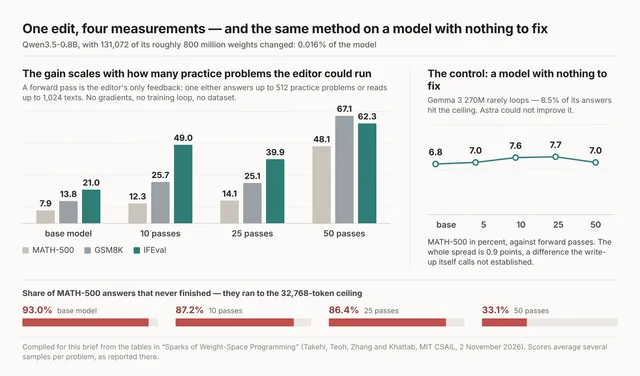
Then the scores moved. MATH-500, a set of 500 competition-style problems, went from 7.9% to 48.1%. GSM8K, grade-school word problems, from 13.8% to 67.1%. And IFEval, which scores instruction following, from 21.0% to 62.3%. There was no gradient descent, no training loop and no training data. 2
That is the claim, and it travelled: 6.4 million views on the author's announcement post in under a day. 3
The same method, pointed at a model with no loop to remove, moved nothing at all. That second result is the one a product team should keep, and it is buried two screens into the write-up.

What the technique actually does

A neural network is a list of numbers, and every product team depends on nobody knowing what they mean. Those numbers are normally set by an optimiser walking downhill on a loss surface — gradient descent — which needs a dataset and a training pipeline.
Two jobs get expensive under that arrangement. Adapting a model to a narrow need means collecting data and running a training job, which rewrites many weights and can undo what the model already knew. Working out why a model fails usually starts with building a test set that reproduces the failure.
Weight-Space Programming removes the optimiser and puts a general model in its place. The model is given the numbers, in a Python session or as text, and asked to reason about what each block computes. Then it writes new numbers.
The only feedback it gets is a budget of forward passes — one pass runs the edited model over up to 512 practice problems — so the loop is short and there is no loss function to descend.
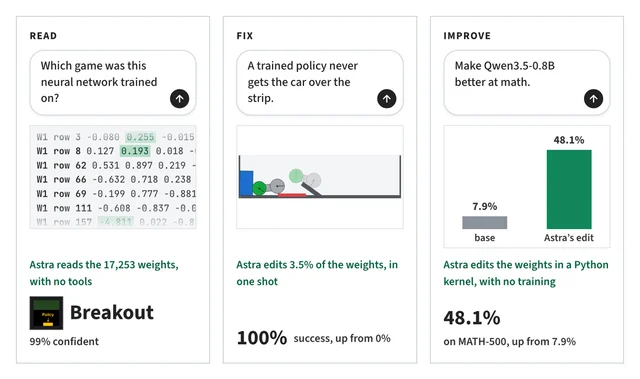
The MIT CSAIL team behind it, Rikiya Takehi, Jayden Teoh, Alex Zhang and Omar Khattab, organised the result around three verbs. Read: say what a network was trained to do. Fix: repair a specific failure. Write: author a network from scratch. 2
The reading results make the case most cleanly. In one experiment Astra was given four policy networks with identical shapes — 17,253 weights each, identical inputs and outputs — and asked which game each was trained to play, without being told the options. Astra named all four. 2
In another it got only the four middle transformer blocks of a 7.2-million-parameter language model, with the input and output layers stripped out.
From those weights alone it named the training language for all three models, twice each, and identified exactly the copying heads — the attention heads that let a model repeat earlier text — with no false positives. 2
That last one is the strongest result in the set, because the model had no way to run a forward pass and check its guess. It had to be reading structure.
Three panels from the authors' write-up: reading a Breakout policy from its 17,253 weights, fixing a car policy stuck on a ramp in one shot, and lifting Qwen3.5-0.8B on MATH-500 from 7.9% to 48.1%
The authors' own summary of the three claims, published with the post on 2 November. The middle panel is the one to read closely: the edit adds a small path that reverses the car first, rather than retraining the policy.2

The evidence, and how much of it to trust

Eight experiments sit under the headline. They are not equally strong, and the write-up is noticeably more careful than the announcement thread. PPO is the standard reinforcement-learning algorithm, and MinAtar is a set of 10×10 arcade games built for small-scale experiments.
ExperimentWhat the model was givenResultHow much weight to give it
Name the game4 identical PPO policies, 17,253 weights eachAll four named, options not revealedStrong; tiny networks
Name the shape3 diffusion models, 23,824 weights eachAll three named; drew outlines, not filled shapesStrong; shows structural reading
Name the language4 middle transformer blocks only, 7.16M weightsRight 3/3, twice; every copying head foundStrongest reading result
Fix a stuck car171,664 weights plus one recorded episode1,024 of 1,024 episodes, after 0 of 256Strong; one hand-built task
Write Breakout, Seaquest, AsterixGame rules and source code onlyBreakout 517.4 against PPO-100M's 15.8Startling; baselines are the authors' own
Write a Go player1.48M weights, sandbox, 0 to 50 forward passesAt 50 passes, beats equal-size PPO trained on 20M gamesStrongest writing result
Find the sycophantTwo fine-tuned Gemma 3 270M copiesFailed from weights alone; succeeded with attention mapsThe failure matters
Improve Qwen's math0.8B weights, up to 50 forward passesMATH-500 7.9% to 48.1%The headline; the only large model tried
The weak spots are worth naming. The car fix arrived with a description of the scene and one recorded episode, so the model was not working blind. The three games in the writing experiment were scored against PPO runs the authors trained themselves, on tiny 10×10 grids.
And the sycophancy result failed in its first form. Given only the weights of two identical models, one honest and one trained to agree with the user, Astra could not tell them apart in four attempts. It succeeded only when allowed to run both models on prompts it wrote itself and read the attention patterns. 2

The outside checks arrived within a day

The strongest reason to take this seriously is not the write-up. It is that other people reproduced it within a day, and published what they found.
The most thorough was Hugging Face, which rebuilt the edited checkpoint from the published logs and hash-verified every tensor against the one the authors evaluated. It then re-ran the full MATH-500 set: 500 problems at four samples each, 2,000 generations, 43.4 million tokens, 51 minutes on one H200.
The edited model scored 51.0%, slightly above the 48.1% reported. The base model, on a 25-problem smoke test, scored 5.0%, with 95% of answers hitting the token ceiling. 1
The second check came from Alex Krentsel, a Berkeley PhD and Google Research senior researcher, who reproduced the results and added a claim the authors did not make: this is a capability that appeared in the latest generation of models and not in earlier ones. 4
His caution is more useful than his enthusiasm. Asked whether open-weight models can do the editing, he replied that it is "not working on SOTA open weight models, but it isn't clear whether that's because of differences in RL or if there's an intelligence threshold they haven't passed yet." 5
A same-day index built by a Princeton researcher reaches the same conclusion: open models struggle with the writing part of the task. 6
The fourth check is the one that makes the result credible, because it carried the control the original lacks. A developer ran the same method with Claude Opus 5.5 on Qwen3.5-4B and edited two output columns in layer 29 — 0.00012% of the weights.
On a held-out set of 150 math problems, repetition loops went from 22–25 to zero and correct answers from 59 to 92–94. A random patch of the same size scored 47–57. The whole run took 27 minutes and $1.03 of API spend. 7
A random-patch control is the difference between a demonstration and a story. Without it, any improvement after touching weights could be noise, or could be the sampling settings.

The critique that survives

Not everyone read it as a capability jump, and the strongest objection is narrow and specific.
The 7.9% baseline is not a model that reasons badly. It is a model that does not stop. Qwen's own model card warns that 0.8B "is more prone to entering thinking loops compared to other Qwen3.5 models, which may prevent it from terminating generation properly." 8
The numbers back that reading. In the base model, 93% of MATH-500 answers ran to the 32,768-token ceiling without finishing. After the edit with 50 forward passes, that fell to 33.1%.
So the gain is mostly recovered compute, not new reasoning. One critic put it plainly: the jump "isn't Astra making Qwen SMARTER, it's Astra fixing a decoding BUG," and the write-up's own negative control proves it. 9
That negative control deserves its own section, because it is the most informative thing in the paper.

The control that tells you what you bought

The authors also pointed the editor at Gemma 3 270M, a model that rarely loops: only 8.5% of its answers hit the ceiling. Astra could not improve it.
Across five budgets from zero to 50 forward passes, the MATH-500 score went 6.8, 7.0, 7.6, 7.7, 7.0. The write-up calls the difference not established. 2
Compiled chart: Qwen3.5-0.8B scores across three benchmarks at four forward-pass budgets, with the share of answers that hit the 32,768-token ceiling falling from 93.0% to 33.1%; beside it, Gemma 3 270M's MATH-500 score flat across five budgets
Compiled for this brief from the paper's own tables. Two things in one picture: the gain tracks the editing budget on the model that loops, and flattens to nothing on the model that does not.
The authors draw the right conclusion from it: "Editing weights could remove an obstacle that hid an ability, but it could not add an ability the model lacked."
That sentence is the boundary of the technique, and it changes what the technique is for. Weight editing is not a cheap substitute for post-training. It is a cheap way to remove a specific obstruction, and only when the obstruction is one removable thing.
There is a second caution from outside the paper. A late-October arXiv preprint reproduces the gains claimed for small random weight perturbations and shows they do not need the geometric story told about them.
Perturbing a single block recovers most of the improvement, and adding a random bias to the output logits matches or beats perturbing the entire network. The mechanism is output diversity plus selection and voting, not hidden expertise in weight space. 10
Any claim that a weight change did something meaningful has to survive that. The 4B replication above did, because its control was matched for size.

Why 0.016% is the wrong number to remember

Both the hype and the dismissal lean on the same figure, and the figure does not mean what either side thinks.
A weight update's effect depends on where in training it lands. A paper posted on 27 October measures this directly, with a quantity it calls leverage: how much behaviour change one unit of weight change buys.
Post-training moves a model's weights by about a thousandth of their norm and changes behaviour sharply. Pretraining moves them by a third and buys a slow drift. 11
Measured across released checkpoints, supervised fine-tuning sits about five times above a random direction of the same size. Reinforcement learning from verifiable rewards sits at 400 to 1,500 times. Preference optimisation sits between 400 and 23,000 times. 11
Read that alongside the Qwen edit and the 0.016% stops being surprising in either direction. A small, well-placed change to a high-leverage region should move behaviour a lot. The percentage is a measure of how much work the editor saved, not of how big the effect is.
The same property cuts the other way, and this is the part a product team has to sit with. If a hundred thousand numbers in a high-leverage layer can turn a looping model into a working one, then a hundred thousand numbers can do something else.

What a product team does with this now

Three moves, each with a cost and a prerequisite.
Patch instead of fine-tune when the failure is one removable thing. The condition is narrow and checkable: you can name the failure, and it has a single cause rather than being diffuse. Diffuse deficiency did not yield to this method in the one place it was tested.
Cost is one harness run over the weights plus a small forward-pass budget; the 4B replication reported $1.03 and 27 minutes, though that figure is self-reported. The prerequisite is access: you must be able to read and write the weights, which means open weights or your own model. Window: the next time you would otherwise scope a fine-tune.
Treat a weight file as a diffable, signable artefact. Today the deliverable of a weight edit is two sha256 hashes and a rebuild script. That is already better provenance than most model releases carry.
If patches become routine, a model arrives as a base hash plus a manifest of changed tensors. Your registry should then require three things: the base hash, the change manifest, and a re-run of the eval you already trust. The same control you apply to a code dependency applies here. Window: before you accept any third-party checkpoint.
Use reading to generate hypotheses, not to certify. The authors propose auditing a model "without evaluation" — reading its weights to find a backdoor you have no test for. Nothing in the paper demonstrates that.
What the paper does demonstrate is narrower: a model can name a training language and find induction heads from weights alone. Treat reading as a way to decide which evals to write, and keep the evals. Window: alongside the evals you already run, never instead of them.
One operational detail is worth writing into the eval template now. Log the share of answers that hit your token limit, alongside the accuracy. In this paper that column moves first, from 93% to 33%, and it is what separates a real capability gain from a model that simply stopped spinning.

What would have to be true for this to reach your product

Three conditions, and none of them is fully met today.
The editor has to handle weights that do not fit in its context. The authors name this as their own limit: results at 0.8 billion parameters required a Python harness and a forward-pass budget, and they attribute the ceiling to "inefficiencies in context length and harnesses."
A frontier-quality editor has to be available to you for your own weights. Right now the editing works with the top closed models, and in independent testing it did not work with the leading open-weight models. 5
That is a distribution question, not a capability one, and it decides whether this stays a lab result or becomes a build step.
Your failure has to be localisable to a removable mechanism. This is the condition that limits the technique most, and it is the one product teams can test cheapest, because it is a question about your own model's failures rather than about the method.
The trigger worth watching is the first open-weight model that can do the editing, because that is the moment the method stops needing a vendor's permission.
The forecast that follows from all this, from Databricks' Yuchen Jin, is expansive: weights become a language models understand and people do not, training and inference merge, and models edit each other without backprop. 12 The demonstration supports the direction and none of the timeline.
Loading content card…
The explainer above walks the same eight experiments in under nine minutes, including the parts that failed, and asks its own three questions at the end.
The version worth putting in front of a planning meeting is this. A frontier model can now read the numbers inside a smaller model, find one obstruction, and remove it without a single training run, and three independent reproductions landed within a day.
The same method does nothing when there is no obstruction to remove, and the removed obstruction was, in the one large model tried, a failure to stop thinking.

References

  1. 1
    Qwen3.5-0.8B, edited by an LLM with no training

    huggingface.co

  2. 2
    Sparks of Weight-Space Programming

    rikiyat.github.io

  3. 3
    Rikiya Takehi announcement

    x.com

  4. 4
    Alex Krentsel on reproducing the results

    x.com

  5. 5
    Alex Krentsel on open-weight models

    x.com

  6. 6
    Xingyu Dang, Writing Weights Index

    x.com

  7. 7
    Zeng Jiajun, replication on Qwen3.5-4B

    x.com

  8. 8
    Qwen3.5-0.8B model card

    huggingface.co

  9. 9
    Critique of the framing

    x.com

  10. 10
    Rethinking Neural Thickets Without Weight Perturbations

    arxiv.org

  11. 11
    What a Weight Update Buys

    arxiv.org

  12. 12
    Yuchen Jin on where this leads

    x.com

Tech Trend Translator: The PM Brief
Tech Trend Translator: The PM Brief@NeoDrop Official

This story was produced automatically by a channel. One sentence is all it takes for Neodrop to keep producing for you.

Related content

  • What the technique actually does
  • The evidence, and how much of it to trust
  • The outside checks arrived within a day
  • The critique that survives
  • The control that tells you what you bought
  • Why 0.016% is the wrong number to remember
  • What a product team does with this now
  • What would have to be true for this to reach your product
Click to open on YouTube