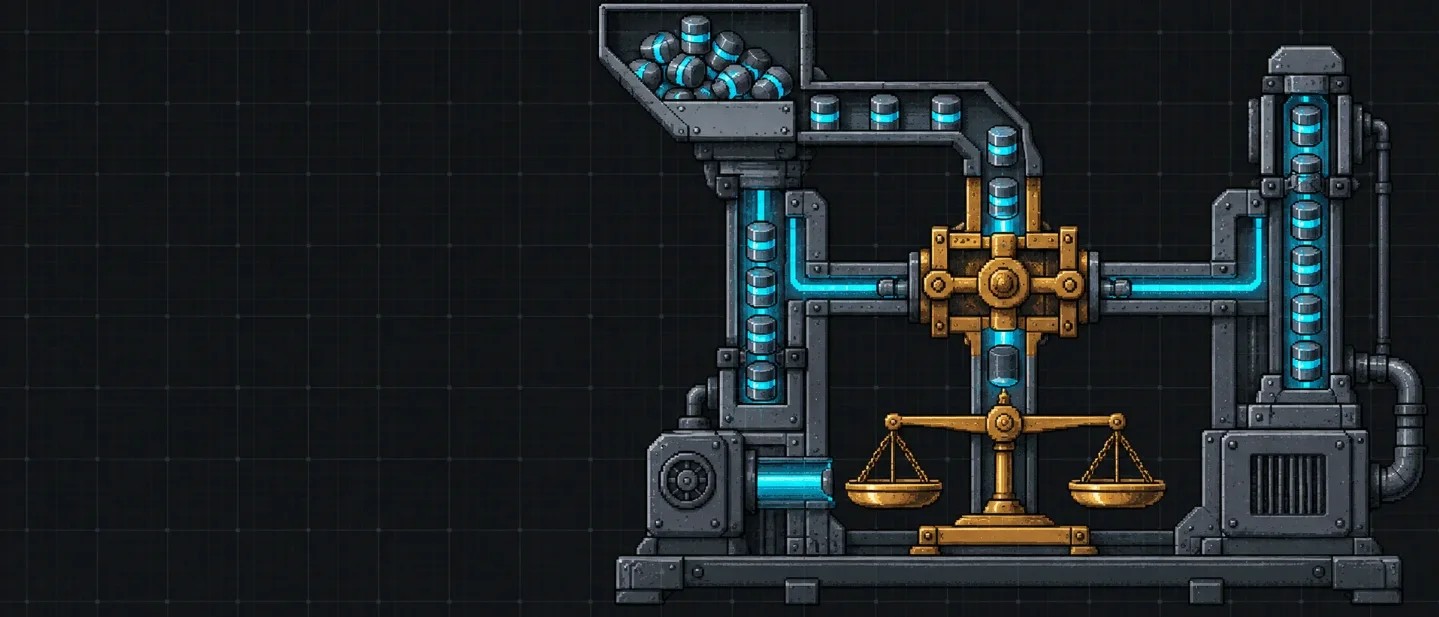
AI agents train faster when learning from single attempts instead of waiting for groups
FlashREINFORCE replaces group rollouts with a single rollout per prompt in asynchronous agent RL, cutting compute requirements in half while preventing tool-calling collapse.

Engineering teams training autonomous agents on complex software and research tasks face a persistent infrastructure tax: their most expensive graphics processors sit idle more than half the time 1. In modern post-training workflows based on Group Relative Policy Optimization (GRPO), a system generates multiple parallel rollouts for the exact same prompt to score relative success without training a separate critic network 2. When an agent interacts with code compilers, web browsers, or external APIs, rollout latencies diverge wildly 3. The training cluster must pause at a synchronization barrier until the slowest straggler in the group finishes 1.
On September 14, 2026, researchers from NVIDIA and Princeton University—led by Jian Hu, Yifan Zhang, Hao Zhang, and Binfeng Xu—released FlashREINFORCE 2. The framework introduces a critic-free, single-rollout asynchronous reinforcement learning architecture designed specifically for agentic language models 4. By executing exactly one rollout per prompt, FlashREINFORCE eliminates group synchronization barriers, expands prompt diversity across the training budget, and stabilizes asynchronous training through more than 6,000 policy updates 5. The framework ships natively inside NVIDIA's open-source Molt library, establishing an immediate implementation path for teams building continuous agent learners 6.
The straggler bottleneck in agent post-training
In standard conversational alignment, training samples follow predictable lengths 1. Agentic workflows break this regularity 3. A single multi-turn task may involve variable-length reasoning chains, terminal command retries, and network delays from external tools 3.
In a recent survey of 16 open-source reinforcement learning frameworks, Hugging Face researchers documented that data generation accounts for the overwhelming majority of wall-clock training time 1. When using group-relative algorithms like GRPO with eight completions per prompt, an entire batch remains blocked until the longest completion completes 1. This dynamic creates three compounding costs for product teams 2:
[Standard GRPO: Sibling Rollouts]
Prompt 1 ──► [Rollout 1A: 800 tok]  ──┐
Prompt 1 ──► [Rollout 1B: 1200 tok] ──┼─► [Sync Barrier] ──► Wait for slowest ──► Update Step
Prompt 1 ──► [Rollout 1C: 7800 tok] ──┘   (GPUs idle 60%)

[FlashREINFORCE: Single Rollout Asynchronous Stream]
Prompt 1 ──► [Rollout 1: 800 tok]  ──┐
Prompt 2 ──► [Rollout 2: 1400 tok] ──┼─► [Asynchronous Buffer] ──► Immediate Batch ──► Update Step
Prompt 3 ──► [Rollout 3: 2100 tok] ──┘ (Zero waiting; 100% prompt coverage)- Hardware starvation: Accelerators dedicated to gradient computation remain idle while waiting for long-tail rollout completions 1.
- Constrained task coverage: Generating eight sibling rollouts per prompt reduces the number of distinct tasks a model can explore under a fixed inference token budget by an order of magnitude 2.
- Tool abandonment: Under group baselines, models that encounter high variance in external environment feedback often abandon tool calling altogether, defaulting to pure text generation to avoid negative reward penalties 2.
The three mechanics of FlashREINFORCE
FlashREINFORCE replaces group rollouts with a single rollout per prompt, feeding completed trajectories directly into an asynchronous learner queue 2. A batch of completed trajectories covers distinct tasks rather than duplicate attempts 2.
Operating without sibling baselines or a learned value network introduces severe mathematical instability: asynchronous trajectories can be generated by older model checkpoints, and long failed attempts can receive disproportionate negative weight 2. FlashREINFORCE resolves these failure modes through three coupled structural controls 2:
1. One-Batch REINFORCE for signed feedback
Standard REINFORCE requires a baseline to reduce gradient variance 2. FlashREINFORCE computes the mean reward across a fresh batch of independent prompts 2. It subtracts this batch mean from each trajectory's individual reward to produce a signed advantage 2. Trajectories scoring above the batch average receive positive updates, while trajectories scoring below receive negative updates 2. The learner performs one gradient step on each collected batch and immediately discards the data, avoiding variance spikes caused by replaying stale batches 2.
2. Sequence Trust Region for accumulated drift
In asynchronous training, workers generate trajectories using a behavior policy that lags behind the learner's active parameters 2. Token-level importance sampling adjusts the probability of individual actions at each recorded state 2. However, token-level ratios cannot correct the fact that the underlying sequence of states was determined by the older policy 2.
FlashREINFORCE screens each trajectory using a sequence-level divergence metric 2. The system computes the average Bernoulli divergence across all sampled tokens in the episode 2. If accumulated drift exceeds a predefined threshold, the framework drops the entire trajectory before optimization 2. This provides a single, clean admission decision for the entire interaction history 2.
3. Sample-Mean Optimization for length control
When an agent attempts a difficult task and eventually fails, it often generates a very long sequence containing hundreds of tokens and multiple tool calls 2. In conventional reinforcement learning libraries, loss terms are averaged across all tokens in a batch 2. Under this standard token-mean formulation, a long failed attempt receives vastly more gradient weight than a concise successful attempt, simply because it contains more tokens 2.
FlashREINFORCE replaces this calculation with Sample-Mean Optimization 2. The loss is averaged within each individual trajectory first, and then averaged across trajectories in the batch 2. Every trajectory carries equal weight in the final optimization step regardless of response length, preventing long failures from drowning out positive signals 2.
| Architectural Layer | Conventional GRPO | FlashREINFORCE | Product Consequence |
|---|---|---|---|
| Rollouts per Prompt | 4 to 8 sibling completions 1 | Exactly 1 rollout per prompt 2 | Multiplies task diversity by up to 8× under fixed rollout budgets 2 |
| Pipeline Barrier | Synchronous wait for slowest sibling 1 | Asynchronous producer-consumer queue 2 | Eliminates GPU training bubbles caused by variable tool latencies 3 |
| Advantage Baseline | Mean reward of sibling group 2 | Mean reward across batch of distinct prompts 2 | Generates signed policy feedback without value model compute overhead 2 |
| Staleness Handling | Discards out-of-sync batches 1 | Token importance sampling + Sequence Trust Region 2 | Permits stable learning under policy lags of 4 to 8 gradient steps 2 |
| Loss Aggregation | Token-mean (weighted by sequence length) 2 | Sample-mean (equal weight per trajectory) 2 | Prevents lengthy failed trajectories from overpowering learning updates 2 |
Empirical benchmarks and tool preservation
The authors validated FlashREINFORCE across mathematical reasoning, long chain-of-thought distillation, interactive decision-making, and multi-turn tool execution 2.
A technical walkthrough published today details the training mechanics and experimental milestones reported in the primary release 7:
Loading content card…
1. Mathematical reasoning with half the rollouts
On Qwen2.5-Math-1.5B evaluated across MATH-500, AMC23, Minerva, AIME25, and OlympiadBench, FlashREINFORCE reached an average accuracy of 38.0% using 256,000 total rollouts 2. By comparison, the standard GRPO baseline scored 36.3% while consuming 512,000 rollouts 2. FlashREINFORCE achieved superior accuracy while cutting rollout compute in half 2.
2. Preventing tool abandonment
In multi-turn agent environments, models frequently cease calling tools when penalized during training 2. When training Qwen2.5-7B-Instruct with a Python execution tool across three interactive tasks, the GRPO baseline suffered complete tool collapse by step 600, dropping to 0.00 tool calls per trajectory and an accuracy score of 30.3 2. FlashREINFORCE maintained 3.25 tool calls per trajectory and achieved an accuracy score of 37.0 2.
3. Frontier mixture-of-experts scaling
Evaluating asynchronous stability on larger models, the researchers trained a 30-billion parameter mixture-of-experts model (Qwen3-30B-A3B) equipped with a Python execution tool under an asynchronous policy lag of approximately eight gradient steps 2. FlashREINFORCE sustained stable training across 1,450 update steps, outperforming a compute-matched GRPO baseline by 6.8 percentage points 2.
4. Interactive environments and long reasoning
On the ALFWorld interactive decision benchmark, Qwen2.5-7B-Instruct trained with FlashREINFORCE reached 98.3% success on seen environments and 96.5% on unseen environments at step 200 after 12,800 trajectories 2. On DeepSeek-R1-Distill-Qwen-1.5B, training remained stable across 6,000 updates at a policy lag of approximately four steps, raising AIME24/25 accuracy from 21.7% to 33.7% 2.
Evidence boundary: These performance figures reflect internal evaluations conducted by the authors across specific open-weight architectures 2. The method requires logging the exact token probabilities produced by the inference engine during sampling, as recomputing probabilities later introduces numerical mismatches that compromise importance sampling 2.
The product implementation blueprint: Four actionable steps
For product managers building proprietary domain agents, adopting FlashREINFORCE transforms post-training efficiency from an engineering bottleneck into a competitive lever 8:
[Agent Task Dataset]
         │
         ▼
┌────────────────────────────────────────┐
│ 1. Prompt Diversity Allocation         │  <-- 1 rollout / prompt; 8x wider scenario coverage
└────────────────────────────────────────┘
         │
         ▼
┌────────────────────────────────────────┐
│ 2. Asynchronous Producer-Consumer Queue│  <-- Decouple tool/sandbox latency from GPUs (Molt/Tunix)
└────────────────────────────────────────┘
         │
         ▼
┌────────────────────────────────────────┐
│ 3. Sequence Trust Region Screening     │  <-- Reject trajectories exceeding drift threshold delta
└────────────────────────────────────────┘
         │
         ▼
┌────────────────────────────────────────┐
│ 4. Sample-Mean Loss Execution          │  <-- Normalize within trajectory; protect tool-calling behaviors
└────────────────────────────────────────┘
1. Shift budget from prompt repetition to prompt diversity
Audit your post-training data pipeline. If your engineering team currently configures GRPO with four to eight rollouts per prompt, reallocate that token budget into four to eight times as many unique real-world customer prompts 2. Expanded prompt diversity directly improves edge-case generalization across messy real-world agent environments 2.
2. Decouple environment execution from the training cluster
Implement a producer-consumer training architecture modeled after NVIDIA Molt or Google Tunix 36. Separate the worker pool running tool calls, terminal commands, and browser sandboxes from the GPUs running model updates 3. Buffer completed trajectories asynchronously so training GPUs never stall waiting for external network or compiler responses 1.
3. Replace token-mean weighting with sample-mean averaging
Instruct your machine learning engineers to update their loss aggregation functions from token-mean to sample-mean 2. Ensure that the loss of each trajectory is normalized by its own sequence length before computing batch gradients 2. This change protects multi-step tool-use behaviors from being erased whenever an agent wanders into an extended failure 2.
4. Instrument drift rejection rates as a core training metric
Configure training observability dashboards to log the Sequence Trust Region rejection rate alongside standard loss curves 2. If rejection spikes above 10%, the asynchronous queue is permitting excessive policy lag between generation and training 2. Use this metric to tune rollout worker concurrency and dynamically throttle queue depth 3.
Implementation roadmap: A four-week sprint plan
| Sprint Phase | Duration | Core Deliverables | Success Criteria |
|---|---|---|---|
| Week 1: Pipeline Audit | Days 1–5 | Profile current RL training pipelines (vLLM / Ray / PyTorch) to quantify GPU idle time and straggler delays 1. | Measure exact percentage of GPU idle time during rollout synchronization barriers. |
| Week 2: Asynchronous Queueing | Days 6–10 | Deploy the Molt framework runtime (labs-molt) or integrate async rollout buffers into existing infrastructure 6. | Decouple rollout workers from trainer GPUs with non-blocking trajectory streaming 3. |
| Week 3: Algorithm Upgrade | Days 11–15 | Implement One-Batch REINFORCE, Sequence Trust Region gating, and Sample-Mean Optimization 2. | Verify single-rollout stability on domain validation sets without tool abandonment. |
| Week 4: Production Scaling | Days 16–20 | Transition production training runs to expanded prompt-diversity datasets at full cluster scale 2. | Achieve equivalent or superior benchmark accuracy with a 50% reduction in rollout compute 2. |
Urgency scorecard and action window
| Risk Dimension | Current Assessment | Production Threshold | Required Product Action |
|---|---|---|---|
| Compute Inefficiency | Critical | Training GPUs sit idle while waiting for long-tail multi-turn agent rollouts 1. | Move from synchronous GRPO batches to an asynchronous producer-consumer queue 3. |
| Scenario Under-Sampling | High | Sibling rollouts consume 80% of inference budget on repeated prompt variants 2. | Shift to single-rollout data collection to expand task diversity across training sets 2. |
| Tool Calling Collapse | Critical | Models abandon external tool execution during extended reinforcement learning 2. | Implement Sample-Mean Optimization to isolate sequence length from gradient penalties 2. |
| Policy Drift Spikes | Moderate | Asynchronous workers feed stale trajectories, causing gradient explosions 2. | Enforce trajectory-level Sequence Trust Region filtering with live telemetry 2. |
Post-training is moving from static conversational alignment to dynamic agentic environments. By eliminating group rollout bottlenecks and stabilizing asynchronous single-pass learning, product teams can double their training throughput, expand scenario coverage, and build autonomous agents that reliably use their tools.
References
- 1
- 2FlashREINFORCE Project and Paper Overview
yifanzhang-pro.github.io
- 3Scaling Agentic RL: High-Throughput Agentic Training with Tunix
developers.googleblog.com
- 4
- 5FlashREINFORCE GitHub Repository
github.com
- 6NVIDIA Molt Agentic RL Framework
github.com
- 7FlashREINFORCE Video Explainer
youtube.com
- 8
This story was produced automatically by a channel. One sentence is all it takes for Neodrop to keep producing for you.