Launch week: September 28 - October 4, 2026
Four dated orbital launches fill the September 28-October 4 UTC week: Starship's first attempt to reach orbit with 26 Starlink V3 satellites, NASA's Crew-13 crew rotation, a 130-payload rideshare from Vandenberg, and the first NRO flight on a Falcon Heavy.

Four dated orbital launches fill the September 28 – October 4, 2026 UTC week, and all four fly on SpaceX rockets. Monday brings Starship's first attempt to reach orbit, carrying satellites for the first time. Thursday pairs a NASA crew rotation with a 130-payload rideshare seven hours apart, and the early hours of Friday bring the first Falcon Heavy of its kind for the National Reconnaissance Office. One DLR research rocket is also inside the window. Two things are unsettled: SpaceX is launching Starship "as soon as" Monday, "pending regulatory approval", and tracking services disagree about how long Friday's launch window stays open. 123
All times below are Coordinated Universal Time (UTC).
NET marks a target that has not been fixed, meaning no earlier than; TBD marks a field nobody has announced yet.Quick schedule
| UTC date and window | Mission and vehicle | Operator | Launch site and pad | Payload and destination | Status and webcast |
|---|---|---|---|---|---|
| Sep 28, 12:15 Window opens 12:15, closes 13:30 | Starship Flight 14 (Starlink Group 31-1) Starship-Super Heavy v3 | SpaceX | Starbase, Texas, Pad 2 | 26 Starlink V3 satellites to low Earth orbit, the first operational deployment on Starship; Booster 21 and Ship 41 both fly for the first time and both splash down rather than land | On schedule, pending regulatory approval. Live webcast on SpaceX's Flight 14 page from about 11:45 UTC and continuing through splashdown. 12 |
| Oct 1, 15:10 | Crew-13 Falcon 9 Block 5 and Crew Dragon Grace | SpaceX for NASA | Cape Canaveral Space Force Station, Florida, SLC-40 | Four crew to the International Space Station for about six months as Expedition 75/76; booster B1101 flies for the third time and lands at Landing Zone 40 | On schedule, delayed from September 12. NASA carries the launch on NASA+ and nasa.gov/live. 345 |
| Oct 1, 18:18 Window opens 18:18, closes 19:16 | Transporter 18 Falcon 9 Block 5 | SpaceX | Vandenberg Space Force Base, California, SLC-4E | 130 payloads to sun-synchronous orbit, including two spacecraft with reentry vehicles and four orbital transfer vehicles carrying 41 of the payloads for later deployment; booster B1082 flies for the 25th time and lands at Landing Zone 4 | On schedule, with a backup October 2 at the same time. Live webcast on SpaceX's Transporter-18 page from about 18:03 UTC. 67 |
| Oct 2, 03:53 Window closes 04:42 on one source, 05:42 on another | NROL-97 Falcon Heavy | SpaceX for the National Reconnaissance Office | Kennedy Space Center, Florida, LC-39A | Classified national security payload to a high-energy orbit; first NRO payload on a Falcon Heavy, and the two side boosters land at Landing Zones 2 and 1 while the centre core is expended | On schedule, with a backup October 3 at 03:48 UTC. No agency webcast published; NASASpaceflight's stream opens ahead of the window. 8910 |
Oct 1–8, earliest date October 1, time TBD | MAPHEUS-17 Red Kite / Improved Malemute sounding rocket | DLR (MORABA) | Esrange Space Center, Sweden | Microgravity experiments in materials science and life science on a suborbital flight of several minutes; payload manifest not published | TBD inside the window. No webcast announced. 11 |
Mission cards
Starship Flight 14: the first attempt to stay in orbit
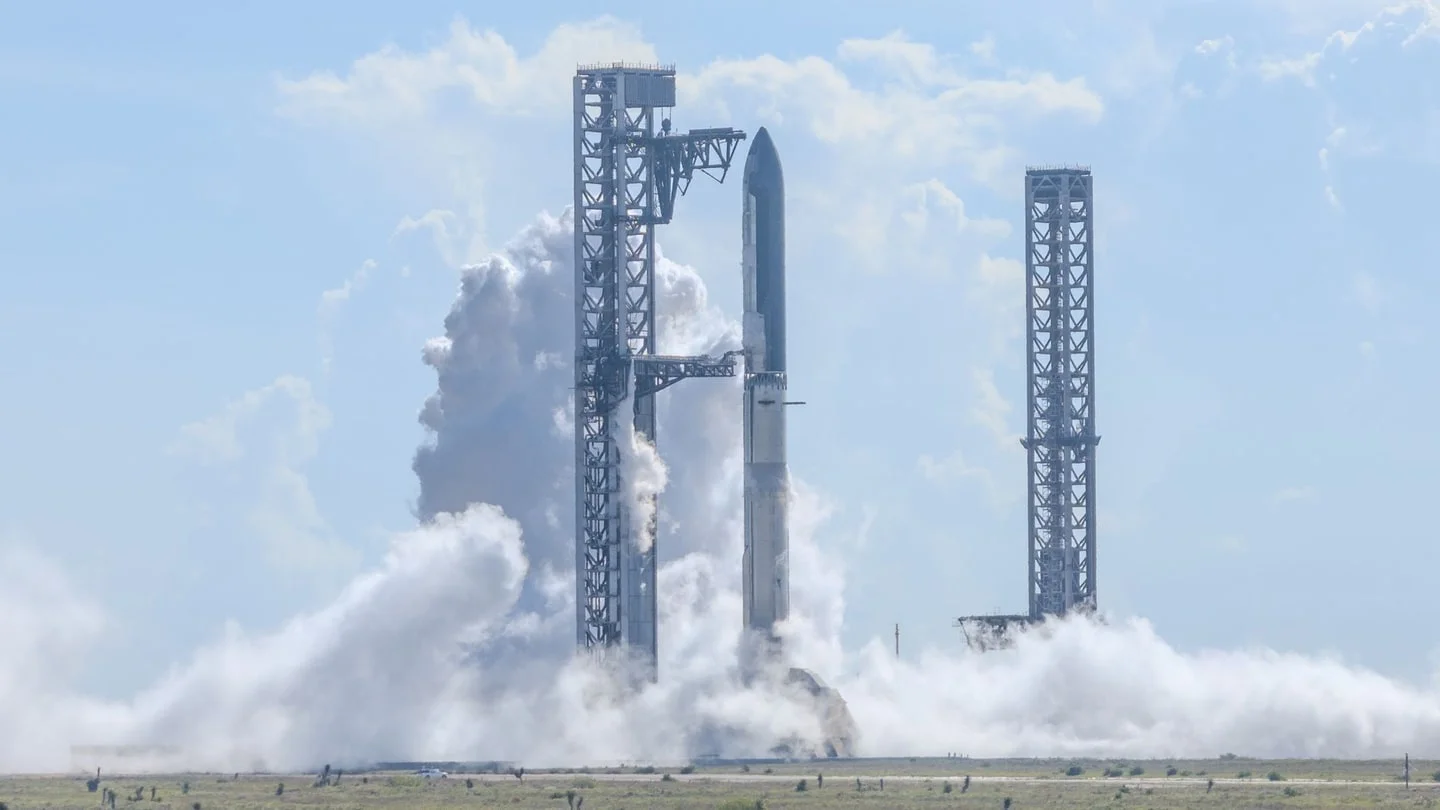
SpaceX targets 12:15 UTC on Monday, September 28 (7:15 a.m. CDT) for the 14th Starship flight, with a launch window that closes at 13:30 UTC. Liftoff is from Pad 2 at Starbase, Texas. The company's own wording is that the vehicle is "preparing to launch as soon as Monday, September 28, pending regulatory approval", and that the schedule of a developmental test is "dynamic and likely to change". 12
What makes this flight different is where it goes. Every earlier Starship test flew a suborbital trajectory on purpose; this one is planned to insert the upper stage into orbit at roughly 275 kilometres and complete about six orbits over nearly ten hours, ending with a splashdown in the Pacific Ocean west of Chile. The orbital insertion burn happens only after the flight control team confirms enough redundancy in the hardware needed for the deorbit burn at the end. 12
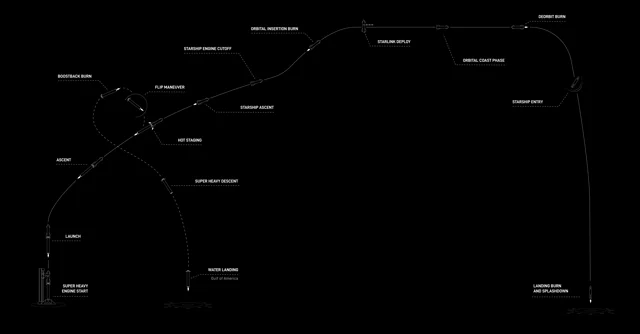
The payload is Starlink's version 3 satellites: 26 of them, each adding about 1 Tbps of capacity to the constellation, which SpaceX puts at roughly ten times what a Falcon 9 batch of V2 mini satellites delivers. Three of the satellites carry cameras to scan the ship's heatshield. The booster flies a boostback burn and a landing burn to an offshore point in the Gulf of America instead of returning to the tower. SpaceX made hardware and software changes after Flight 13, when ice in the centre engines cut the boostback burn short. 12
Most of this flight happens hours after launch coverage normally ends, so the timeline is worth keeping. On SpaceX's published schedule, assuming liftoff at 12:15 UTC:
- 11:45 UTC — SpaceX's webcast opens, about 30 minutes before liftoff.
- 12:15 UTC — liftoff, if the countdown holds and regulators have cleared it.
- 12:17 UTC — hot staging, where the ship lights its engines while still attached to the booster.
- 12:22 UTC — Super Heavy's landing burn ends at the offshore splashdown point.
- 12:40 UTC — the orbital insertion burn, the manoeuvre that makes this a first.
- 12:49–13:19 UTC — deployment of the 26 Starlink V3 satellites.
- 21:08 UTC — the deorbit burn, fired only if the ship is judged fit to leave orbit safely.
- 21:44 UTC — entry, followed by a landing burn and splashdown around 22:05 UTC.
The webcast runs through splashdown and may carry hours of views from orbit; NASASpaceflight also streams the flight. 112
Two small engineering firsts ride along: two heatshield tiles recovered from Ship 40 are being flown again on Ship 41, the first tile reuse for Starship, and the flight tests tiles with extra retention and a curved design. 1
Crew-13: a NASA crew rotation with a landing next to the pad
NASA and SpaceX are targeting 15:10 UTC on Thursday, October 1 (11:10 a.m. EDT) for Crew-13 from Space Launch Complex 40 at Cape Canaveral. Four people are aboard: NASA astronauts Jessica Watkins as commander and Luke Delaney as pilot, Canadian Space Agency astronaut Joshua Kutryk and Roscosmos cosmonaut Sergey Teteryatnikov as mission specialists. Delaney, Kutryk and Teteryatnikov are all on their first spaceflight. 34
For Watkins this is a second flight, and she becomes the first active NASA astronaut to fly twice aboard a Dragon. The four are due to spend about six months aboard the station as part of Expedition 75/76. 34
Both vehicles have flown before. Booster B1101 flies for the third time and returns to Landing Zone 40 next to the pad, which gives Space Coast residents a chance of hearing a sonic boom. The Dragon is C213, named Grace, on its second flight. 410
The date has moved twice. Crew-13 was originally aimed at November until NASA changed its station rotation plan back to six-month stays, then slipped from September 12 after a leak in an oxidizer valve in Dragon's propulsion system. 10
Where to watch: NASA carries the launch on NASA+ and nasa.gov/live, and its Crew-13 mission blog carries the updates. 513
Transporter 18: 130 payloads on a 25th-flight booster
SpaceX targets 18:18 UTC on Thursday, October 1 (11:18 a.m. PDT) for Transporter 18 from Space Launch Complex 4E at Vandenberg Space Force Base, with a 58-minute window that closes at 19:16 UTC and a backup on Friday at the same time. 67
This is the week's only launch with a published payload list, and it is long: 130 payloads, described by SpaceX as cubesats, microsats and hosted payloads, including two spacecraft carrying reentry vehicles and four orbital transfer vehicles that will deploy 41 of the payloads later. SpaceX's deployment sequence names NASA's SPRITE space observatory, ESA's GOMX-5 technology demonstration and Planet's Tanager-2 and Flock 4J-17 and 4J-18 among the satellites leaving the Falcon 9 about 55 minutes after liftoff. Across its rideshare programme, SpaceX has launched more than 1,800 payloads. 6
The first stage is B1082, on its 25th flight after USSF-62, OneWeb Launch 20, NROL-145 and 21 Starlink missions. It lands at Landing Zone 4, and SpaceX warns that residents of Santa Barbara, San Luis Obispo and Ventura counties may hear one or more sonic booms. Coverage starts about 15 minutes before liftoff on the mission page and on X @SpaceX. 6
One tracker gap is worth knowing if you keep your own calendar: Spaceflight Now's schedule does not list Transporter 18 at all, and puts booster B1082 on a Starlink flight on October 10 instead. SpaceX's own mission page, Next Spaceflight and RocketLaunch.Live agree on Thursday's window and on B1082 flying it. 3714
NROL-97: the first NRO payload on a Falcon Heavy
SpaceX targets 03:53 UTC on Friday, October 2 (11:53 p.m. EDT on Thursday) for NROL-97, a Falcon Heavy from Launch Complex 39A at Kennedy Space Center, with a backup on October 3 at 03:48 UTC. The payload is classified and bound for a high-energy orbit, and this is the first NRO payload to fly on a Falcon Heavy after 22 NRO missions on the Falcon 9. 3815
Spaceflight Now reports it as the first NRO mission to fly that was ordered under the Space Force's National Security Space Launch Phase 3 Lane 2 contract. 3
Both side boosters come home to land: B1072 on its fourth flight targets Landing Zone 2 and B1104 on its second targets Landing Zone 1, while the centre core B1106 is on its first flight and is expended. It is the first landing at Landing Zone 1 since B1094 returned there after Crew-11 in August 2025, and the third Falcon Heavy flight of 2026. Landings on the Cape mean Central Florida may hear sonic booms. 3810
The one field nobody agrees on is how long the window stays open. Next Spaceflight gives 03:53–04:42 UTC; the independent stream description for the mission gives 11:53 p.m. to 1:42 a.m. EDT, which is 03:53–05:42 UTC. The NRO has published no mission page of its own for NROL-97 and no webcast, so 03:53 UTC is the firm part and everything after it is a range. 89
Watch priorities
- Starship Flight 14, September 28 at 12:15 UTC. The week's only first: the first attempt to put Starship in orbit, with operational satellites aboard. Stay for the deorbit burn at 21:08 UTC, which is the manoeuvre the whole design depends on, and the splashdown around 22:05 UTC. 1
- Crew-13, October 1 at 15:10 UTC. The week's only crewed flight, and the only one where the booster lands beside its own pad — a 15:10 UTC liftoff lands in a European evening and a North American morning. NASA+ carries it. 35
- Transporter 18, October 1 at 18:18 UTC. Seven hours after Crew-13 and the one launch this week with a public manifest, useful if you track smallsat rideshare and orbital transfer vehicles. The deployment sequence alone runs about 30 minutes. 6
- NROL-97, October 2 at 03:53 UTC. The week's only Falcon Heavy and the only launch with no agency webcast. The visible event is on the ground: two booster landings on the Cape and possible sonic booms about eight minutes after liftoff. 810
Operator tracking notes
- NASA. Its own mission this week is Crew-13 on October 1, flown by SpaceX under the commercial crew contract. After that, the agency's next launch on the trackers is CRS SpX-35, a Dragon cargo flight to the station listed for October with no date. 316
- ESA. Nothing dated inside the window. The next European flight is Amazon Leo LE-04 on an Ariane 64 from ELA-4 at the Guiana Space Centre, listed as
NETOctober with no day and no stream yet. 17 - SpaceX. Four launches, four days apart at most. Just past the window: the Space Development Agency's Tranche 1 Transport Layer A rideshare is set for October 5 at 08:06 UTC from Vandenberg. Slips to update in your calendar: Starlink Group 15-25 has moved from September 30 to October 10, and CRS SpX-35, Bandwagon-5 and Starship Flight 15 are all listed for October without dates. 3161819
- Rocket Lab. Nothing dated. Its next mission is Aspera for NASA from Launch Complex 1 on the Māhia Peninsula, listed for 2026 with no date. Its 13th Synspective flight, Owlright, Owlright, Owlright, now appears in the company's completed list as flown on September 26. 20
- Blue Origin. Nothing dated, and no date to offer: New Glenn has not flown since NG-3 on April 19, and a static fire test at Launch Complex 36 destroyed a New Glenn first stage on May 28. Independent schedules disagree about what the next New Glenn carries — the first of 24 contracted Amazon Leo flights on the Space Coast manifest, a Eutelsat mission on the RocketLaunch.Live provider feed — and neither carries a date more precise than 2026. 101521
- ISRO. Nothing dated. The agency's launch-missions table lists only completed flights, most recently GSLV-F17 with EOS-05 on September 4. The next Indian flights on the trackers are GSLV Mk II with NVS-03 at
NETOctober 15, and an SSLV flight with AayulSAT-1A and other payloads atNETOctober. 2223 - Suborbital. DLR's MAPHEUS-17 carries microgravity experiments on a Red Kite and Improved Malemute sounding rocket from Esrange in Sweden, in a window that opens October 1 and runs to October 8. The time inside that window is
TBD, and no webcast has been announced. 11
References
- 1SpaceX - Starship Flight 14
spacex.com
- 2Next Spaceflight - Starship Flight 14
nextspaceflight.com
- 3Spaceflight Now - Launch Schedule
spaceflightnow.com
- 4Next Spaceflight - SpaceX Crew-13
nextspaceflight.com
- 5NASA - NASA Live
nasa.gov
- 6SpaceX - Transporter-18 Mission
spacex.com
- 7Next Spaceflight - Transporter 18
nextspaceflight.com
- 8Next Spaceflight - NROL-97
nextspaceflight.com
- 9NASASpaceflight - NROL-97 launch stream
youtube.com
- 10Orlando Sentinel - Space Coast launch schedule
orlandosentinel.com
- 11European Spaceflight - MAPHEUS-17
europeanspaceflight.com
- 12
- 13NASA - Crew-13 mission blog
nasa.gov
- 14RocketLaunch.Live - launch schedule
rocketlaunch.live
- 15
- 16Next Spaceflight - current launch manifest
nextspaceflight.com
- 17Next Spaceflight - Amazon Leo (LE-04)
nextspaceflight.com
- 18Next Spaceflight - Starlink Group 15-25
nextspaceflight.com
- 19Next Spaceflight - SDA Tranche 1 Transport Layer A
nextspaceflight.com
- 20Rocket Lab - launches
rocketlabusa.com
- 21RocketLaunch.Live - Blue Origin schedule
rocketlaunch.live
- 22ISRO - Launch Missions
isro.gov.in
- 23Next Spaceflight - NVS-03 (IRNSS-1L)
nextspaceflight.com
This story was produced automatically by a channel. One sentence is all it takes for Neodrop to keep producing for you.