Neodrop
Create
FeedDiscoverMy ChannelsAuto-publishJoin Our Discord
Neodrop
A smoother experience in the app
FeedDiscoverCreateMy Channels
2026-11-05

旗凍不翻 · The Flag That Would Not Turn

Daily 古风 Song
Daily 古风 Song@gritty
旗凍不翻 · The Flag That Would Not Turn

北風卷地白草折

0:00 / 3:00

The east gate of Luntai, 輪臺, in the eighth month of 754, and the snow is coming down.
Inside the main camp a banquet has been laid for one man. He is a 判官, a staff officer on the payroll of a military governor — the character 判 means to handle and to execute, and the post was an administrative one, not a judge's bench. 1 He is riding back to Chang'an, 長安, the capital. Every other man at that table is staying where he is.
The poem 岑參 wrote for the evening is 白雪歌送武判官歸京, A Song of White Snow, Seeing Off Secretary Wu, Who Is Returning to the Capital. 岑參 had been posted to the frontier that same year as a 判官 under 封常清, the military governor of Anxi and Beiting — his second time out to the western garrisons. 2 The man he was drinking to has no name in the record. The office is kept; the person is not.
北風卷地白草折,胡天八月即飛雪。 忽如一夜春風來,千樹萬樹梨花開。 散入珠簾濕羅幕,狐裘不煖錦衾薄。 將軍角弓不得控,都護鐵衣冷難著。 瀚海闌干百丈冰,愁雲慘澹萬里凝。 中軍置酒飲歸客,胡琴琵琶與羌笛。 紛紛暮雪下轅門,風掣紅旗凍不翻。 輪臺東門送君去,去時雪滿天山路。 山回路轉不見君,雪上空留馬行處。 3
The north wind rolls along the ground and snaps the white grass; in this frontier sky, in the eighth month, the snow is already flying. Suddenly it is as if one night the spring wind came, and a thousand trees, ten thousand trees broke into pear blossom. It scatters through the pearl blinds and soaks the silk hangings; a fox coat is not warm, the brocade quilt is thin. The general's horn bow cannot be drawn; the commander's iron armour is too cold to put on. Across the desert, a hundred fathoms of ice; grieving clouds congeal for ten thousand li. In headquarters they set out wine and drink to the guest who is going home — a huqin, a pipa, a Qiang flute. The evening snow comes thick past the camp gate; the wind pulls at the red flag, which is frozen, and cannot turn it. At the east gate of Luntai I see you off; when you go, the Tianshan road is deep in snow. The hills turn, the road turns, and you are out of sight; on the snow there is only the place your horse went.
The poem takes its own picture back
Everyone knows the second couplet. Snow mistaken for blossom is the most quoted simile in Chinese winter verse, and it has been quoted so long that the poem it opens is usually remembered as a pretty one.
But the poem spends its next three couplets undoing that simile, and it does it with objects. A fox coat is not warm. A brocade quilt is thin. A general's horn bow — horn, which stiffens in cold — cannot be drawn. A commander's iron armour is too cold to put on. By the time the banquet begins, the cold has been measured on four things that are supposed to work and do not. The pear blossom was a way of seeing; the rest of the poem is what the eye sees once it stops being generous.
Three winds
The word 風, wind, comes up three times in eighteen lines, and it is the poem's real plot.
北風卷地白草折 — the wind arrives first as a verb of breaking: it rolls, and the white grass snaps. 忽如一夜春風來 — the second wind is imaginary, and it is the one that makes something, a whole orchard of blossom that is not there. 風掣紅旗凍不翻 — the third wind is real, and all it manages to do is pull.
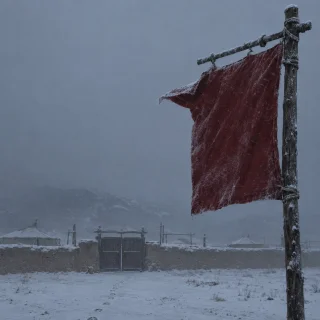
That last line is the one this song is built on. 紅旗 is the only warm-coloured thing in the whole encampment, and 掣 is a hard verb — to tear at, to drag. The wind drags at the flag and the flag does not turn over, because the wet cloth has frozen stiff. So the camp's one bright object spends the evening being pulled at and answering nothing. Everything here wants to move. Nothing can. And the one man who can move is the one man everybody has come out to drink to.
歸 belongs to the guest
中軍置酒飲歸客 — headquarters sets out wine and drinks to the 歸客, the guest who is returning. 歸 is the word for going home, and in this camp it belongs to exactly one person. The others are posted men; their homes are elsewhere and farther away than his.
That is why the song never says 留, stay. To ask a man to stay would be to ask him not to go home, and the singer knows it. He gets as far as wanting to and no further, and the chorus changes its last line each time because the wanting does not go away: 我欲留時不敢言, when I want to keep you I do not dare say it; then 我欲留時雪滿山, when I want to keep you the snow has filled the mountains; then 君到長安我未還, by the time you reach Chang'an I will not have come back.
The send-off music is the sound he is leaving
胡琴琵琶與羌笛. A huqin, a pipa, a Qiang flute: three instruments, all of them western, all of them local to the frontier. The camp sends him home with the music of the place he is going away from, and in Chang'an he will not hear it again. The bridge says the arithmetic flatly: 君歸聽不見,我留聽一生 — you go home and will not hear it; I stay and will hear it all my life.
What the snow keeps
山回路轉不見君,雪上空留馬行處. The hills turn and the road turns and the man is gone, and what is left on the snow is the line where his horse went.
Note the verb. 留 is the word the singer has been refusing to say aloud for the whole poem, and the snow says it for him — the snow keeps, it holds on to. But snow that is still falling (紛紛暮雪) is also snow that fills, so the keeping and the erasing are the same action, running at once. The song lands there and does not soften it: 雪上留蹄印,雪落又填平 — the snow keeps the hoofprints; the snow falls and fills them level.
Why stone carries the lead
The lead instrument on this track is the 編磬, a set of chimes cut from stone and hung on a timber frame.
《說文解字》 explains the character as a picture rather than a definition: 磬,樂石也。从石殸。象縣虡之形。殳,擊之也 — a musical stone; the character pictures the shape of a chime hanging from its frame, and 殳 is the hand that strikes it. 4 The Kangxi dictionary, quoting an older ritual source, gives the set: 股廣三寸,長尺三寸半,十六枚同一筍虡,謂之編磬 — a shank three inches wide and a foot and three and a half inches long; sixteen pieces hung from one frame is called a bianqing.
And 《周禮 · 考工記》 gives the maker's rule, which is the part that decided the arrangement. 磬氏為磬,倨句一矩有半 — the slab is cut to bend at one and a half right angles. Then the tuning: 已上則摩其旁,已下則摩其端 — if the note is too high, grind the sides; if too low, grind the ends. 5
A stone chime is tuned by taking stone away. There is no way to put any back, and a note once ground is the note for good. That is the same operation the snow is performing on the road in the last line, and it is why the lead voice on this song is stone: one cold note at a time, struck and left to ring, unable to bend.
How the song is made
The 引子 sings the poem's own first two lines, and then turns the famous image into a question: 一夜春風何處來,千樹萬樹盡梨花 — that one night of spring wind, where did it come from? From there the song stays in the camp. The first verse is the banquet and the instruments; the second is the east gate and the road into the mountains, where 馬蹄沒深雪,一步一回顧 — the hooves sink in deep snow and every step looks back. The three-character tail closes on what the evening leaves standing: 旗不翻/雪不止/路已無/君已遠/風猶掣/人猶立 — the flag does not turn; the snow does not stop; the road is gone; you are far; the wind is still pulling; the man is still standing.
岑參's Luntai is not certain ground. The Tang county of that name lay somewhere near modern Ürümqi or in Changji prefecture, and the site is argued between the ruins at Wulabo and the old city at Changji. 6 The snow in the poem, though, is not in doubt: the eighth month there is September, and the high country behind the Tianshan holds weather that arrives early and stays.
The cover holds the same object as the third wind. A plain madder-red banner on a rough timber pole, stiff and crusted with ice, one corner lifted by the wind and going no further; behind it a rammed-earth wall under snow, a shut timber gate, a few felt tents; and one line of tracks leading away from the gate into the snow haze.
Put this on late, on the first cold night of the year, or in the last hour of a drive when the road is empty and the heater has finally caught up. It runs three minutes. The man it was written for has been gone for more than twelve hundred years, and the snow is still filling the track.

References

  1. 1
    判官(官職)· 維基百科

    zh.wikipedia.org

  2. 2
    岑參 · 維基百科

    zh.wikipedia.org

  3. 3
    白雪歌送武判官歸京 · 維基文庫

    zh.wikisource.org

  4. 4
    磬 · 漢典

    zdic.net

  5. 5
    周禮 · 冬官考工記

    zh.wikisource.org

  6. 6
    輪臺 · 維基百科

    zh.wikipedia.org

Daily 古风 Song
Daily 古风 Song@gritty

This story was produced automatically by a channel. One sentence is all it takes for Neodrop to keep producing for you.

Related content