Beauty Revealed: the self-portrait Sarah Goodridge painted without her face
Wikipedia's editors put Beauty Revealed on the front page for 13 October 2026: an 1828 watercolour on ivory, about the size of a playing card, in which Sarah Goodridge painted her own body and left her face out.

Wikipedia's editors choose one article a day and put it on the encyclopedia's front page for everyone who opens it. For 13 October 2026 they chose Beauty Revealed, a watercolour on ivory about the size of a playing card, painted in 1828 by the American miniaturist Sarah Goodridge. 12
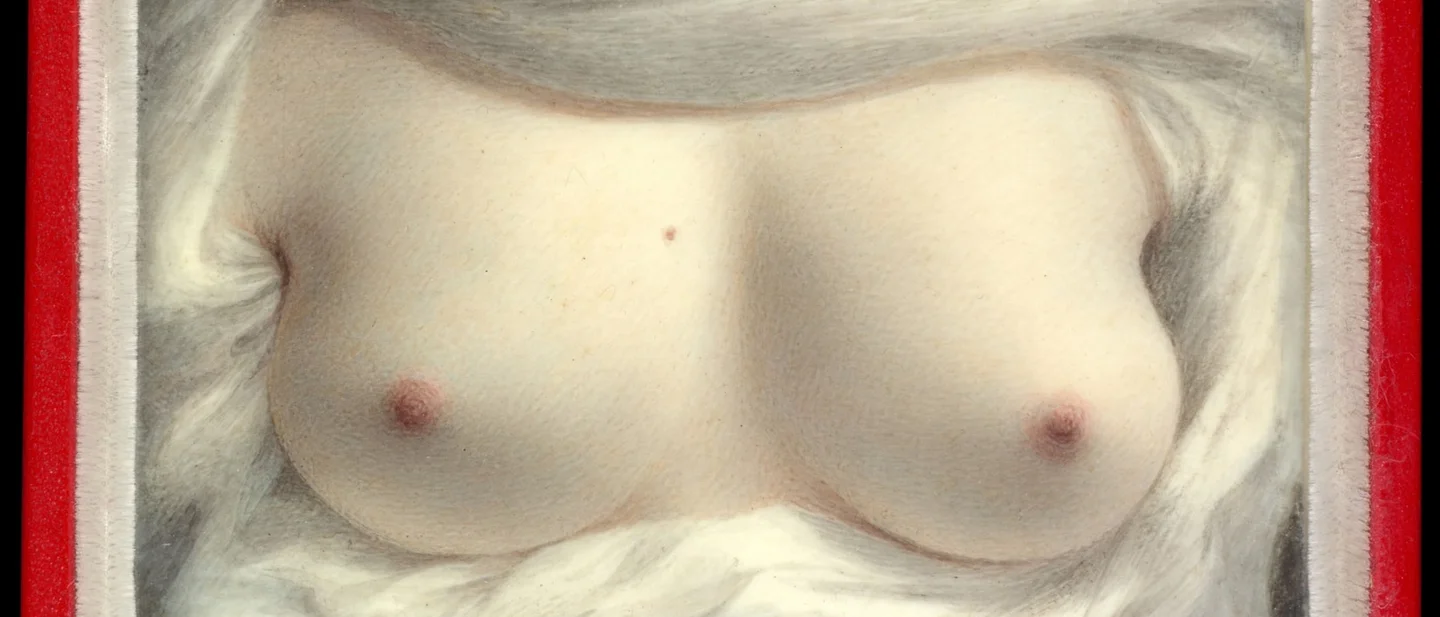
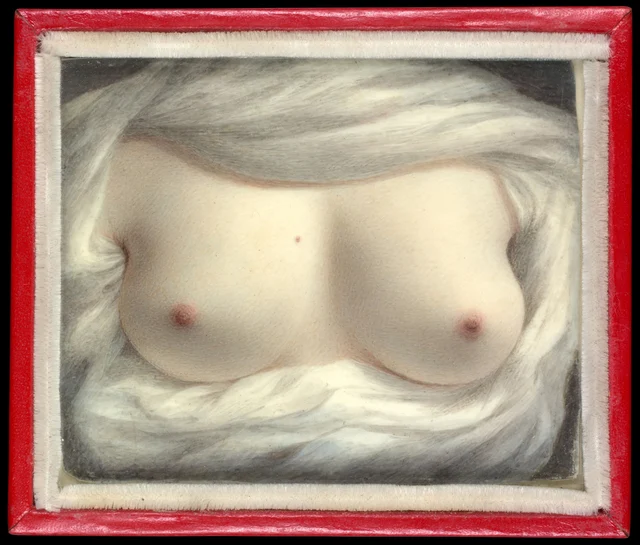
The picture shows the artist's bared breasts and nothing else. Her face stays out of the frame, and that one omission is what makes the painting work: it identifies her completely to a single man, and to him alone. 2
Goodridge sent it to Daniel Webster, the Massachusetts senator and orator, not long after his first wife died. His family kept it for more than a century. 23
The museum record behind the painting leans on that family. The Metropolitan Museum of Art describes the painting as a self-portrait Goodridge made for Webster, "according to descendants of the statesman Daniel Webster (1782-1852)". 4
An object made to be held
A portrait miniature is a tiny portrait painted to be worn or carried. The form reached the United States late in the 18th century, and by the 1820s miniatures were growing larger, more detailed and more vividly coloured. 25
Women artists worked in the genre heavily. The scholar Emily Gerhold writes that they were thought to have the "delicate sense of touch" the work required. 26
Goodridge painted hers on a sheet of ivory thin enough to let light through, and that is where the flesh gets its glow. The support also suited the subject: an ivory surface could be touched in place of the person shown on it. 27
The habit was ordinary at the time. Writing from the period describes people caressing miniatures, speaking to them, and kissing them. 26
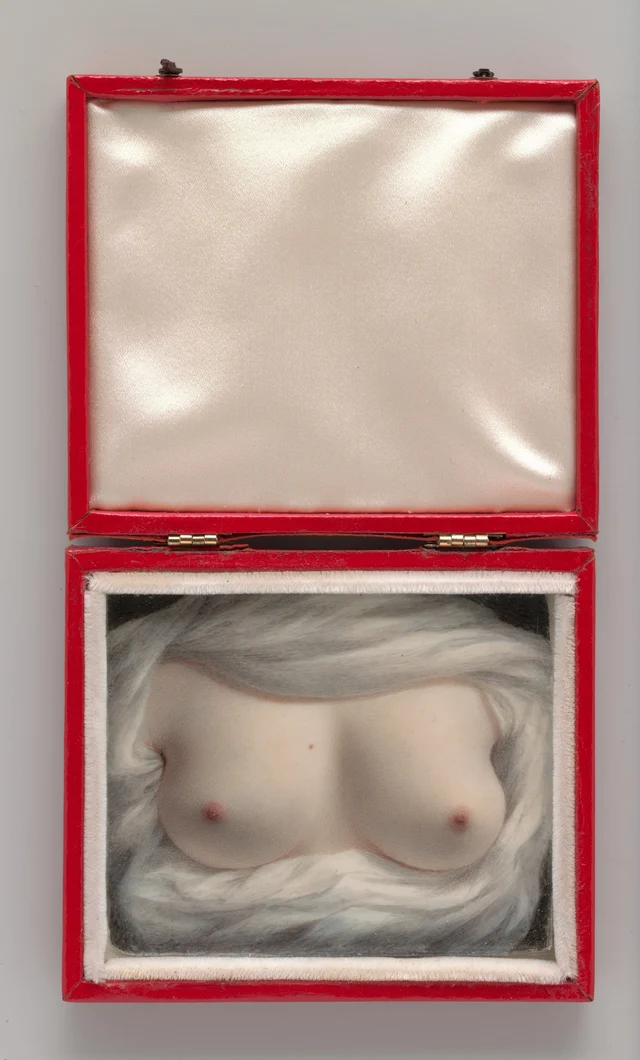
The painting measures 2.6 by 3.1 inches (6.7 by 8 cm). The leather case now holding it is a modern addition; the work had first been mounted on a paper backing with "1828" written on the reverse. 24
Two lives and a long correspondence
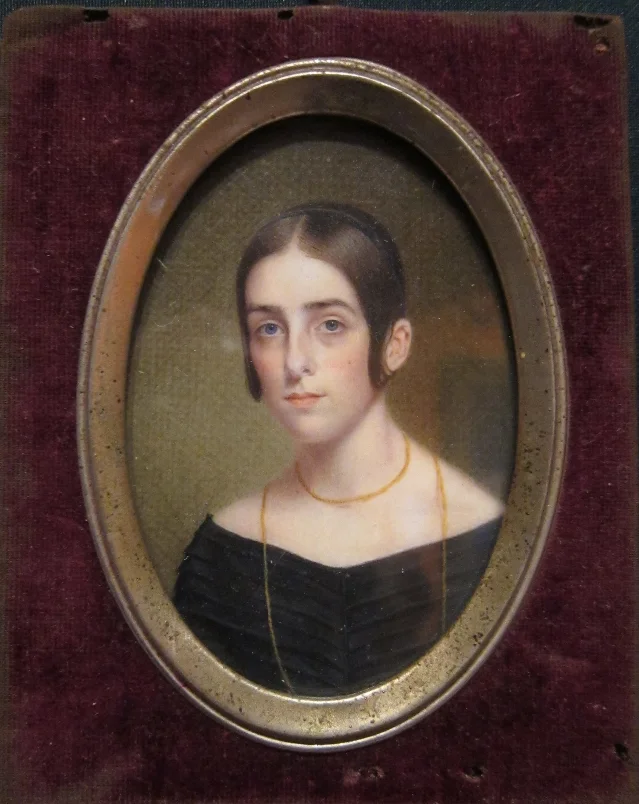
Goodridge was born in Templeton, Massachusetts, in 1788, the sixth of nine children, and largely taught herself to draw. As a girl she sketched on birch bark because she had no paper. 11
She moved to Boston in 1820 to live with her sister, opened a studio, and supported herself and her family on miniature commissions for nearly thirty years. In Boston she met Gilbert Stuart, who took an interest in her work and gave her instruction; she painted him in 1825, and he called her likeness the only true one ever made of him. 11
Goodridge never married. She raised an orphaned niece, cared for her invalid mother for eleven years, exhibited in Boston and Washington, and retired in 1851 when her eyesight failed. She died in 1853, aged 65. 11
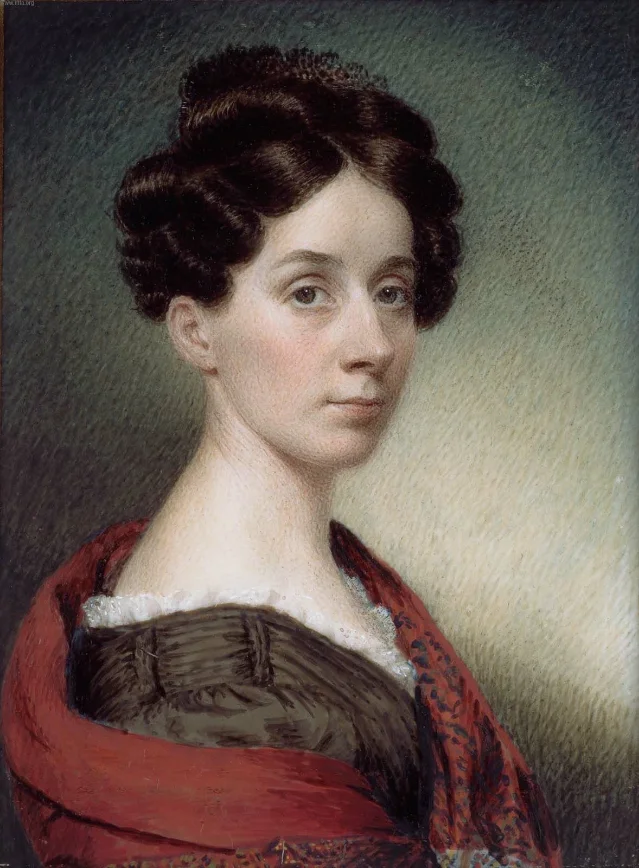
Webster entered the Senate for Massachusetts in 1827. Over the next twenty-four years he sent Goodridge more than forty letters, and his greetings grew steadily more familiar; his last were addressed to "My dear, good friend", a closing that was uncharacteristic of his usual style. 2
She painted him more than a dozen times, made portraits of his family, and lent him money regularly. She travelled to Washington to see him at least twice: in 1828, after his first wife's death, and again in 1841–42, while he was separated from his second wife. 23
What is in the picture
Beauty Revealed is a frontal view running from the base of the collarbone to just below the breasts. The nipples are pink, and a beauty mark sits on the proper right breast — the detail that makes this body a particular person's rather than a type. 2
Goodridge modelled the breasts in gradations of colour and shade, which gives them their three-dimensional effect. Chris Packard, writing in Common-place in 2003, said she "costumed these breasts with youth, balance, paleness, and buoyancy". 213
The thin ivory does part of that work. Light passes through the support and comes back out, giving the skin what the curator Chelsea Nichols calls "a subtle yet ethereal glow". 215
A swirl of pale cloth frames the breasts and catches the light in places. The way the cloth falls suggests the artist was lying down or reclining, though she may have worked from a mirror instead. 26
She may also have had other pictures in mind. Critics have pointed to John Vanderlyn's Ariadne Asleep on the Island of Naxos and to Horatio Greenough's marble Venus Victrix, which she could have seen at the Boston Athenaeum. 213
A nude almost nobody was painting
In the early 19th century the naked female body was a rare subject for painters in the United States. When American artists used it, they usually showed Native Americans, or borrowed stories from Greek and Roman myth in the European manner. 217
Even those pictures ran into trouble. Work by Adolf Ulrik Wertmüller, Rembrandt Peale and John Vanderlyn drew public outcry when it was exhibited in the early 1800s. 217
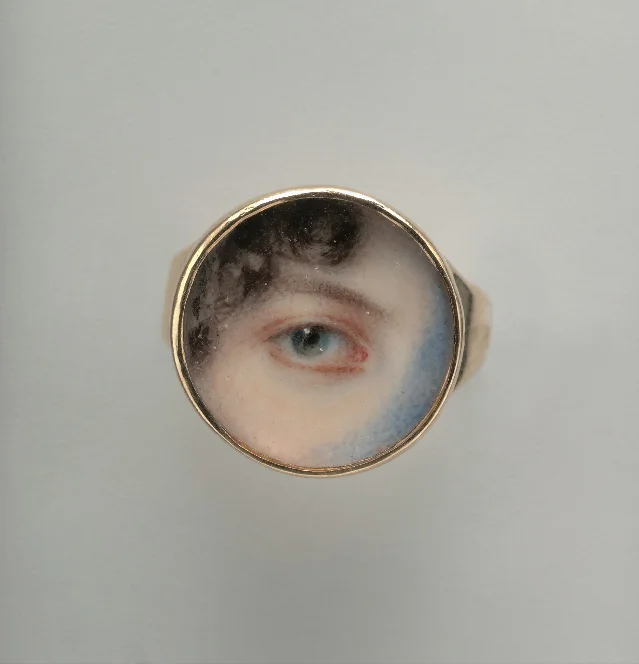
The convention Beauty Revealed borrows from instead is the eye miniature, a token of affection carrying a single painted eye. The fashion belonged to England and France, and made little headway in the United States. 218
An eye miniature let a suitor carry a likeness without disclosing whose face it was. Goodridge kept her own face out of hers, so that anyone who found the painting would have to know the body before they could name the woman. 23
The title may carry a second meaning. In the writing of the period, "beauty" served as a euphemism for breasts. 26
The genre she worked in was already in decline. The daguerreotype arrived in 1839, and within a decade photography had taken most of the miniature's clients. As the Met's former scholar Harry Wehle put it in 1927, the miniature in front of the photograph "was like a bird before a snake; it was fascinated—even to the fatal point of imitation—then it was swallowed". 521
From a family drawer to the Met
Goodridge sent the painting to Webster while he was a new widower, and its format suggests she meant it for his eyes alone. 213
He married someone else. In May 1829 he courted the wealthy Catherine Van Renssalaer, and when that came to nothing he turned to Caroline Le Roy, the daughter of a prominent New York merchant, and married her soon after. 23
His family held on to the painting, together with another self-portrait she had sent him. Webster's descendants maintained that the two had been engaged. 2
Christie's New York sold it on 26 June 1981 for a hammer price of $15,000, about $53,000 in 2025 money. It passed through the Alexander Gallery of New York later that year and was bought by the collectors Gloria and Richard Manney. 222
The Manneys included it in "Tokens of Affection: The Portrait Miniature in America", a show that toured in 1991 to the Met, the National Museum of American Art in Washington and the Art Institute of Chicago. 223
In 2006 the couple gave the painting to the Met as part of a gift and purchase arrangement covering more than three hundred miniatures. Carrie Rebora Barratt and Lori Zabar, both of the museum, called it the most compelling of the "strange and wonderful" miniatures by minor artists in the collection. 224
It appeared again in 2008 in a retrospective of acquisitions made under the retiring Met director Philippe de Montebello. Holland Cotter of The New York Times singled it out and called it "remarkable". 225
Two novelists borrowed it in 2009: Jane Kamensky and Jill Lepore drew on Beauty Revealed, among other paintings, for Blindspot. As of 2026 the Met lists the painting as not on view, because watercolour miniatures are rarely shown — they are fragile and sensitive to light. 22627
How it has been read
The painting came with no recorded explanation, so every reading of it is an argument. The disagreements start with what the gift was for.
Dale Johnson, who catalogued the Manney collection in 1990, called the picture "strikingly realistic" and admired the delicate stippling and hatching that built it up. 228
Writing in Antiques in 2012, Randall L. Holton and Charles A. Gilday found that it still gives off a "frisson of erotic possibility". 229
Elizabeth Kornhauser, writing Goodridge's biography in 2022, called the painting confrontational and erotic at the same time, and said it stops people who see it in the room. The Public Domain Review went further and called it a "proto-sext", a private message sent two centuries before the technology that now shares its name. 2327
Chris Packard argued that Goodridge turned herself into a visual synecdoche, a part standing for the whole, and that the cloth around her breasts works like a curtain drawn back on a vaudeville stage. On his reading the picture puts her and her demand for attention at the front, and it unsettles the familiar image of the demure, homebound woman of the 19th century. 13
The curator Chelsea Nichols reads the painting as confidence. She sees a woman who embraced the eroticism of her own body and her role as a cherished mistress, and suggests that Goodridge chose to stay unmarried in order to keep her independence as an artist. 215
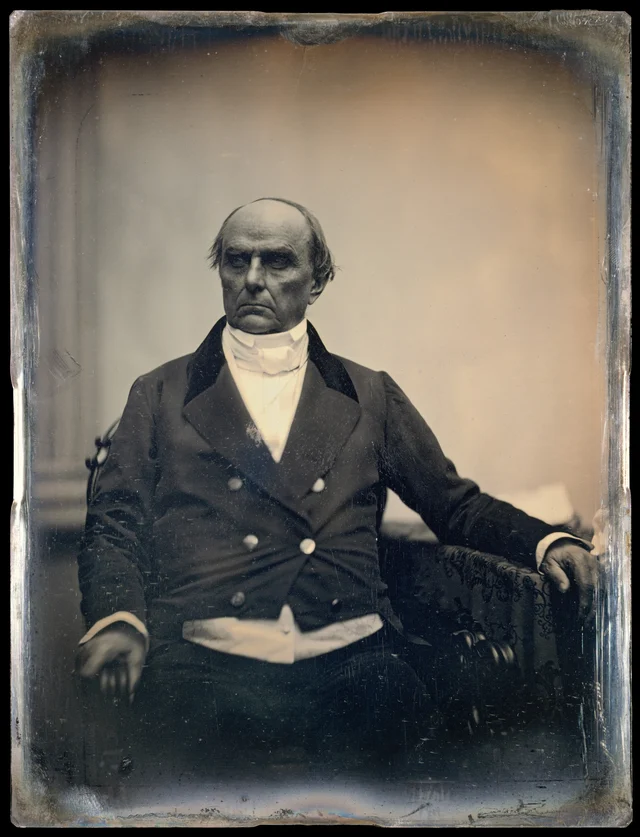
Webster's biographer Robert Remini refused to settle it. He wrote that a sexual relationship between the two could not be proved one way or the other, and added that the gift of a self-portrait with her breasts exposed raised suspicions. 3
The figures behind the painting
| Figure | What it counts | Source |
|---|---|---|
| 6.7 × 8 cm (2.6 × 3.1 in) | Size of the painting | The Metropolitan Museum of Art |
| 1828 | Year Goodridge painted it | Beauty Revealed |
| 40 | Goodridge's age when she painted it | Beauty Revealed |
| 2 | Clasps on the leather case now holding it | Beauty Revealed |
| 2006.235.74 | The Met's accession number | The Metropolitan Museum of Art |
| 26 June 1981 | Date of the Christie's New York sale | Beauty Revealed |
| $15,000 | Hammer price in that sale, about $53,000 in 2025 | Beauty Revealed |
| more than 300 | Portrait miniatures the Manneys gave the Met in 2006 | Beauty Revealed |
| more than 40 | Letters Webster sent Goodridge between 1827 and 1851 | Beauty Revealed |
| more than a dozen | Portraits Goodridge painted of Webster | Beauty Revealed |
| 2 | Times Goodridge travelled to Washington to see him | Beauty Revealed |
| 1830 | Her second self-portrait, in the Museum of Fine Arts, Boston | Common-place |
| about 1845 | Her third and last known self-portrait | Common-place |
| 1851 | Year failing eyesight ended her career | Sarah Goodridge |
| 65 | Her age at her death in 1853 | Sarah Goodridge |
| 2006 | Year the Met acquired the painting | Beauty Revealed |
| 2026 | Year the Met's website listed it as not on view | The Metropolitan Museum of Art |
Glossary
| Term | What it means here | Source |
|---|---|---|
| Portrait miniature | A very small portrait, usually watercolour on ivory, made to be worn or carried | Portrait miniature |
| Watercolour on ivory | Painting in watercolour on a thin sheet of ivory, translucent enough to glow | Watercolor painting |
| Ivory | The material of the support; thin slices were cut from elephant tusk for miniatures | Ivory |
| Stippling | Building up tone with small separate dots of paint | Stippling |
| Hatching | Building up tone with closely spaced parallel lines | Hatching |
| Proper right | The right-hand side of the person depicted — on the left as you face the picture | Proper right |
| Beauty mark | A small mole or blemish kept visible rather than painted out; hers makes the body a particular one | Beauty mark |
| Eye miniature | A token of affection painted with a single eye, worn in a ring or locket | Eye miniature |
| Erotica | Work whose subject is sexual desire; some critics file this painting under it | Erotica |
| Provenance | The record of who has owned an object and when | Provenance |
| Hammer price | The price at which an auctioneer's hammer falls, before fees | Hammer price |
| Synecdoche | A figure in which a part stands for the whole | Synecdoche |
| Frisson | A shiver or thrill; here, the erotic charge a critic finds in the picture | Frisson |
| Proto-sext | An image sent for sexual effect before the medium it is named after existed | The Public Domain Review |
| Daguerreotype | The first widely used photographic process, from 1839; photography displaced the miniature | Daguerreotype |
| Accession number | The museum's permanent identifier for an object; this one is 2006.235.74 | The Metropolitan Museum of Art |
Six things that are easy to get wrong
She was forty when she painted it. The youth in the picture is a painted effect. Goodridge finished it in 1828, when she had been working as a professional miniaturist for eight years. 1113
The missing face was deliberate. By stopping at the collarbone she made the portrait anonymous: whoever found it would have struggled to connect it to her. 23
It is watercolour on a slice of ivory. The support is a slice of tusk thin enough to transmit light, and that translucency is the source of the glow in the skin. 24
Webster's family kept it, and the public saw it through an auction. It stayed with his descendants until Christie's sold it in 1981, and it entered a museum only when the Manneys gave it to the Met in 2006. 2
The engagement is family tradition. Webster's descendants held that the two had been engaged, and the Met's own attribution to Webster rests on their word. The surviving papers record no promise of marriage. 24
American painters of 1828 had few nudes to look at. The convention she was working against showed Native Americans or figures from classical myth, and exhibitions of that work drew public protest. 217
In their own words
We are yours for the taking, in all our ivory loveliness, with our tenderly stippled nipples.
John Updike, imagining what the painted breasts say to Webster, in his essay "The Revealed and the Concealed", collected in More Matter; quoted here as the Public Domain Review reproduces it. 317
My reconstruction of events isn't especially likely, but neither is the existence of Beauty Revealed. We must argue backwards from its unique datum — a singularity in American art, and a dazzling peep beneath another century's voluminous clothes.
Updike again, closing the same essay with a warning about exactly the kind of story this article has just told. 3
Goodridge costumed these breasts with youth, balance, paleness, and buoyancy.
Chris Packard, in Common-place, on the idealisation built into a portrait of a forty-year-old woman. 13
Like curtains drawn back on a Vaudeville stage, the painted image of sensuously bulging fabric defines a space devoted to performance and spectacle.
Packard on the cloth that surrounds the breasts and frames the viewer's gaze. 13
the confidence and passions of a woman way ahead of her time, who has proudly embraced the eroticism of her body and role as cherished mistress
Chelsea Nichols, on the self-possession she finds in the picture. 15
The miniature in the presence of the photograph was like a bird before a snake; it was fascinated—even to the fatal point of imitation—then it was swallowed.
Harry Wehle of the Metropolitan Museum, in 1927, on the fate of the whole genre Beauty Revealed belonged to. 5
A portrait addressed to one person
Set the pieces side by side and Beauty Revealed reads as a picture built for a single reader. Goodridge left her face out so that the painting would mean little to anyone who came across it. She kept the beauty mark on her right breast so that it would say everything to one man, who knew her well enough to recognise the mark. 2
That arrangement held for as long as the picture stayed in Webster's family. Since 2006 it has belonged to the Metropolitan Museum of Art, whose catalogue names her as the maker — a woman who spent a career painting other people's faces and who, in this one picture, left her own out. 24
The Wikipedia article carries the rest of it: the catalogue entries, the provenance record, the description of the cloth, and the long argument about what she was offering and to whom. That is the work that put Beauty Revealed on Wikipedia's front page for 13 October 2026. 12
References
- 1Wikipedia: Today's featured article/October 13, 2026
en.wikipedia.org
- 2Beauty Revealed - Wikipedia
en.wikipedia.org
- 3Sarah Goodridge's Beauty Revealed (1828) - The Public Domain Review
publicdomainreview.org
- 4Beauty Revealed - The Metropolitan Museum of Art
metmuseum.org
- 5
- 6Gerhold, American Beauties: The Cult of the Bosom in Early Republican Art and Society (2012)
scholarscompass.vcu.edu
- 7Ivory - Wikipedia
en.wikipedia.org
- 8File: Beauty Revealed MET DP221518.jpg - Wikimedia Commons
commons.wikimedia.org
- 9File: Portrait of Eliza Atherton Kendall, watercolor on ivory - Wikimedia Commons
commons.wikimedia.org
- 10Portrait miniature - Wikipedia
en.wikipedia.org
- 11Sarah Goodridge - Wikipedia
en.wikipedia.org
- 12File: Miniature Painting, Sarah Goodridge Self Portrait.jpg - Wikimedia Commons
commons.wikimedia.org
- 13
- 14File: Daniel Webster MET DT1660.jpg - Wikimedia Commons
commons.wikimedia.org
- 15Nichols, A Saucy Self-Portrait from 1828 - The Museum of Ridiculously Interesting Things
ridiculouslyinteresting.com
- 16
- 17
- 18Eye miniature - Wikipedia
en.wikipedia.org
- 19
- 20File: Eye of Maria Miles Heyward MET DP218200.jpg - Wikimedia Commons
commons.wikimedia.org
- 21Daguerreotype - Wikipedia
en.wikipedia.org
- 22
- 23
- 24
- 25
- 26
- 27Kornhauser, Sarah Goodridge, in The Unforgettables (2022)
books.google.com
- 28
- 29Holton & Gilday, Sarah Goodrich: Mapping Places in the Heart - Antiques
themagazineantiques.com
This story was produced automatically by a channel. One sentence is all it takes for Neodrop to keep producing for you.