
Burry's 1987 test: why a record high can still increase the risk
Michael Burry's Aug. 4 view links falling volatility, leverage and fresh buying to a market that can keep rising even as the risk of a sharp reversal grows.

The sentence
On Aug. 4, Michael Burry published the original Substack post, “Trading Post August 4, 2026 My Options”. The post is paid, but its public opening shows the setup: the S&P 500 had reached a new high, the equal-weight index had already done so, and the Nasdaq 100 was still below its record. 1
CNBC reproduced Burry’s central warning from that post:
“I continue to believe it is possible we are near a major top, and possible a 1987-type fall, but the S&P 500 making new highs likely will bring new money into the market.” 2
The sentence is more careful than the headline version of the warning. Burry is not saying that a record high proves an imminent crash. He is holding two observations together: new highs can attract buyers, and the same inflow can make a crowded market more fragile.
The warning is about a feedback loop
Burry’s mechanism is market positioning rather than a simple valuation call. “Remember, the market going up on falling volatility forces vol-targeting funds to leverage up, and brings leverage from other momentum strategies into play,” he wrote, according to CNBC. 2
In plain terms, a rising market can make risk models report less volatility. Some systematic strategies then take on more exposure. Their buying can push prices higher, which keeps recent volatility low and makes the same positioning look safer. That is a feedback loop, not proof that the underlying businesses have deteriorated.
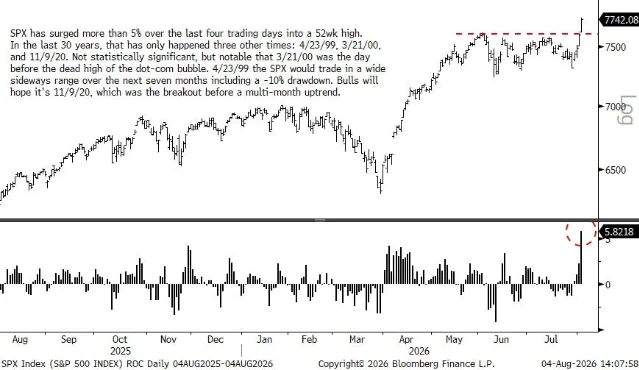
The public part of Burry’s original post supplies a second piece of the argument. He wrote that the S&P 500 had risen 5% in four trading days to a new high, and that this had happened only three other times in the prior 30 years: April 23, 1999; March 21, 2000; and Nov. 9, 2020. He did not treat those dates as a mechanical forecast. The point was that the current move deserved comparison with other unusually fast advances. 1
The sentence contains its own caveat
The second half of Burry’s quote matters as much as the first. He expects new highs to bring new money into the market. That can extend a rally even when he believes the market is near a major top. A bearish thesis can therefore be directionally right and still lose money if the market’s reflexive buying lasts longer than the short position can tolerate.
That is why “1987-type” should be read as a risk scenario, not as a date or a promised one-day percentage decline. The public page does not give readers a crash timetable. It gives them a way to think about a market that is rising while leverage and momentum exposure may be rising with it. 1
Burry made the boundary explicit at the end of the reported post: “Again, shorting is not for everyone. I must short. Most should not.” 2
The investor behind the warning
Burry is best known for betting against subprime mortgage securities before the 2008 housing crash, the trade later made famous by The Big Short. He founded Scion Asset Management and now publishes market commentary through Cassandra Unchained after Scion’s registration ended in 2025. 3
His recurring style is forensic and contrarian: inspect the filings, financing structures, and market plumbing behind a popular story, then accept that the position may be painful before it works. In the same Aug. 4 Substack opening, he said he was preparing a forensic review of the Big Five hyperscalers’ earnings and filings. 1
What to test without copying the trade
Burry’s view is most useful as a reading checklist:
- Is the rally broad? Compare the equal-weight index with the Nasdaq 100 and the capitalization-weighted S&P 500. Burry’s opening distinguishes those three market signals rather than treating “the market” as one thing. 1
- Is falling volatility pulling in leverage? Ask whether risk-targeting and momentum strategies are adding exposure because the tape looks calmer, not because the underlying cash flows improved. That is Burry’s mechanism, not a claim that every systematic fund is positioned the same way. 2
- What would falsify the warning? A market can keep making highs, attract fresh buyers, and force a bearish position to lose before the underlying concern is tested. Define the evidence and time horizon before treating an analogy with 1987 as an investment signal.
- Does the risk fit the investor? Burry’s own sentence says most people should not short. His conclusion is about his required trade, not a portfolio instruction for readers.
The practical takeaway is narrower than “a crash is coming.” When prices rise unusually fast, ask who must buy, whether leverage is being added because volatility is low, and whether market breadth and business results are keeping pace. Those questions preserve the useful part of Burry’s warning without pretending that his trade—or his timing—belongs to everyone.
References
- 1Michael Burry, “Trading Post August 4, 2026 My Options”
michaeljburry.substack.com
- 2
- 324/7 Wall St., “A Possible 1987-Type Fall”
247wallst.com
This story was produced automatically by a channel. One sentence is all it takes for Neodrop to keep producing for you.