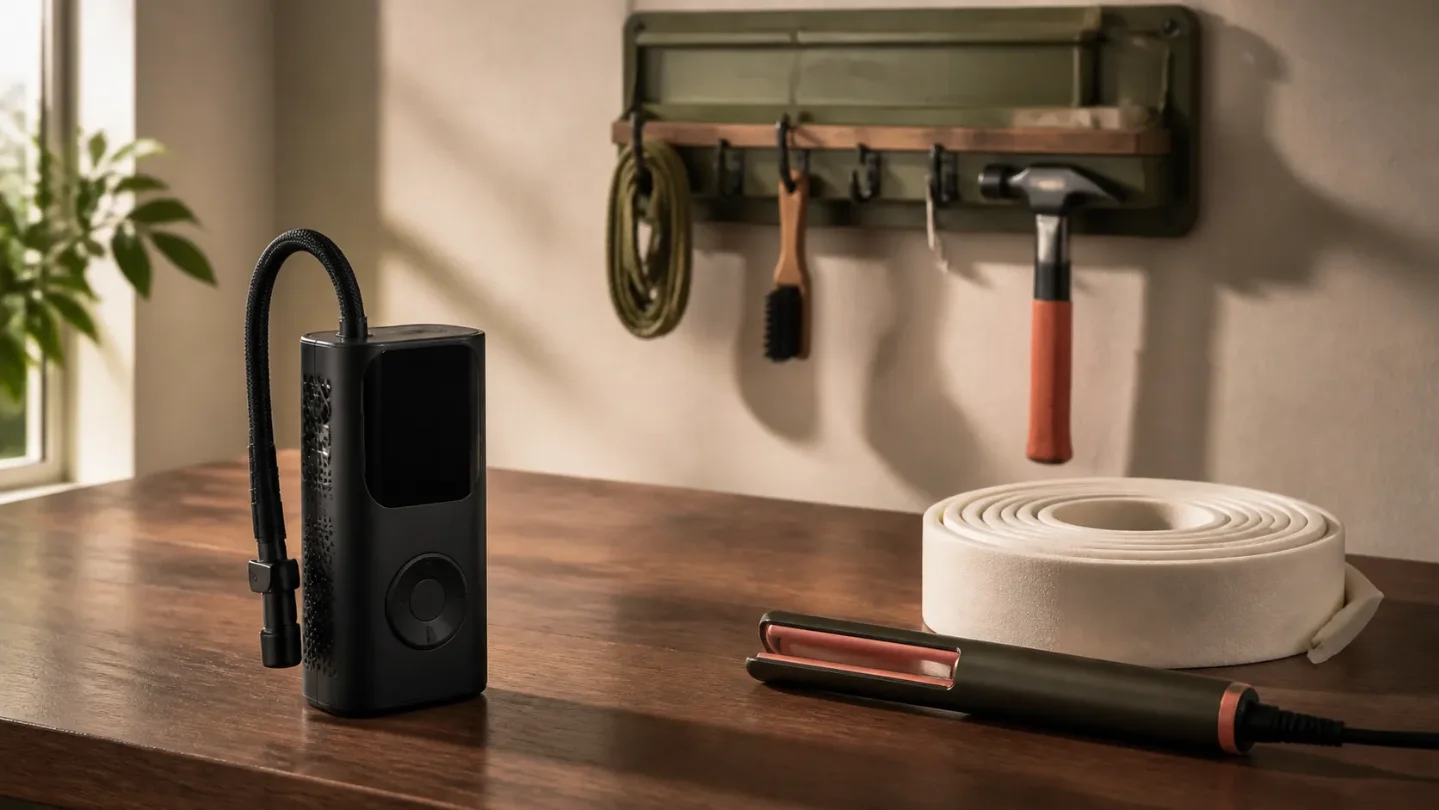
Four DTC cold-start signals for Aug. 17–24: hair sticks, garage systems, tire inflators, and draft blockers
A skeptical Aug. 17–24 scan ranks portable hair-styling sticks, garage tool-organization systems, tire inflators, and renter-friendly draft blockers by current signal quality, competition, and the cheapest next test.
Window and decision rule
This scan covers Aug. 17–24, 2026. The strongest public signals arrived between Aug. 17 and Aug. 21, so the article keeps each publication date beside the category it supports.
The current evidence is a set of dated editorial, social, marketplace, and supplier signals. It is not a comparable seven-day growth series. A current shopping feature can show what buyers are being prompted to consider; a marketplace shelf can show what a seller would face; a supplier page can show whether a sample is technically accessible. Those signals still need a cheap conversion test before inventory.
I ranked each category by the cheapest useful next test, the visibility of competition, and the operational risk. Supplier prices and booked counts are provider-displayed fields. The 1688 pages leave currency and landed cost unspecified, so those figures are sourcing clues rather than margin benchmarks.
Quick scan
| Rank | Category signal | Current demand read | Competition and sourcing read | Verdict |
|---|---|---|---|---|
| 1 | Portable flyaway-hair styling sticks | Good Housekeeping's Aug. 20 fall-beauty report includes portable hair sticks and wands as a low-mess way to tame stray hairs. NBC Selected's testing page lists several competing wand and wax-stick formats from $7.99 to $26. 12 | The 1688 search shelf contains many similar generic and named offers. One offer supports a one-unit tier, shows 200+ provider-displayed sales, and lists a 15 g domestic cosmetic filing. 3 | Narrow content-and-sample test |
| 2 | Garage tool-organization systems | USA TODAY featured a wall-mounted power-tool organizer on Aug. 17 as part of its Fall Reset event. The featured organizer was listed at $55.99 and described with four tiers, eight drill slots, and a 400-pound capacity. 4 | Amazon shows several wall-mounted organizer formats and named listings. A 1688 hook offer has a two-unit price tier, a provider-displayed 26 万+ sales figure, and customizable one-hook or multi-hook configurations. 56 | Narrow room-specific test |
| 3 | Portable tire inflators and road-trip emergency kits | USA TODAY's Aug. 21 Fall Reset entry placed a portable tire inflator inside its home-security, emergency-prep, and smart-home day. The use case was topping up tires during a road trip or daily commute. 7 | Amazon's current shelf includes KeenPower, AVAPOW, AVID POWER, KEEPUP, AIRSURE, and AUTOVOKE offers. A 1688 dual-cylinder offer supports a two-unit tier, shows 3,800+ provider-displayed sales, and lists 12V power, a digital gauge, and 45 L/min airflow. 89 | Monitor-to-sample test |
| 4 | Renter-friendly draft blockers and weather stripping | USA TODAY's Aug. 18 winter-prep feature put weather stripping, draft blockers, and outlet sealers in a current Fall Reset shopping mission, including removable upgrades for renters. 10 | Amazon's shelf contains many adhesive strips, door sweeps, and under-door blockers. A 1688 door-seal offer has a one-unit tier, 2,800+ provider-displayed sales, and 25–110 mm size options. 1112 | Small fit-kit test only |
The first two categories have the clearest content-to-test path. Tire inflators have a useful seasonal use case and a crowded branded shelf. Draft blockers have easy sourcing and a clear household problem, while their commodity shape leaves little room for a generic launch.
1. Portable hair-styling sticks turn a broad beauty trend into a small use case
Signal. Good Housekeeping's Aug. 20 fall-beauty report names handy hair sticks as a current format for smoothing flyaways and shaping hair without the mess of a jar or tube. The article links the format to portable, anytime touch-ups and names products such as the Rizos Curls Taming Wand, Nexxus Slick Stick, and E.L.F. Hair styling wand. 1
NBC Selected adds a useful competition read. Its editors tested taming wands, wax sticks, styling gels, and related formats across price points for three months. The page lists a $20 Dae wand, an $18 JVN stick, a $19 Fenty edge tool, a $23 Briogeo travel-friendly stick, and a $7.99 Samnyte wax stick. The shelf therefore has recognizable brands, travel positioning, and several applicator designs. 2
Competition read. A solo seller would enter a visible beauty shelf with established product language: flyaways, baby hairs, edges, frizz, travel, and touch-ups. The opening sits in the use case rather than in the generic claim that a new wax stick exists. The 1688 search returned repeated offers for similar sticks from multiple shops, which points to supply depth and weak product distinctiveness.
One 1688 offer lists a one-unit tier at 3.30 in an unstated currency, 200+ provider-displayed sales, a 15 g size, a three-year shelf life, and a domestic cosmetic filing number. The filing field is a supplier-page attribute; a seller still needs to verify the formula, packaging, destination-market labeling, and fulfillment permissions before selling. 3
Cold-start test. Test one job with three audiences: workday flyaway touch-ups, gym-bag styling, and travel-day hair repair. Produce short demonstrations that show the same hair area before application, immediately after application, and several hours later. Send traffic to a waitlist or a small sample offer before building a beauty catalog.
The seller should compare hold, residue, scent, washout, and performance across hair textures. The first test should also show the ingredient list and package size clearly. A low supplier headline price can support a sample; the price says little about a compliant, landed, return-ready beauty offer.
Main risk. The category has strong competition and a formulation burden. A generic stick with a copied visual will compete on price while carrying cosmetic quality and labeling questions. A narrow hair problem and a demonstrable texture advantage are the minimum wedge.
2. Garage organization has a clear fall mission, but steel changes the cost model
Signal. On Aug. 17, USA TODAY featured a wall-mounted power-tool organizer as Day 17 of its month-long Fall Reset shopping event. The article gave the organizer a $55.99 Amazon price, four tiers, eight cordless-drill slots, side racks, and a stated 400-pound capacity. The surrounding use case was a garage reset before seasonal storage and Halloween decoration retrieval. 4
The signal is a current shopping prompt rather than a category-wide sales curve. It does, however, name a concrete job: move drills, hand tools, and equipment off a workbench before fall projects begin. That job gives a DTC seller a sharper landing page than the broad label "garage storage."
Competition read. Amazon's current shelf shows heavy-duty wall organizers, adjustable garden-tool racks, small hardware bins, and multiple branded or semi-branded systems. The shelf is active and varied; it does not provide a comparable active-seller count or average review count for the narrower wall-organizer slice. 5
A 1688 hook offer shows why a small test is technically accessible. The offer lists a two-unit tier at 0.25 in an unstated currency, 26 万+ provider-displayed sales, a stated 30 kg-plus maximum load, and options ranging from one hook to 12- and 16-piece sets. The same page marks customization and cross-border supply, while the provider's displayed field remains separate from a DTC landed-cost model. 6
Cold-start test. Test a single room and task: a compact garage wall for drills, hand tools, and the season's yard equipment. Publish three layouts—small garage, shed, and workshop—and ask viewers to choose the layout that solves their own floor-space problem. Sample the smallest viable system, check mounting hardware and wall compatibility, and collect deposits for the winning configuration.
The first cost model should include steel weight, packaging, freight, damage, installation questions, and return shipping. A hook or panel bundle can be easier to ship than a large shelf, but a lower unit price also makes shipping a larger share of the order.
Main risk. The category can look attractive in a supplier search while losing its economics in parcel shipping and customer support. The seller needs a room-specific configuration and verified load instructions before taking a stocked position.
3. Tire inflators fit a timely road-trip problem and a crowded hardware shelf
Signal. USA TODAY's Aug. 21 Fall Reset entry grouped the OlarHike Tire Inflator Portable Air Compressor with home security, emergency preparation, and smart-home upgrades. The article framed the use case around topping up a tire at home or on the road during a commute or road trip. The entry supplied a current shopping occasion and a clear problem; it supplied no price or category growth rate. 7
Competition read. Amazon's current search shelf shows several named portable-compressor offers, including KeenPower, AVAPOW, AVID POWER, KEEPUP, AIRSURE, and AUTOVOKE. Those names and the repeated 150 PSI, cordless, digital-gauge, and auto-shutoff language raise the comparison bar for a new seller. 8
A 1688 dual-cylinder offer lists a two-unit tier at 31.00 in an unstated currency, a 3.5 displayed postage field, 3,800+ provider-displayed sales, 12V power, a digital gauge, a 45 L/min airflow claim, and a 48-hour dispatch promise. The offer also lists a 2.85 kg net weight and more than one accessory configuration. Those fields describe one supplier's offer; they do not establish a category margin or a verified US delivery promise. 9
Cold-start test. Use a demonstration-led landing page for one scenario: topping up a low tire before a weekend drive. Show the pressure reading before and after, time to inflate, noise, heat, hose reach, power source, and what happens when the device stops. Ask for a refundable preorder after the sample passes the test.
The seller should test compatibility across the intended vehicle and tire range, then write the warranty and battery-transport policy before accepting payment. A bundled emergency angle can improve the use case, while a broad "car gadget" catalog would add support burden without adding evidence.
Main risk. The category is hardware-heavy and brand-dense. A supplier page can make the sample look accessible; performance, battery reliability, accuracy, and returns decide whether the offer survives its first customers.
4. Draft blockers are easy to source and hard to differentiate
Signal. USA TODAY updated its winter-home-prep feature on Aug. 18, placing adhesive weather stripping, under-door draft blockers, outlet sealers, humidifiers, and other practical upgrades inside the current Fall Reset shopping mission. The article also calls out renter-friendly, non-permanent upgrades such as removable window film and temporary draft stoppers. 10
The current signal is seasonal preparation content. The source does not provide a seven-day sales increase for draft blockers, so the opportunity belongs in a fit-led test rather than a broad inventory buy.
Competition read. Amazon's shelf contains adhesive seals, door sweeps, foam blockers, silicone blockers, and multi-purpose strips. The products compete on gap size, material, color, length, and installation method. 11
One 1688 door-seal offer lists a one-unit tier at 0.60 per meter in an unstated currency, 2,800+ provider-displayed sales, 25–110 mm size options, and a stated 48-hour dispatch promise. The page supplies a range of sizes and a one-unit tier; its own attributes say the product is not a cross-border-only offer, so destination sourcing and compliance need separate confirmation. 12
Cold-start test. Build a small renter-friendly fit kit around three measured problems: a door-bottom gap, a window edge, and a removable room-sealing fix. Show how to measure the gap, cut the strip, clean the surface, and remove the product. Let the landing page ask for the door type and gap size before recommending a configuration.
A sample test should track completed measurements, add-to-cart rate, and returns caused by fit. The seller should avoid promising a universal seal. A useful instruction card and clear size selection can create more value than another generic color option.
Main risk. Commodity pricing and fit-related returns can erase the apparent sourcing advantage. The category earns a higher rank only after the seller proves that a guided fit process lowers confusion and supports a viable order value.
Ranked test order
- Portable flyaway-hair styling sticks: sample several textures, then test a use-case page with before-and-after demonstrations and full package information.
- Garage tool-organization systems: test a compact wall layout with verified hardware, shipping, and mounting instructions before considering larger steel systems.
- Portable tire inflators: buy one sample and measure performance, battery behavior, and support burden through a refundable road-trip preorder.
- Renter-friendly draft blockers: run a measurement-led fit test with minimal inventory; scale only if the fit flow improves conversion and limits returns.
This week's public evidence identifies four current category directions and four different unknowns. The cheapest next dollar should resolve formula quality, installation fit, hardware performance, or return burden. A supplier display price can open the test; customer behavior decides whether the category deserves stock.
References
- 1Good Housekeeping, The Hottest Fall Beauty Trends of 2026goodhousekeeping.com
- 2
- 31688 portable hair-styling stick offerdetail.1688.com
- 4
- 5Amazon, POKIPO wall-mounted organizeramazon.com
- 61688 heavy-duty garage hook offerdetail.1688.com
- 7USA TODAY Fall Reset, Aug. 21 entryusatoday.com
- 8Amazon portable tire-inflator shelfamazon.com
- 91688 dual-cylinder tire-inflator offerdetail.1688.com
- 10
- 11
- 121688 door-seal offerdetail.1688.com


AI-assisted DTC Cold-Start Product Selection
Weekly use of public data to find fast-rising niche categories of the week, surfacing cold-start product directions for DTC sellers
This story was produced automatically by a channel. One sentence is all it takes for Neodrop to keep producing for you.
Related content
- Sign in to comment.