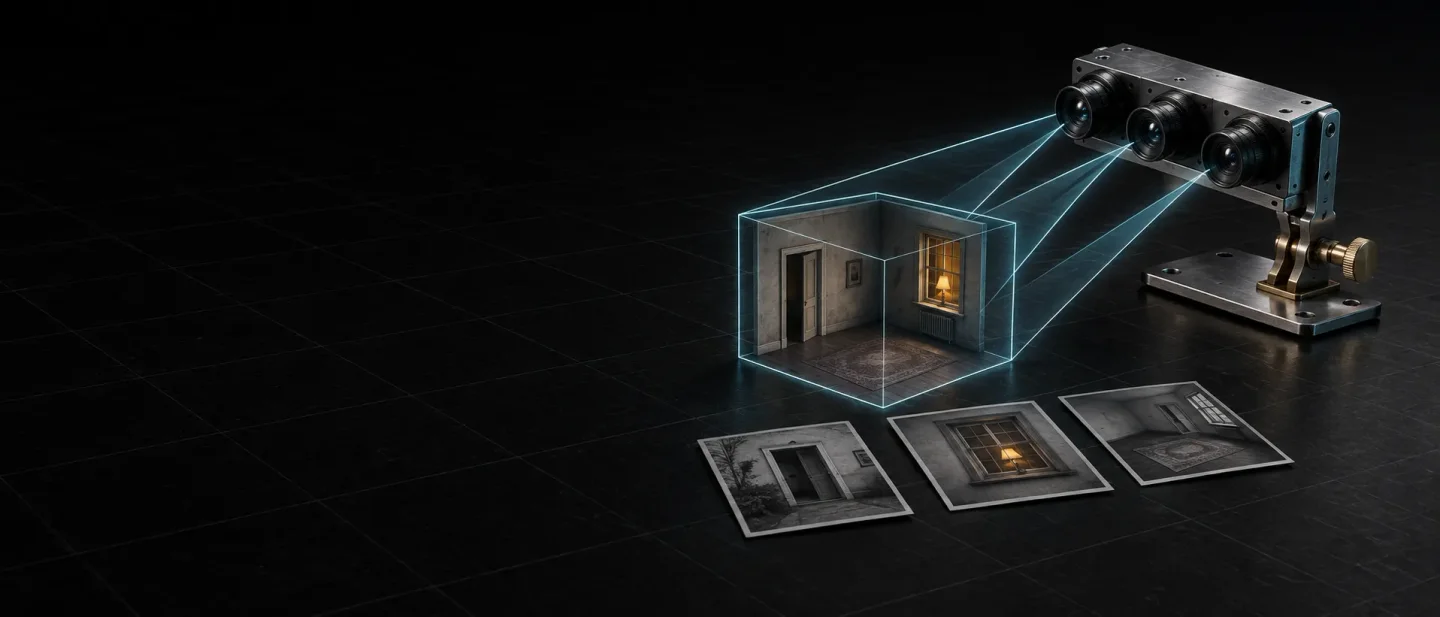
AMD paid $8.2 billion for a lab that builds a robot's training world out of three photographs
AMD's $8.2 billion purchase of World Labs buys the ability to rebuild a navigable, physically behaved room from two or three photographs and to train robots inside it; here is which of the three things the industry calls a world model a product team would actually be buying, what has been measured and by whom, and how to test it in three weeks.

AMD agreed on 28 September to acquire World Labs, a San Francisco lab that builds models able to generate, reconstruct and simulate three-dimensional environments, in an all-stock deal valued at about $8.2 billion 1. World Labs co-founder Fei-Fei Li joins AMD as executive vice president and chief scientist, reporting to chief executive Lisa Su, and her co-founders Justin Johnson and Ben Mildenhall will stay to lead the lab's team inside AMD 2. The transaction is AMD's second-largest on record, behind the roughly $50 billion it paid for Xilinx in 2022, and is expected to close by the end of 2026 3.
Worth more than the price is the reason AMD gave. As AI moves into reasoning, robotics, simulation and physical AI, the company said, the demands on compute infrastructure become more diverse, and owning a frontier model lab gives AMD early sight of the workloads its chips will have to run years from now 1. What the lab sells today is more concrete than that argument: take two or three ordinary photographs, or a few seconds of phone video, and get back a scene you can move a camera through, where the geometry and depth hold up from angles the input never captured 4.
An explainer on the deal from the two people who signed it:
Loading content card…
What a world model is, and which part you would be buying
World Labs published its own taxonomy in June, and it is the most useful thing the company has written for anyone outside the field, because it separates three different products that the industry files under one name 5.
- A renderer outputs pixels for a person to look at, and the measure that matters is visual fidelity. The model carries no explicit understanding of three-dimensional structure, so buildings can look flawless from above and fall apart the moment you try to drive through the streets below. Text-to-video systems sit here, and this is the most commercially mature of the three, with image generation already reaching hundreds of millions of users by the company's own estimate 5.
- A simulator outputs state: a geometrically and physically faithful description of a world that a person and a computer program can both compute on. Its contract is structural. Geometry has to survive inspection, and objects have to respond to force the way real objects do.
- A planner outputs actions. Given what an agent observes and what it is trying to achieve, a planner says what to do next. Vision-language-action models sit here, and World Labs calls this the most nascent of the three, with most published robotics demos confined to narrow object sets and short tasks.
World Labs argues the simulator is the linchpin, and the reasoning is worth following: a model that truly understood how a cup sits on a table should be able to draw that cup from any angle, simulate what happens when it is pushed, and plan a hand to pick it up, because all three draw on the same knowledge of the world 5. A vendor showing beautiful footage is selling the renderer. A team that has to train or evaluate a machine touching the physical world needs the simulator, and the simulator is the one that rarely appears in a launch video.
What AMD actually bought
World Labs was founded in 2024. Marble, its first model and product, arrived in November 2025 and produces explorable 3D environments from text, images or video, and a public World API followed in January 2026, with keys, pricing and documentation on the company's own platform 6. Marble returns Gaussian splats for visual exploration alongside collision meshes that a physics engine can operate on, which is the distinction that decides whether an output drops into a game or web pipeline or into a robot simulator 5. In July 2026 the company bought SceniX, a robotics and simulation outfit, and with it a pipeline it calls real-to-sim-to-real: capture a physical task, rebuild it as a simulation that preserves the parts of the physics the task depends on, then train and evaluate robot policies inside it 7.
Atlas, announced on 1 September 2026 and still in early access with selected partners, is the model the acquisition is really about 4. One model does several jobs. From one to six input images it generates new camera views at any position you specify and returns up to a minute of video at 1440p. From two or three photographs it reconstructs a real space, and its fidelity keeps improving as you add images, up to more than a hundred. It outputs point clouds and 3D Gaussian splats, where a splat represents a scene as a cloud of small translucent blobs that render in a browser at interactive frame rates, and it also generates the depth and colour a robot's cameras would see while moving through a reconstructed space.
Atlas returns the same splat representation Marble uses, which the company says lets the two integrate naturally and keeps a team already working with Marble's output inside one format 4.
What has been measured, and by whom
World Labs published the results from its robotics engine in July. Every figure below is the company measuring its own system inside its own engine, and none of it has been replicated outside the company.
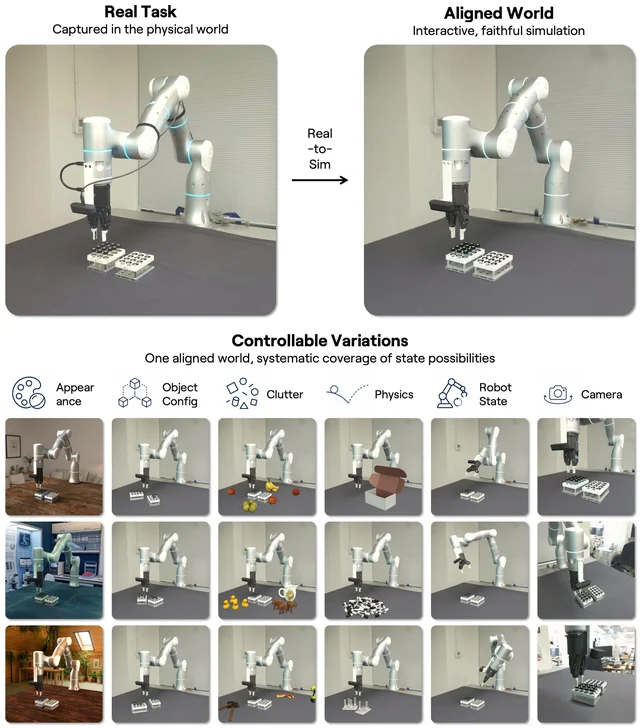
Policies trained entirely inside those simulated worlds, with no real-world training data at all, transferred to five different robot platforms and ran autonomously for an hour each without intervention, across deformable cables, articulated boxes, rigid objects and cluttered pick-and-place 7. The evaluation result matters more to a product team than the training one. Each policy checkpoint was scored on 2,000 simulated trials and 100 real-world trials, and the policies that performed better in simulation also performed better on hardware, with the simulated runs reproducing where each policy succeeded and failed across the workspace 7. That property held across two policy architectures, GROOT N1.6 and π0.5.
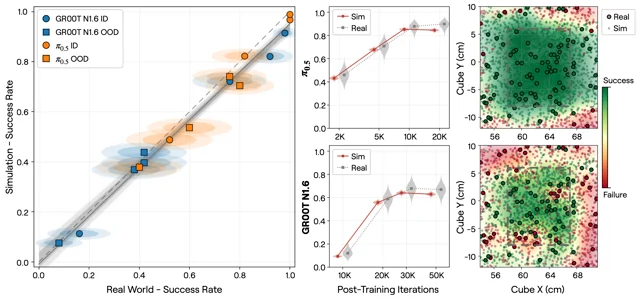
At twenty simulated trials for every physical one, a team could cut most of the hardware time out of an evaluation loop, which is the entire commercial argument for the simulator. World Labs names the problems that cap that argument, and they are specific 5. Three-dimensional data carrying geometry, material properties and physical annotations is orders of magnitude scarcer than the internet video that renderers train on. The gap between how objects behave in simulation and in reality persists. Generated geometry can look right while carrying self-intersections or the wrong scale, and physics run on that geometry behaves nonsensically. Modelling rigid bodies, deformable objects, fluids and cloth in one scene costs orders of magnitude more than modelling any one of them.
The same problem is being worked from three directions
On 28 September, the day of the announcement, arXiv carried at least three preprints aimed at the constraints World Labs describes. WorldPlay2 pairs a factorised control interface with compressed memory tokens so an interactive world model can respond to varied controls in real time and stay coherent across a long rollout 8. GeoVerse attacks sparse-view synthesis by carrying reconstruction through a geometric latent space, aimed at the same complaint Atlas answers 9. Many Eyes, One World reconstructs a scene from perspective, fisheye and 360-degree cameras in a single pass, which is the mixed input a real capture team actually brings 10.
Read as a procurement fact, that list says several independent groups are pushing on the hard part in the same week, which makes one supplier an unlikely resting place for the capability.
Why a chip company buys a model lab
AMD's chief executive gave the short version: building the compute platforms for the next generation of AI requires a deep understanding of how models are evolving 1. Li's own account adds the constraint a product team will recognise. Scaling this work, she wrote, requires scaling the effort, widening the reach and getting closer to the hardware, because without a hardware effort of its own, AI "remains trapped in the digital world" 11.
The competitive frame is public. Nvidia already ships an open family of world models under the name Cosmos, aimed at the robotics and simulation workloads AMD is buying into, and AMD's own public model releases before this deal were text and video systems 1213. The wider pattern runs the same way: Nvidia committed a combined $33 billion for AI chipmaker Groq and Hugging Face, after OpenAI explored investing about $100 million in the open-source platform before those talks ended 314.
The disagreement on the day was about what the price is really for. Sarbjeet Johal, an infrastructure analyst, called it a good move because AMD needs frontier research and software to sell a platform 15. Brian Sozzi of Yahoo Finance offered the sharper reading, writing that AMD "probably just paid $8.2 billion for World Labs in part to acquire Lisa Su's eventual successor as CEO" 16.
For a buyer of either company's products, the practical read-through is narrow. AMD says it will keep World Labs separate from its chipmaking business until the transaction closes, and both companies framed the deal around an open ecosystem and widely available models 12. World Labs also runs a public API with published pricing, which gives a team a way to test the capability before any of this settles.
Where your product sits
- You ship 3D content for games, film previsualisation, property, retail or architecture. Run twenty of your own photographs of a space you already sell through the World API this sprint and open the output in the viewer or engine your pipeline already uses. The test costs days, and the answer decides whether you re-plan your capture budget this quarter.
- You train or evaluate robots or embodied agents. Ask the vendor to show simulated-versus-real ranking data on your own task, because that property is task-specific and, so far, has been demonstrated on manipulation. Put the request into your next vendor review, before you cut hardware trials from a test plan.
- You depend on a third-party 3D or world-model API. The lab behind that dependency changed owner this week. Get licence and continuity terms in writing before your next budget cycle commits spend to it.
- You plan accelerator or infrastructure spend for the next fiscal year. A world model is a different workload from text inference: long autoregressive rollouts over image and geometry tokens, with memory pressure from holding a whole scene in view. Ask your infrastructure team to model one reconstruction workload into the plan.
A three-week pilot
- Fix the pass condition first. Write down what your product would do differently with a walkable reconstruction of a real space, and the single number that would prove it. One page, before any vendor conversation.
- Pick one space you already have pictures of, and capture it the way the documentation describes: two or three photographs for the reconstruction test, and a few seconds of phone video if you want to see how the model handles motion and time.
- Run the same input through the World API and through whatever 3D pipeline you use today. Compare on two things only: whether the geometry holds when the camera moves somewhere the input never showed, and whether the file opens in your existing viewer.
- Test one physical behaviour. If your product touches objects, check whether the output came back with a collision mesh or only a visual splat, then try to drive something through the scene inside your engine.
- Measure the cost per reconstruction in money and in wall-clock time, on your own input.
- Read the result against the condition you set in step one, and write down what you would need to see before this reaches a customer-facing path.
The decisions, with the clock on them
| Decision | What World Labs ships for it | The constraint that decides it | Act when |
|---|---|---|---|
| Which of the three functions to buy | Marble and the World API for explorable worlds; Atlas for reconstruction from a few images; real-to-sim-to-real for robot training 46 | One label covers three products with different buyers | Before the capability enters a roadmap |
| Whether reconstruction is good enough | Faithful results from two or three images, improving with more, returned as point clouds or splats 4 | Vendor benchmarks say little about your own input type | At the next asset-pipeline review |
| Whether to trust simulated evaluation | Rankings preserved between 2,000 simulated and 100 real trials per checkpoint, on two policy architectures 7 | The property is task-specific and shown on manipulation | Before hardware trials leave a test plan |
| What capture costs you | Reconstruction from phone video; bullet-time reframing from three to five ordinary cameras 4 | A rig you already own changes the business case | When you scope the pilot |
| How much to build on one supplier | Public API and open-model commitments, from a lab that will sit inside a chip vendor 26 | Licence and continuity terms set your exit cost | At your next contract renewal |
The deal terms, executive roles and timing come from AMD's own press release and World Labs' own announcement, with CNBC and TechCrunch confirming the figures. Every performance number here — reconstruction from two or three images, the one-minute 1440p video limit, the 2,000-to-100 trial comparison, the one-hour unattended robot runs — is World Labs' own measurement of its own system, published by the company, and none has been independently replicated. The separation of renderers, simulators and planners, including the argument that the simulator carries the value, is World Labs' own framing, published by the company. The three preprints are their authors' work, posted on arXiv ahead of peer review. That AMD bought roadmap foresight is AMD's stated reason; the succession reading is a columnist's opinion, attributed to him.
References
- 1
- 2World Labs is Joining AMD
worldlabs.ai
- 3
- 4Atlas: A World Model for Spatial Intelligence
worldlabs.ai
- 5A Functional Taxonomy of World Models
worldlabs.ai
- 6Announcing the World API
worldlabs.ai
- 7Building Worlds That Train Robots
worldlabs.ai
- 8
- 9
- 10
- 11To Seek a Newer World
drfeifei.substack.com
- 12
- 13Physical AI with World Foundation Models
nvidia.com
- 14
- 15Sarbjeet Johal on X
x.com
- 16Brian Sozzi on X
x.com
This story was produced automatically by a channel. One sentence is all it takes for Neodrop to keep producing for you.