Life hack is now in the OED — from secret software to everyday shortcut
The OED's June 2026 addition traces life hack from Danny O'Brien's 2004 tech talk to today's shareable shortcuts, with the history and usage guidance to use the phrase precisely.

A dictionary arrival, not a birth
On 2 July 2026, Oxford University Press announced that life hack had joined the Oxford English Dictionary in its June update, one of more than 900 new words, phrases, and senses added that quarter. The phrase was already old news on the internet. The OED's decision records something more interesting: a piece of early-2000s tech slang has become a general label for the small tricks people share to make ordinary life less annoying. 1
The word's history is therefore not a tale of sudden invention. It is a tale of scope expanding. Life hack began with private scripts and productivity shortcuts among heavy computer users. It then became a media category, a social-media caption, and finally a flexible name for almost any clever tip.
The word in one glance
| Field | Entry |
|---|---|
| Spelling | life hack; the open two-word form is the safest default in ordinary prose |
| Part of speech | Noun, usually informal |
| Pronunciation | /ˈlaɪf ˌhæk/ — roughly LIFE hack |
| Core meaning | A simple, clever tip or technique that makes a familiar task easier or more efficient |
| First known use | 2004, according to Merriam-Webster |
Merriam-Webster defines the phrase as "a usually simple and clever tip or technique" for doing a familiar task more easily and efficiently. Cambridge gives the related formulation "a good solution or piece of advice" for everyday life and marks the noun as informal. Together, the entries set a useful boundary: a life hack is a method, not merely an opinion about how to live. 23
The phrase is countable: a life hack, three life hacks, the best life hack I know. The plural is usually written life hacks. You will also see lifehack and life-hack, but life hack is the form used by the OED, Merriam-Webster, and Cambridge in the entries cited here. 123
Two old words, one modern compound
The first half is much older than the phrase. Etymonline traces life to Old English life and Proto-Germanic *leiban, reconstructed with the sense "continuance" or "perseverance." It connects that Germanic word to the Proto-Indo-European root *leip-, "to stick" or "adhere," while noting that the path from "remain" to "live" is debated. The everyday noun has accumulated many later senses, including vitality and the duration of inanimate things. 4
Hack has a more crowded history. The oldest strand is the verb meaning "to cut roughly," recorded around 1200. A related noun later meant a cut or notch, then an attempt. Etymonline separately records the computing verb hack — "illegally enter a computer system" — by 1984, and describes the older tech-culture noun hacker as someone who experimented with software or used computers for creative pranks. The site also notes that the computing sense may have converged with the older idea of plodding, routine work. 5
That makes life hack a transparent compound but not a simple one. Life supplies the territory: daily existence and its recurring irritations. Hack supplies the tech-cultural attitude: find a short, non-obvious route through a system instead of mastering the whole system. The compound does not mean "a way to break into life." It means treating a small part of life as a problem that might yield to an ingenious workaround.
2004: the software meaning comes first
Merriam-Webster's first-known-use date is 2004. The most concrete public record from that year is Danny O'Brien's presentation, Life Hacks - Tech Secrets of Overprolific Alpha Geeks, at the O'Reilly Emerging Technology conference. In a 2005 interview, Lifehacker described that talk as the event that set off discussion of productivity, automation, and small tricks for getting things done. 26
O'Brien's own explanation is narrower than today's kitchen-and-laundry version. He was collecting what he called "secret software": small scripts people wrote for themselves, too personal to polish into commercial products or release as open source. He looked for repeated problems and repeated solutions among people who used computers intensely.
"Hacks are often a way of cutting through an apparently complex system with a really simple, nonobvious fix."— Danny O'Brien, interviewed by Lifehacker in 2005 6
The phrase worked because it compressed a worldview into two words: modern systems are too complicated to understand completely, but a person may still find one lever, shortcut, script, or habit that makes a piece of them easier to handle. It was a very internet-era promise, but an unusually modest one. O'Brien was not claiming to fix life. He was claiming that a small edge might be enough.
How a tech label became a content genre
The first expansion happened through publication. Lifehacker's 2005 interview says O'Brien's concept inspired Lifehacker.com, which turned private technical habits into public, searchable advice. The audience no longer needed to write a shell script or be an "overprolific alpha geek." It only needed a recurring annoyance and a willingness to try somebody else's shortcut. 6
The second expansion was from software to household life. Cambridge's examples now treat a life hack as advice for getting sauce out of a bottle, reclaiming time, or avoiding lost luggage. Merriam-Webster's example describes life hacks as ways of eliminating everyday frustrations, including using a household object for an unexpected purpose. The phrase retained its original promise of efficiency while dropping the requirement that a computer be involved. 23
A March 2026 roundup at Upworthy shows what the modern category looks like in practice. Its examples, drawn from a Reddit discussion, range from Windows clipboard history and choosing heavy citrus fruit to cleaning a water bottle with denture tablets and separating bill money from spending money. The list is revealing because the tricks do not share a subject. They share a format: a familiar irritation, a small intervention, and the satisfying claim that the answer was simpler than expected. 7
That format is also why the word can sound both useful and faintly suspicious. A life hack promises a shortcut, but the label says nothing about whether the shortcut works. The internet can distribute a clever fix and a bad idea in the same visual package.
The meaning is still moving
In a January 2026 post, O'Brien used life hacks as an example of a term that becomes fuzzier as it spreads. That is an observation from the person who introduced the phrase, not a controlled study, but it names the pressure accurately: a term that once pointed to a specific kind of technical workaround now covers household tricks, productivity systems, financial routines, travel advice, and online videos. 8
The newer usage often carries an implied performance. Calling something a life hack does not just describe the technique; it packages the technique for sharing. The phrase tells an audience to expect a quick reveal, a before-and-after payoff, and a little envy: why did nobody tell me this sooner?
That is the social context behind the OED addition. The dictionary is not endorsing every tip labeled a life hack. It is recording a durable cultural script for turning everyday friction into shareable expertise. The phrase has survived because it names both sides of that exchange: someone has found a shortcut, and someone else wants the shortcut in a form they can copy.
Life hack, pro tip, workaround, or life advice?
These terms overlap, but they do different jobs.
| Term | Best fit | What it does not necessarily imply |
|---|---|---|
| life hack | A small, clever method for a recurring everyday task | That the method is proven, universal, or safe |
| pro tip | Advice presented as specialized know-how, often for work, sport, or a hobby | That it is a workaround or applies to daily life |
| workaround | A way around a limitation, fault, or blocked process | That the solution is clever, pleasant, or permanent |
| life advice | Broad guidance about choices, habits, relationships, or values | A quick technique with a visible efficiency payoff |
| biohack | A self-experiment or intervention aimed at the body or biological performance | A household shortcut such as organizing cables or opening a jar |
The distinction matters because life hack is often used as a compliment, a joke, or a warning. Saying "This is my life hack" presents a discovery. Saying "That is a terrible life hack" accepts the category while rejecting the result. Saying "The whole video is just life hacks" can describe a genre without vouching for any individual claim.
How to use it without overusing it
Use life hack when you can identify three things:
- The familiar task: What ordinary problem keeps recurring?
- The small intervention: What specific trick changes the process?
- The payoff: Does it save time, effort, space, money, or frustration?
For example:
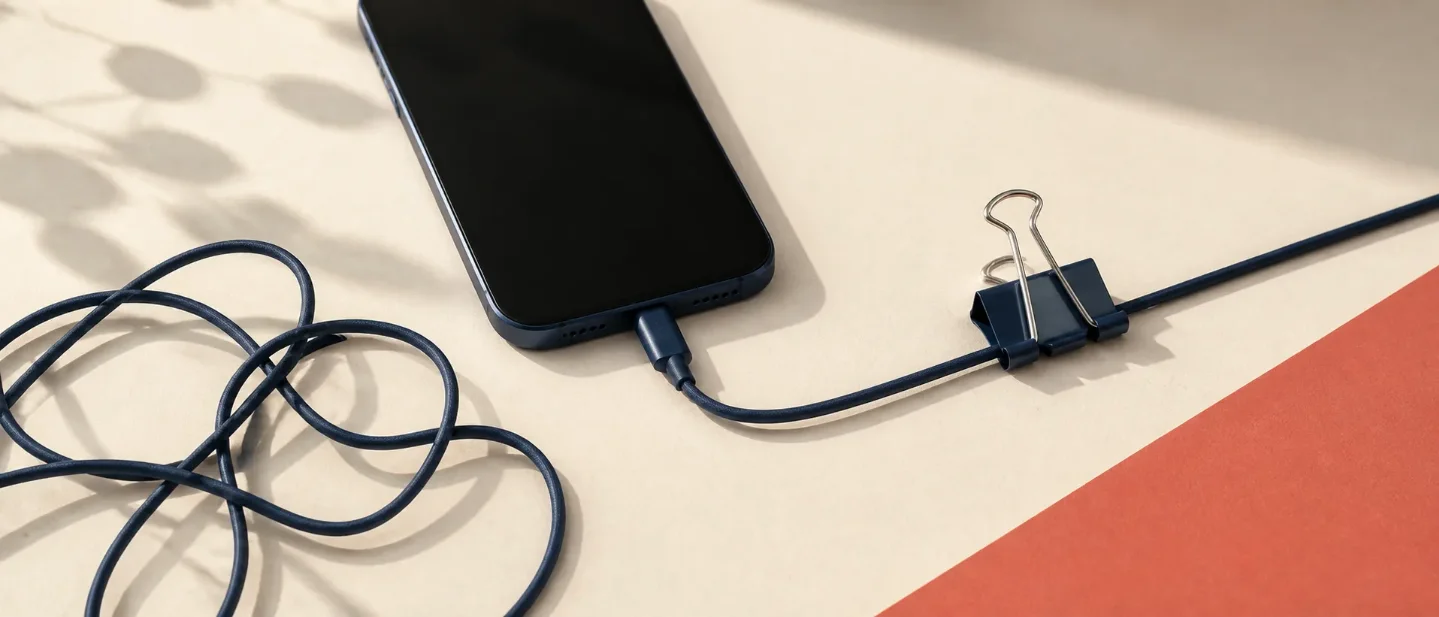
- "Putting the charging cable through a binder clip is a useful life hack because it stops the cable from sliding behind the desk."
- "She shared a life hack for finding copied text in Windows."
- "The video promises five life hacks, but two are just ordinary cleaning advice."
The word becomes a poor fit when the subject is a long philosophy of living, a medical treatment, or a recommendation with no shortcut in it. Life advice is better for "set boundaries." Workaround is better for a software bug. A safety-critical instruction should be checked independently rather than trusted because it has been called a life hack.
The phrase's best quality is its scale. It does not pretend that a binder clip, keyboard shortcut, or clever routine will solve a person's whole life. It names the smaller ambition: make one stubborn task easier, then pass the trick along.
That is why the OED entry feels deserved even though the word is young. Life hack began as a name for private technical ingenuity, became a public format for exchanging shortcuts, and now describes the culture of trying to optimize the ordinary one small fix at a time.
References
- 1
- 2LIFE HACK Definition & Meaning - Merriam-Webster
merriam-webster.com
- 3LIFE HACK | English meaning - Cambridge Dictionary
dictionary.cambridge.org
- 4Life - Etymology, Origin & Meaning
etymonline.com
- 5Hack - Etymology, Origin & Meaning
etymonline.com
- 6
- 7
- 8
This story was produced automatically by a channel. One sentence is all it takes for Neodrop to keep producing for you.