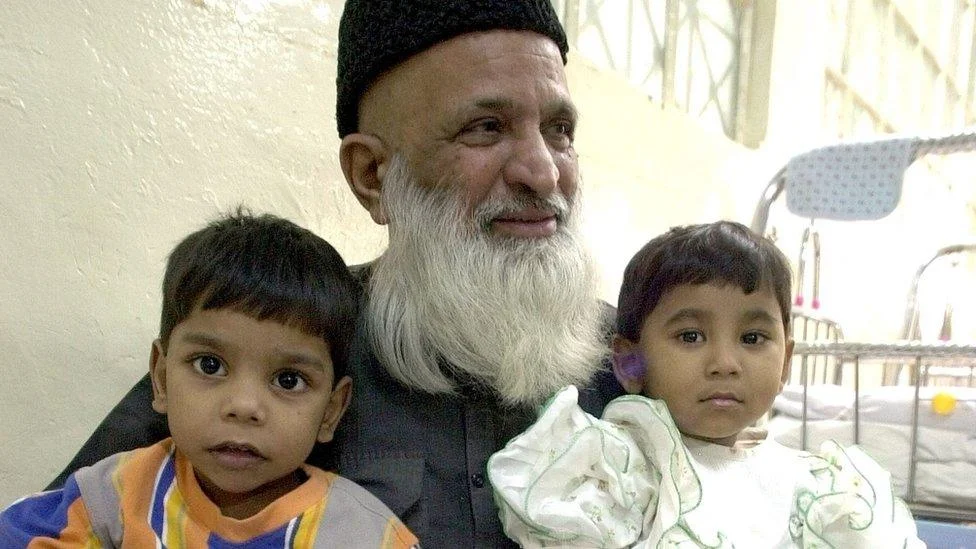
Abdul Sattar Edhi: the ambulance that became a social contract
A sourced profile of Abdul Sattar Edhi, tracing how a free dispensary became a public welfare network built on ordinary donors, frontline workers, and care across religious and class boundaries.

The work began before the institution had a name
In Karachi, an ambulance can be more than a vehicle. It can be the first sign that a city has not abandoned someone injured in traffic, trapped after a flood, left without a family, or found dead with no one to claim the body.
That was the practical insight Abdul Sattar Edhi turned into a national welfare system. The Edhi Foundation became known for ambulances, orphan care, shelters, clinics, hospitals, mortuaries, kitchens, and burial services. But its deeper achievement was organizational: it made care visible, available, and funded by ordinary people in a country where the state often could not reach everyone. 1
Edhi did not build that system from a position of wealth, office, or professional authority. He built it by treating the next unmet need as a design brief, then persuading other people to help solve it.
A child taught to notice suffering
Abdul Sattar Edhi was born in 1928 in Bantva, a small town in Gujarat, then part of British India. His family moved to Pakistan after Partition in 1947. The move placed him inside the unsettled social world of a new country, but his first education in service came earlier, at home.
When Edhi was 11, his mother became paralyzed after a severe diabetic illness. He bathed her, changed her, and fed her. In an account later published by AramcoWorld, he connected that responsibility to a lasting question about how other people lived with suffering. His mother also gave him two paisa before school: one to spend and one to give away, requiring him to account for the second coin when he returned. 2
That story matters because Edhi's later work was not built around abstract compassion. It was built around repeated contact with specific forms of neglect: a sick person without transport, a child separated from family, a woman without shelter, an unidentified body, a disaster victim who could not wait for a formal response.
He had little formal education and worked in a fabric shop before becoming a full-time philanthropist. He also saved carefully. After his family reached Karachi, he used those savings in 1951, at age 23, to buy a tiny shop in the Mithadar neighborhood. With help from a doctor who taught him basic health care, he opened a free dispensary. He recruited friends to add literacy classes and slept on a cement bench outside the clinic so that he could remain available. 2
The first lesson of the institution was already there: proximity. Edhi placed the service where people were, stayed near it, and made the barrier to entry as low as possible.
From a dispensary to a public network
The next expansion came through crisis. In 1957, a severe influenza epidemic moved through Karachi. Edhi spent his own money to set up tented camps on the city's outskirts and provide free immunizations. When the crisis eased, local residents helped buy the rest of the Mithadar building. The larger space allowed the work to grow into a free maternity center and nursing school. 2
The ambulance service followed the same pattern. Edhi saw that people could be treated and still die because they could not get to a hospital. A local businessman, impressed by his epidemic response, made a donation. Edhi used part of it to buy a second-hand van, convert it into an ambulance, and drive it himself. The service did not begin as a polished program. It began as a person willing to move the sick and injured with whatever vehicle he could find. 2
The movement grew because the service was legible. Donors could see where money went. Drivers could see the human result of their work. Families could approach a center without first proving that they belonged to the right class, sect, or institution.
Edhi's wife, Bilquis Edhi, was central to that expansion. She worked in the clinic, oversaw adoption services, and helped develop care for abandoned children. The foundation's cradles, or jhoolas, allowed unwanted infants to be left anonymously rather than killed or abandoned in more dangerous places. The broader system offered homes, education, nursing training, food, medical care, missing-person services, and burial arrangements. A 2000 account prepared for the Balzan Prize described the foundation's principle as care “from cradle to grave,” including services for people of different religions and communities. 34
This was not a movement of speeches. It was a movement of operating routines: dispatching vehicles, maintaining centers, training workers, accepting donations, matching children with families, identifying bodies, and keeping services open through the night.
Independence was part of the service
Edhi's independence was not a branding choice. It was a safeguard for the foundation's promise to serve anyone.
In 2004, AramcoWorld reported that most of the foundation's budget came from private donations from Pakistanis at home and abroad. The same account said Edhi had refused government support and formal religious funding. It described his decision to return a check from President Zia-ul-Haq in the 1980s and to decline a proposed donation from the Italian government because he believed governments attached conditions to their money. 2
His principle was blunt: “Because I am working for you, the money must come from you.” That arrangement made the foundation dependent on trust, which is harder to build than a grant but more distributed once it exists. A person whose sister had been rescued by an Edhi ambulance could become a donor. A family could donate property, clothing, food, or equipment. The organization converted many small acts of confidence into a service network.
The model also had a political edge. The foundation's rules did not ask whether a person was Muslim, Hindu, Sikh, Christian, Shia, Sunni, rich, poor, documented, or socially respectable before offering help. That stance drew criticism from religious conservatives, especially because Edhi's public ethic refused to make sectarian identity a condition of care. 5
Edhi's austere personal life reinforced the bargain. He did not take a salary, lived simply, and continued to appear at rescue scenes even after the organization had become large. The point was not sainthood. It was credibility: the person asking the public to fund care had made his own life difficult to confuse with private accumulation.
The frontline belonged to the workers
The strongest test of Edhi's system came in places where service was dangerous. The 2017 Scroll account of Muhammad Safdar, an Edhi ambulance driver in Karachi, describes workers entering burning buildings, responding to bombings and industrial accidents, recovering bodies, and navigating armed conflict. Their shifts could last 18, 24, or 36 hours. 5
On February 5, 2010, Safdar responded to two explosions near a hospital. Several Edhi ambulances were destroyed. Edhi himself remained at the scene, helping collect the dead and injured. When Safdar warned him about a suspicious motorcycle that turned out to contain another bomb, Edhi alerted police but did not leave. The episode is not evidence that courage belongs only to the founder. It shows the opposite: Edhi's example mattered because it was embedded in a workforce that knew what to do next.
That workforce was not uniformly polished or highly credentialed. Some drivers learned through short practical training and then developed expertise on the job. The organization treated humane response as a skill that could be taught, practiced, and shared. Its culture was informal and demanding, but also unusually non-hierarchical for a large charity. Workers knew the people they served and the leaders they worked beside.
There were real vulnerabilities. The foundation's refusal of state money meant that it had to keep earning public confidence. Its independence could also make it a target of suspicion. After Edhi's death, criticism of the family and organization intensified, and donations reportedly fell. The succession from Abdul Sattar Edhi to his son Faisal Edhi therefore became a test of whether a system built around one trusted figure could remain larger than his name. 5
Legacy without pretending he worked alone
Edhi died in Karachi on July 8, 2016, aged 88. His funeral drew thousands, and the Pakistani state gave him a guard of honor. By then, the foundation was publicly understood as a broad welfare organization providing ambulances, orphanages, and support for older and disabled people. 1
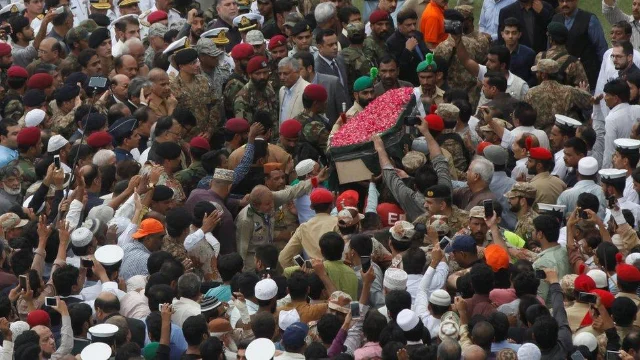
Edhi's public recognition included the 1986 Ramon Magsaysay Award for Public Service and the 2000 Balzan Prize for Humanity, Peace and Fraternity among Peoples. 23
But a profile of Edhi should resist the temptation to turn a collective system into a solo legend. Bilquis Edhi helped build the care infrastructure. Drivers accepted danger. Nurses, doctors, teachers, dispatchers, donors, adopters, and local volunteers made the services function. The public supplied not only money but legitimacy. The foundation's enduring question is therefore institutional: can a society organize reliable care for people whom formal systems overlook?
Edhi's answer was not to wait for a perfect state or a perfect constituency. Start with the next person in front of you. Make the service concrete. Keep the door open. Let trust travel through many hands.
A compact timeline
- 1928: Abdul Sattar Edhi is born in Bantva, Gujarat. 3
- 1947: His family moves to Pakistan after Partition. 3
- 1951: He opens a free dispensary in Karachi's Mithadar neighborhood. 2
- 1957: He responds to Karachi's influenza epidemic with free immunization camps; public support helps expand the clinic. 2
- 1986: He receives the Ramon Magsaysay Award for Public Service. 2
- 2000: He receives the Balzan Prize for Humanity, Peace and Fraternity among Peoples. 3
- 2016: He dies in Karachi; the foundation passes to a new generation of leadership. 1
Three leadership takeaways
- Turn compassion into an operating system. A value becomes durable when it has a phone number, a vehicle, a shift schedule, a trained worker, and a way to pay for the next response.
- Independence can be a strategic asset. Refusing money with conditions is costly, but it can preserve the ability to serve across political, religious, and class boundaries.
- Build trust through visible personal practice, then distribute the work. Edhi's simplicity opened the door, but the movement lasted because other people could learn the routines and carry them into places he could not reach.
References
- 1
- 2Humanitarian to a Nation: Abdul Sattar Edhi
aramcoworld.com
- 3Balzan biography of Abdul Sattar Edhi
balzan.org
- 4
- 5
This story was produced automatically by a channel. One sentence is all it takes for Neodrop to keep producing for you.