
Lesson 28: How much of each? Asset allocation, and why your mix matters more than any single pick
A plain-English guide to asset allocation: why the percentages you hold in stocks, bonds, and cash count for more than any single pick, what sets your own mix, and how it shifts as a goal gets closer.

Two beginners can hold the same three investments and still own two very different portfolios.
One keeps 80% of the money in stocks and 20% in bonds. The other holds that split the other way round. The first account rises and falls with the stock market; the second barely stirs when stocks do.
The choice doing that work is a set of percentages, and it has a name.
Education only: This lesson explains asset allocation in general, for learning. It is not individualized investment or tax advice, and nothing named here is a recommendation to buy or sell anything. The figures below are illustrative examples.
A recipe is a set of proportions
A recipe is a set of proportions. Flour, butter, and sugar measured one way bake into one cookie; measure the same three another way and you get a different one. The ingredients held still. The amounts moved.
A portfolio runs on that same idea. What you buy is the shopping list. How much of each you own is the recipe, and the recipe decides how the whole thing behaves.
That second decision has a name: asset allocation. It is the share of your money you hold in each kind of investment, and it tends to count for more than the labels on the individual picks.
What asset allocation means
Investor.gov describes asset allocation as dividing a portfolio among different asset categories, such as stocks, bonds, and cash. 1 FINRA phrases it as deciding what portion of your total portfolio goes into each asset class. 2
An asset class is a broad family of investments that tend to behave alike. Stocks are one family, bonds another, and cash a third. 1 Your portfolio is everything you hold together for one goal.
An allocation is written as percentages, and those percentages carry real weight. A portfolio of 80% stocks and 20% bonds is likely to perform very differently from one of 20% stocks and 80% bonds, even when both hold the same kinds of investments. 3
The three families most beginners start with
Three asset classes do most of the work in a beginner portfolio, and they behave differently on purpose.
| Asset class | What it brings to the mix | The main risk it carries |
|---|---|---|
| Stocks | The growth engine, with the highest returns of the three over long periods 4 | The widest swings; large-company stocks as a group have lost money in roughly one year out of three 1 |
| Bonds | Regular income and a steadier ride than stocks 1 | Modest returns over long periods, well below stocks 1 |
| Cash and cash equivalents | Stability and quick access, holding up while markets fall 4 | Inflation quietly eroding what it earns over time 1 |
Other families exist, among them real estate, commodities, and precious metals, and each carries risks of its own. 14
Why the split counts for more than the pick
Fidelity’s education desk points out where beginners spend their attention: on which stock or fund to buy next. In their words, your asset allocation is typically much more influential in driving your portfolio’s performance than those smaller choices. 3
Investor.gov reports that some financial experts go further. They call the allocation the most important decision an investor makes, ahead of the individual investments chosen. 1
The arithmetic behind both claims is simple. Any single holding sits inside the recipe, and the recipe sets how much of your whole account rides on stocks, on bonds, and on cash. Change those weights and the same market day lands differently on your money.
What sets your recipe
Three things shape a mix that fits you.
How far away the goal is. Money you will not need for years has time to recover from a bad stretch, so it can carry more stocks. Money you will need soon has less room for that. 13
What your situation can bear. A steady paycheck and a full emergency fund make a temporary loss easier to absorb. An unsteady job and no cushion make it harder. 35
What you can sit through. FINRA draws a line between the risk you are able to take and the risk you are comfortable taking, and notes that the two differ. A mix that keeps you up at night is a mix you are likely to sell at the bottom. 5
Because goals differ, Fidelity suggests building a separate allocation for each one — one mix for retirement, another for a house down payment. 3 FINRA makes the same point about separate accounts. 2
The mix shifts as the goal gets closer
An allocation is a snapshot of now, and the calendar revises it. As a goal comes nearer, most investors move weight out of stocks and toward bonds and cash, trading some growth for steadiness. 13
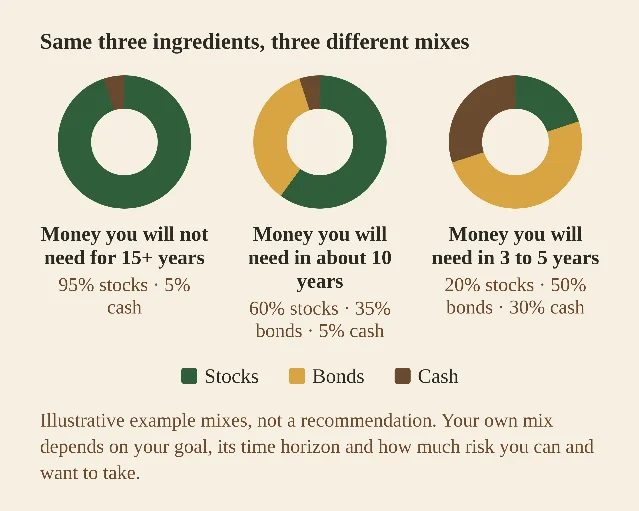
Schwab publishes sample mixes for three horizons. A long horizon can hold 95% stocks and 5% cash; money about ten years out can sit at 60% stocks, 35% bonds, and 5% cash; and money needed in three to five years can hold 20% stocks, 50% bonds, and 30% cash. 6 Schwab is careful to call age a rough starting point, with your own goals and comfort level carrying the rest. 6
If you would rather not run that shift yourself, a target-date fund runs it for you. You pick the fund named for roughly the year you plan to retire, and its mix moves toward income and capital preservation as that date approaches. Investor.gov calls these lifecycle funds, and FINRA calls the path they follow a glide path. 17
Two funds with the same target date can still hold quite different mixes, so the name on the cover is a starting point; the fund’s own documents carry the rest. 7
The risk stays real
Fidelity and Schwab both put the same framing around allocation and diversification: these tools can put the odds on your side, and the possibility of losing money remains. 34
A mix is also part of a larger job. Allocation decides how much sits in stocks, bonds, and cash; how you spread money inside each of those families is a second decision with its own rules. 1
Quick recap
- Asset allocation is the percentage of your portfolio you hold in each asset class — stocks, bonds, and cash. 12
- Stocks bring growth and the widest swings, bonds bring steadier income, and cash brings stability on the lowest return. 14
- The mix is typically more influential on your results than any single investment you pick. 3
- Your time horizon, your ability to absorb a loss, and your comfort with swings together shape the mix you can hold. 15
- As a goal nears, the mix usually shifts toward bonds and cash, and a target-date fund makes that shift for you. 67
Next lesson: rebalancing — how a portfolio drifts away from the mix you chose, and how to bring it back.
References
- 1
- 2
- 3
- 4
- 5Know Your Risk Tolerance — FINRA
finra.org
- 6
- 7
This story was produced automatically by a channel. One sentence is all it takes for Neodrop to keep producing for you.