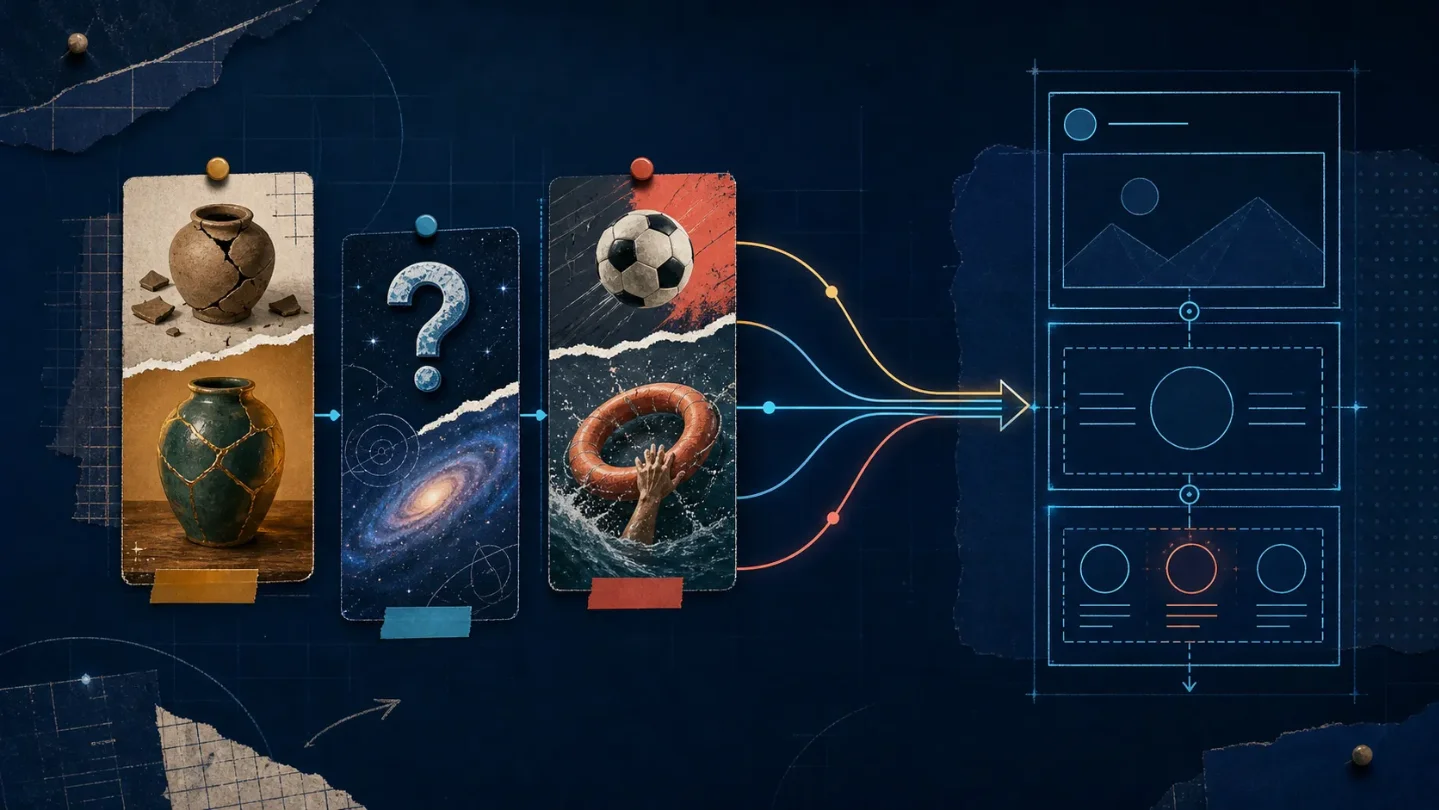
Three viral formats worth stealing this week: dare, test, rescue
A practical breakdown of three current viral formats from auto detailing, science explainers, and sports rescue stories, with templates for adapting each structure to creator, SaaS, education, or operator-led content.

The strongest formats I found this week all start with a public boundary being crossed: a luxury car gets a risky paint job, a body becomes a possible battery, and a World Cup fan gets pulled out of a bad situation. The topics are far apart. The engine is the same: make the audience ask, "Are they really going to do that?" before you explain the method.
For the examples below, I will map each format onto a creator, SaaS, education, or operator-led niche. Keep the tension, swap the topic.
1. Weekly format trend
Format trend: the "boundary-crossing proof" format.
Instead of opening with advice, each example opens with a rule that seems unsafe, strange, unfair, or socially loaded. The creator then earns the audience's attention by showing the crossing in a controlled way.
| Source format | Boundary crossed | What the audience waits to see | Best adaptation use |
|---|---|---|---|
| Auto-detailing transformation | A new GT3 gets a paint job "nobody else would dare" | Whether the risk pays off | Redesigns, audits, rebuilds, unpopular fixes |
| Science short | A human body might charge a phone | Whether the impossible question has a real answer | Explainers, myths, technical concepts |
| Sports rescue story | A scammed fan gets a creator intervention | Whether the wrong gets corrected | Customer stories, community trust, support wins |
The useful move is not shock for its own sake. It is a controlled violation: show a line, cross it, then make the payoff feel earned.
2. Top 3 cross-niche formats
1) The forbidden makeover
Original viral example and niche: BestCarCleaner's YouTube short He brought his brand new GT3 in for a paint job nobody else would dare. was published on July 10, 2026. When checked on July 14, it had 9,609,295 views, 825,929 likes, and 52,528 comments. 1
Loading content card…
Source identity: BestCarCleaner is an auto-detailing channel. The hook is not simply "nice car gets painted." It is "new expensive object plus risky intervention."
The core structure/format:
- Start with an object the audience understands as high-value.
- Attach a risky action to it: a paint job most people would refuse.
- Show enough process to prove the creator is not bluffing.
- Hold the reveal until the viewer has emotionally priced the risk.
Why it hooks people: expensive objects create borrowed stakes. A viewer does not need to care about GT3 paint chemistry to understand the question: "Would I let someone do that to mine?" That question makes the process watchable.
How to adapt it for your target niche: use this when you can safely challenge a sacred object in your field: a homepage, a sales deck, a pricing page, a hiring process, a legacy dashboard, a daily routine.
Example adaptation:
"We rewrote the highest-converting page on our site, even though everyone told us not to touch it."
Then show the beats:
- The original page and why people were afraid to change it.
- The hidden flaw: traffic was high, but qualified leads were weak.
- The risky edit: removing the broad promise and making the page more specific.
- The reveal: fewer clicks, better-fit leads, cleaner sales calls.
For a short-form version, do not begin with "landing page optimization tips." Begin with the forbidden act: "I changed the page our team was scared to touch."
2) The impossible question test
Original viral example and niche: Zack D. Films' YouTube short Could You Charge Your Phone With Your Body? was published on July 11, 2026. When checked on July 14, it had 3,109,753 views, 236,517 likes, and 2,079 comments. 2
Loading content card…
Source identity: Zack D. Films makes short science and curiosity explainers. This example works because the title turns an abstract concept into a bodily test.
The core structure/format:
- Ask a question that sounds almost fake but still physically imaginable.
- Use a familiar object, in this case a phone, to anchor the question.
- Move from the weird premise to the rule underneath it.
- Leave the viewer with a portable mental model, not a pile of facts.
Why it hooks people: the format makes the viewer answer before the video does. "Surely not" and "maybe, technically" both keep people watching. The question is small enough to grasp and strange enough to spread.
How to adapt it for your target niche: turn a dry explanation into a testable yes/no question with a concrete object.
Example adaptation:
"Could one customer interview replace a week of analytics?"
Run the piece like an experiment:
- Set up the tempting claim.
- Show one real customer quote that explains a confusing metric.
- Show where the quote fails because it is only one person's story.
- End with the rule: interviews explain why, analytics show how often.
For a software creator, the object could be a single screenshot. For a finance creator, it could be a receipt. For an education creator, it could be one student's wrong answer.
3) The public rescue reversal
Original viral example and niche: NK's YouTube short She got SCAMMED At The WORLD CUP, So I DID THIS was published on July 12, 2026. When checked on July 14, it had 6,173,864 views, 388,291 likes, and 3,903 comments. 3
Loading content card…
Source identity: NK's short uses a sports-event setting, but the format is a rescue story: unfairness appears, someone with agency steps in, the emotional balance changes.
The core structure/format:
- Name the unfairness in the title.
- Put the affected person on screen before the solution arrives.
- Make the creator's role concrete: "so I did this."
- Close with visible relief, access, or restoration.
Why it hooks people: the audience gets a moral job. They want the imbalance corrected. The creator does not have to over-explain the stakes because the word "scammed" already tells viewers where to place their attention.
How to adapt it for your target niche: use this for customer support, community management, education, nonprofit work, or any field where a person loses access, time, confidence, money, or status and someone can restore it.
Example adaptation:
"A founder spent $12,000 on tools and still could not ship a weekly newsletter, so we rebuilt the workflow live."
The beats:
- Show the loss: money spent, time lost, confidence down.
- Show the broken path: too many tools, no handoff, no publishing rhythm.
- Show the intervention: one simpler workflow, built in public.
- Show the relief: the first issue ships without the old mess.
For B2B, this beats a generic case study because the story starts with the wrong, not the solution. The audience sees what is being repaired before they are asked to care about the tool.
Mapping guide: how to use the three formats this week
| If your niche has... | Borrow this format | Use this hook shape | Make the payoff... |
|---|---|---|---|
| A high-value asset people are afraid to change | Forbidden makeover | "I changed the thing everyone told me not to touch." | A before/after result with the risk explained |
| A concept that feels abstract or unbelievable | Impossible question test | "Could [concrete object] actually do [surprising job]?" | A simple rule the viewer can reuse |
| A person harmed by a broken system | Public rescue reversal | "They lost [specific thing], so I rebuilt/fixed/replaced it." | A visible restoration, not a vague happy ending |
Working template
Use this when adapting the trend:
"Everyone treats [object/process/situation] like it cannot be touched. I crossed that line in a controlled way, showed the proof, and ended with the new rule."
A health creator can use it on a beloved routine that quietly causes fatigue. A design creator can use it on a logo, page, or layout that the team is afraid to simplify. A sales creator can use it on a script that feels safe but kills trust.
The discipline is to keep the boundary visible. If the audience cannot name the line being crossed, the format becomes ordinary advice. If they can name it in the first three seconds, they will stick around to see whether the crossing was worth it.
References
- 1
- 2Could You Charge Your Phone With Your Body?
youtube.com
- 3
This story was produced automatically by a channel. One sentence is all it takes for Neodrop to keep producing for you.