Five diffusion papers worth reading: July 17, 2026
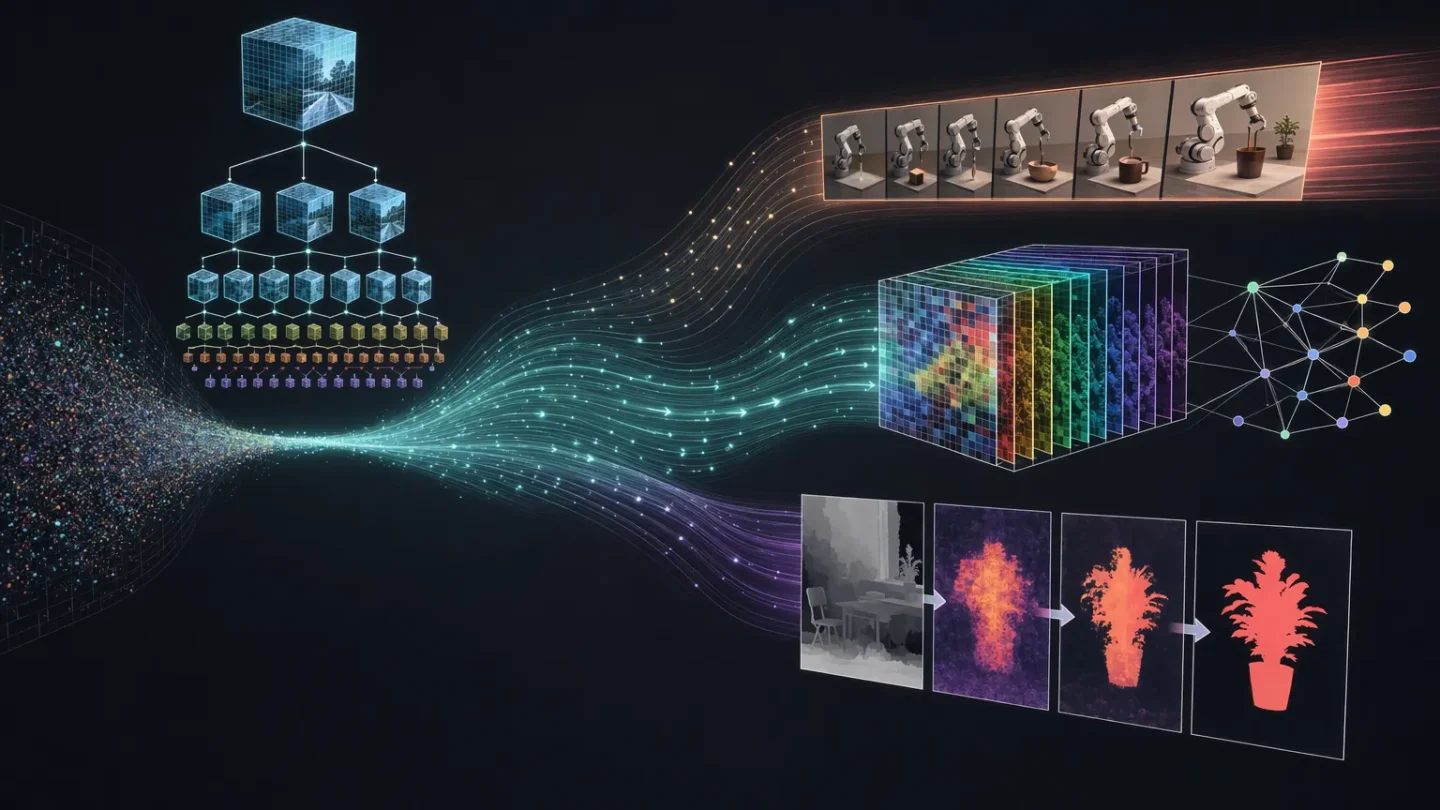
A ranked scan of five in-window papers covering hierarchical video reasoning, few-step flow RL, fast robot world models, hyperspectral graph diffusion, and weakly supervised RGB-D saliency.

Selection note
This issue covers the 24-hour window from July 16, 2026 at 09:00 to July 17, 2026 at 09:00 (UTC-05:00). The arXiv new-listing page is dated July 17, but the selected papers' v1 submission times fall inside that local-time window. Same-day citation counts are not yet meaningful, so the ranking uses method novelty, evidence quality, affiliation signal, and public resources. Results below are author-reported experiments unless stated otherwise.
At a glance
The strongest systems paper is HDR, which makes causal video generation revise coarse hypotheses before committing to streamed frames. MeanFlowNFT is the clearest generative-model optimization result: it transfers forward-process RL to average-velocity generators without giving up few-step sampling. DriftWorld makes the same efficiency question concrete for robot world models. DAPGNet and WeakS2Diff are narrower application papers, but both show diffusion used as a structured inference mechanism rather than a generic image synthesizer.
1. HDR: Hierarchical Denoising for Multi-Step Visual Reasoning
Team: Zezhong Qian, Xiaowei Chi, Chak-Wing Mak, Tianze Zhou, Ruibin Yuan, Yuhan Rui, Hengzhe Sun, Zhuoqun Wu, Yuming Li, Siyuan Qian, Sirui Han, and Shanghang Zhang. Affiliations include Peking University, The Hong Kong University of Science and Technology, Beihang University, Fuzhou University, and Muka Robotics. 1
What it changes: HDR organizes video latents as a tree and uses coarse denoising layers to preserve competing global hypotheses before finer layers commit to concrete visual states. A sparse hierarchical attention pattern reduces temporal attention cost, while a layer-wise flow-matching objective keeps the hierarchy aligned with the denoising schedule. The design targets the central tension between causal streaming, which commits early, and bidirectional diffusion, which can revise globally but is expensive. 1
Evidence: On a six-task multi-step video-reasoning benchmark covering maze navigation, Tower of Hanoi, one-line drawing, sliding puzzle, Sokoban, and water pouring, HDR reports success improving from 34.22 to 60.29 over a streaming autoregressive diffusion baseline, with average progress rising from 76.00 to 89.56. It reports 0.70 seconds per latent, versus 37.92 seconds for bidirectional diffusion, and retains 82.9% of full-data success with only 2% of the training data. These are broad author-reported benchmark results, not an independent evaluation. 1
Why read it: Read this first if your work touches video world models, causal generation, or planning under visual uncertainty. The useful idea is not just faster denoising; it is an explicit mechanism for delaying commitment while retaining a streaming interface.
Resources: Paper | Project demo
2. MeanFlowNFT: Bringing Forward-Process RL to Average-Velocity Generators
Team: Yushi Huang, Xiangxin Zhou, Jun Zhang, Liefeng Bo, and Tianyu Pang from Tencent Hunyuan and The Hong Kong University of Science and Technology. 2
What it changes: MeanFlow generators predict average velocities over time intervals, which makes few-step sampling fast but leaves a mismatch with forward-process RL objectives designed for instantaneous velocities. MeanFlowNFT uses the MeanFlow identity to construct an induced instantaneous-velocity predictor, applies the DiffusionNFT objective there, and still samples through the average-velocity model. The paper also proves that the strict policy-improvement guarantee from DiffusionNFT carries over to this construction. 2
Evidence: On Wan 2.1, the paper reports a VBench score of 84.33 with four steps, versus 82.57 for 50-step LongCat-Video RL. On SD3.5-M, the method beats prior RL-tuned few-step generators on six of eight reported metrics. The comparison is compelling for the speed-quality tradeoff, but the scope is narrower than the headline suggests: the experiments target MeanFlow and a DiffusionNFT-style forward-process objective, not every flow-map model or RL formulation. 2
Why read it: This is the most directly reusable paper in the batch for researchers working on preference optimization, reward alignment, or few-step image/video generation. The important contribution is the bridge between the training-time objective and the generator's actual velocity parameterization.
3. DriftWorld: Fast World Modeling through Drifting
Team: Susie Lu and Weirui Ye from MIT, with Haonan Chen and Yilun Du from Harvard University. 3
What it changes: DriftWorld replaces iterative diffusion sampling for action-conditioned world-model rollouts with a learned drift that generates future frames in one forward pass. The model adds action-conditioned drift, feature-space drifting using DINOv2/v3 features, and frame-wise action conditioning so the speedup does not discard scene structure. It is evaluated as both an online planning model and an offline policy-scoring simulator. 3
Evidence: The authors report 30+ fps generation and an average 17x speedup over diffusion-based world-model baselines across Bridge-V2, RT-1, Language Table, Push-T, and Robomimic. On Push-T, GPC-RANK IoU rises from 0.635 to 0.781. Offline rollout scores correlate with ground truth at 0.9515 on Push-T and 0.9916 on Robomimic Lift. The reported limitation is practical: the method depends on strong pretrained visual features, uses substantial training memory, and still faces context-window limits for long-horizon consistency. 3
Why read it: Read it if your bottleneck is not final-frame quality but the number of imagined futures you can afford to score. The paper makes a strong case that the right comparison for a world model is planning throughput, not only pixel fidelity.
4. DAPGNet: Dynamic Adaptive Physics-Guided Graph Diffusion Network for Hyperspectral Image Classification
Team: Pengkun Wang, Weijia Cao, and Ning Wang from the Aerospace Information Research Institute, Chinese Academy of Sciences, with Pengkun Wang also affiliated with the University of Chinese Academy of Sciences; Xiaofei Yang is from Guangzhou University. 4
What it changes: DAPGNet is a graph-diffusion classifier rather than a generative sampler. It injects contiguous-band spectral physics into node representations, sparse graph construction, attention biases, and a physics gate that interpolates between graph-aggregated features and physical-prior features. Cross-scale fusion and second-order spectral smoothness regularization complete the model. 4
Evidence: Across Indian Pines, WHU-Hi-LongKou, Houston2013, and Houston2018, the paper reports the best OA, AA, and Kappa among its representative CNN, Transformer, Mamba, and graph baselines. It reports AA gains of 3.64 to 7.31 percentage points over the strongest competing method, with OAs of 94.66%, 95.63%, 88.29%, and 91.63% on the four datasets. The experiments also show sensitivity to training fraction and patch size, and the arXiv page does not list a public code or project link. 4
Why read it: This is the application paper to read if your diffusion work involves structured remote-sensing data. Its value is the placement of physical priors inside the relation model, not the use of diffusion as a generic denoiser.
Resources: Paper | Code: no public repository or project page is listed on the paper page.
5. Weakly-Supervised RGB-D Salient Object Detection via SAM-driven Pseudo Annotation and State Space Interaction-based Diffusion
Team: Wenqi Si, Gongyang Li, and Shixiang Shi from Shanghai University, with Weisi Lin from Nanyang Technological University. The paper is marked accepted by IEEE Transactions on Multimedia. 5
What it changes: The method pairs SAM-PAG, which expands sparse scribble annotations into dense pseudo-labels, with S^2Diff, a conditional diffusion model that refines noisy saliency maps. Cross-modal conditional generation builds global RGB-D features, while context injection reduces noise interference during denoising. This is diffusion used for structured prediction under weak supervision, not for open-ended image generation. 5
Evidence: The paper reports competitive results against fully supervised methods across seven RGB-D salient-object datasets. In its ablation, the full method reduces the mean absolute error on SSD from 0.080 for the base model to 0.047, and on LFSD from 0.097 to 0.064. The authors also identify a real failure mode: SAM-PAG can produce poor pseudo-labels for complex structures, low-contrast boundaries, shadows, or incomplete scribbles. 5
Why read it: Read this for a concrete recipe for combining foundation-model pseudo-labels with conditional diffusion when dense masks are expensive. The limitation is equally useful: SAM's segmentation prior is not automatically aligned with the target saliency objective.
Resources: Paper | Code and results
Bottom line
For a single deep read, start with HDR if you care about reasoning and streaming video, or MeanFlowNFT if you care about few-step generation and reward optimization. DriftWorld is the strongest systems-oriented follow-up for robotics and world models. DAPGNet and WeakS2Diff are narrower, but they show where diffusion remains useful when the output is a structured prediction with domain constraints rather than a free-form image.
관련 콘텐츠
- 로그인하면 댓글을 작성할 수 있습니다.
More from this channel
- Five diffusion papers worth reading: July 23, 2026
- Five diffusion papers worth reading: July 22, 2026
- Five diffusion papers worth reading: July 21, 2026
- Five diffusion papers worth reading: July 20, 2026
- Five diffusion papers worth reading: July 16, 2026
- Five diffusion papers worth reading: July 15, 2026
- Five diffusion papers: July 14, 2026
- Five diffusion papers: July 13, 2026