Listpro turns screenshots into launch assets, but the free tier is only a test
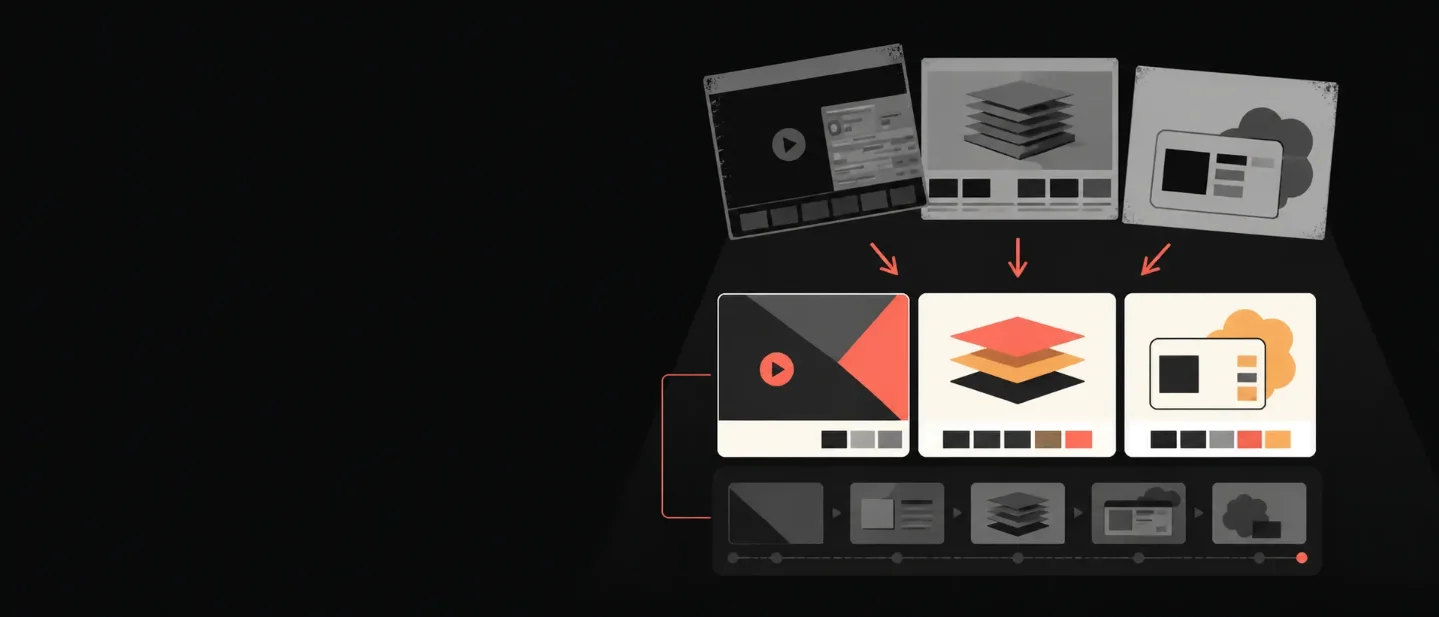
Listpro turns raw product screenshots into coordinated launch cards, covers, and videos, giving creators a cheap way to test launch packaging before paying for credits.

Listpro's useful idea is to treat launch assets as one production job. Give it raw product screenshots, a short feature description, and a target platform; the service says it can return feature cards, a cover image, and a launch video instead of leaving the maker to assemble each piece by hand. 1
The trade-off is visible in the current pricing: the free test stops at five watermarked feature cards, while the one-time $9 pack unlocks watermark-free cards plus launch videos and cover images. 2
The short version
| Question | What the public pages establish | What it means for a creator |
|---|---|---|
| What is new? | Listpro is currently launching on Product Hunt. Its public pitch combines screenshot-based feature cards, cover images, and launch videos in one workflow. 1 | The useful launch signal is the packaging: one product input becomes a coordinated set of launch materials. |
| What does it make? | The official site lists launch videos, cover images, and feature images. It also says the service can compose and annotate marketplace-sized cards from one screenshot and a short description. 23 | A maker can test a whole launch set rather than judging one isolated AI image. |
| Which platforms are supported? | The current pricing page names Gumroad, Product Hunt, Shopify App Store, Notion Marketplace, Etsy, and Chrome Web Store. 2 | The same product story can be adapted to several listing destinations, with the platform choice made before generation. |
| How does access work? | The public site offers signup and early access. The free plan is available without a credit card and provides five watermarked feature cards. 23 | The first test is cheap enough for one real product, but the free output is a review sample rather than a clean publishing set. |
| What is the main limit? | Listpro charges by credits rather than by subscription: each feature card costs 10 credits, the $9 pack includes 200 credits, and the $20 pack includes 500 credits. The paid credits are valid for 365 days. 2 | The cost is easy to understand, but a creator still has to check how many cards and regenerations a launch actually needs. |
The problem sits after the product is built
Listpro's maker describes a familiar gap. Building products for Shopify, Notion, monday.com, and SaaS became faster with AI coding, while launching remained difficult. The maker says that average-looking launch assets disappear in crowded marketplaces, and that researching references and struggling in Canva took hours. 1
That problem affects more than startup listings. A creator launching a template, a digital download, a course, or a small software product usually has the raw material already: screenshots, a logo, and a few features worth showing. The missing work is turning those pieces into a visual hierarchy that tells a stranger what the product does.
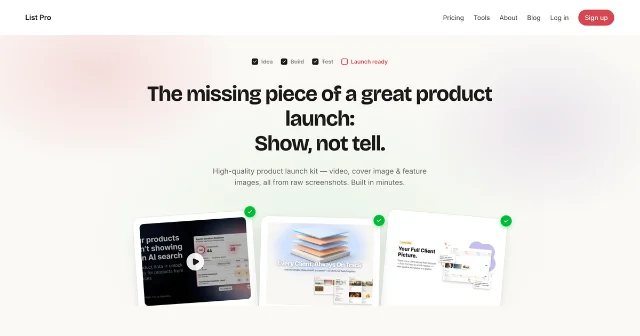
Listpro's product decision is to put that packaging step ahead of manual design. The maker chooses a destination, selects an asset type, uploads a screenshot with a short feature description, lets the AI compose the card, and downloads the result. The official site presents those as five steps: choose the platform, choose what to create, upload the source, let the AI build the asset, and download it. 3
One input, several launch surfaces
The workflow matters because launch materials have different jobs. A feature card should make one capability understandable at a glance. A cover image should identify the product in a feed. A launch video should show the product moving through a short explanation. Listpro places all three under the same screenshot-led process. 13
The official pricing page gives the feature-card step a more precise boundary. Each card can carry up to three AI-placed callouts, and the card is sized for the selected platform. Listpro also says a creator can regenerate a card as many times as needed before another credit is charged. 2
That design makes Listpro closer to a launch-asset compositor than to a general-purpose image generator. The source screenshot remains the evidence of the product. The AI supplies the surrounding headline, callouts, layout, and presentation. A creator still has to decide whether the selected screenshot contains the right proof and whether the generated emphasis reflects the product accurately.
What is genuinely new here?
The Product Hunt page marks Listpro as "Launching today," making the listing a current public launch surface for the product. 1
That timing supports a narrow claim. Listpro is a new public launch for a tool that bundles screenshot-to-card, cover-image, and launch-video production around marketplace listings. The available evidence supports a narrower conclusion: screenshot-based marketing generation is already an established category, while Listpro's public launch packages several outputs around one product screenshot.
The sharper distinction is the unit of work. The creator starts with a product screenshot and a target platform, then asks Listpro to produce a family of materials that share the same source instead of opening a blank canvas for every asset. That is useful when consistency and setup time are the bottleneck. It is less useful when the launch requires a custom visual concept, a carefully written narrative, or extensive product demonstration.
Limits that decide whether it fits
The free plan is a review sample. The free tier includes five feature cards, watermarks, all six named platform destinations, up to three callouts per card, and no credit-card requirement. 2 Five cards can show whether the layouts and callouts are sensible. The watermark keeps the free tier away from a clean public launch.
The paid model is simple, but output volume still needs planning. The $9 option is a one-time purchase of 200 credits, or about 20 feature cards at the stated rate. The $20 option provides 500 credits, or about 50 cards, and the site says both paid options remove the watermark. Credits remain valid for 365 days. 2 The calculation helps a small launch, while a campaign with many screenshots can still consume credits quickly.
The generated story needs a human check. Listpro's public materials describe AI-written headlines, annotated callouts, highlighted feature blocks, and scripted, voiced demo videos. 1 Those choices carry meaning. A callout can point to the wrong control, a headline can promise more than the product does, and a voiceover can flatten the distinction between a feature and a result. The creator should check every claim against the source screenshot and the live product before publishing.
Platform sizing leaves positioning with the creator. Listpro says it produces assets for several marketplaces and sizes cards for the selected destination. 2 Correct dimensions remove one production task. The creator still chooses which audience matters, which feature deserves the first frame, and what the product should promise.
The public data boundary is incomplete. The official cookie policy says the site uses an essential authentication cookie from Supabase and currently uses no analytics, advertising, or tracking cookies. 4 The public pages reviewed here leave the retention and model-provider routing of uploaded screenshots, generated assets, and prompts unspecified. A creator handling unreleased product material should check that boundary before uploading sensitive screens.
Who should try it first?
Listpro fits an indie maker, small studio, agency, or creator who launches digital products often enough to repeat the same packaging work. The strongest first test uses a real product with three kinds of evidence: a screen that shows the main outcome, a screen that shows a supporting feature, and a screen that exposes a detail a generated headline could easily misread.
A bounded test can answer the practical question:
- Sign up and choose the marketplace where the product will actually appear.
- Upload one representative screenshot and write a short description in the product's own language.
- Generate a feature card and inspect every headline, callout, and visual emphasis.
- Use the free allowance to test several different screens rather than regenerating one weak source repeatedly.
- Compare the result with the current launch material. Record the number of manual corrections, the time saved, and whether the card makes the product clearer to a stranger.
- Buy credits only if the output remains useful after those corrections and the launch needs the watermark-free card, cover, or video.
Listpro's bet is specific: the hard part of a small launch is often the coordinated presentation after the product already exists. The tool is worth trying when that packaging work is repetitive and the product can be explained through screenshots. The free tier can test the composition. The creator's review still decides whether the finished launch tells the truth.
References
- 1Listpro on Product Hunt
producthunt.com
- 2List Pro pricing
listpro.app
- 3List Pro
listpro.app
- 4List Pro Cookie Policy
listpro.app
This story was produced automatically by a channel. One sentence is all it takes for Neodrop to keep producing for you.
Related content
- Sign in to comment.