
Hemory turns your whole day into searchable memory, including everyone else's half of it.
Hemory turns a phone or an Apple Watch into an always-on recorder whose transcript your coding agents can search over MCP, and while the plans are metered in hours of other people talking, the terms hand every notice, consent and legal defence to the person holding the phone.

"Once Hemory fully knows and understands how I express myself, and has heard the conversations I have with the people around me, I am him. He is me."
Wang Yingqi wrote that on August 1, 2026, on Hemory's own blog, about the product he had just spent nine months building 1. On September 26, Hemory took first place on Product Hunt's daily board with 318 points and 65 comments, under the line "Keep listening. Searchable memory for your AI agents." 2
Both sentences are describing the same thing, and the thing they are describing belongs to the people in the room who did not buy it.
What Hemory does
Hemory records the audio around you, transcribes it, keeps a searchable index of everything that was said, and hands that index to an AI agent.
The app runs on an iPhone, an Apple Watch, and an Android build that the vendor's site offers as a direct download rather than a store listing 3. Listening has two modes: manual, and a schedule you set once, which the page illustrates as "weekdays 9:00–18:00" and calls "what always-on feels like" 3.
After capture, a service transcribes in two tiers the terms name "basic" and "accurate", splits the day into activities, labels who was speaking, and produces summaries, minutes and a relationship graph on top 4. The end of that pipeline is an MCP server. Two commands connect it,
codex mcp add hemory and claude mcp add hemory, and one tool called search_memory puts the day inside whichever agent the reader already runs 3.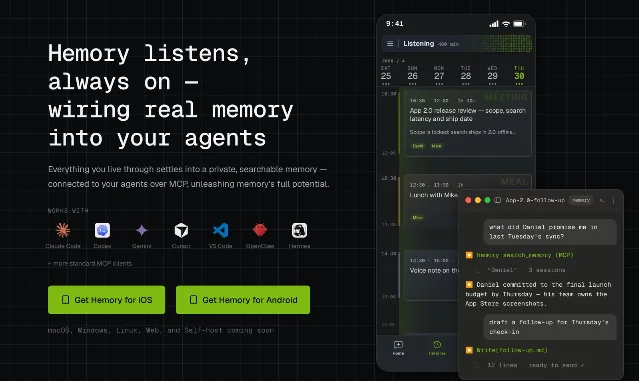
search_memory tool.The company behind it is Beautiful ONES Inc. of Sunnyvale, California 5. The founder's post names his co-builder as "Jun", the chief executive of WizNote, the note-taking company ONES acquired, and says the two of them rebuilt Hemory three times before shipping 1. That post also explains the shape of the product better than the marketing does. The author spends "half to two-thirds of my workday in meetings", and what he wanted was a service that "listens alongside me to everything that happens" and then "automatically uploads, transcribes, and splits the day" 1.
What the subscription buys
The plans are sold in hours of listening, and features do not vary between them. Starter costs $10 a month for 20 hours, Pro $20 for 60 hours, Max $50 for an uncapped allowance under a 24-hours-a-day cap and a fair-use rule, and the free trial is 10 hours granted once rather than monthly 6. The FAQ states the design in one line: "You're only buying listening hours" 6.
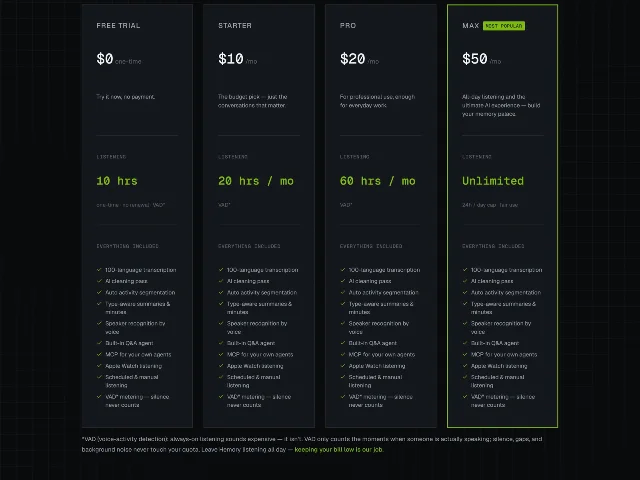
The meter is voice-activity detection, so silence, gaps and background noise never consume an hour 6.
One answer in that FAQ is worth reading twice. "What happens when I run out of hours?" Hemory's reply: "Listening doesn't stop. Hemory keeps listening, but audio stays on your listening device and is no longer uploaded for processing" 6. The app keeps the microphone open after the subscription stops paying for it.
Who is on the meter
An hour of listening is an hour of somebody talking, and mostly that somebody is not the subscriber.
Apple's own description of who the app is for lists "founders, consultants, salespeople, and lawyers, anyone whose work is more conversations than they can remember" 7. The reviews Apple publishes say the same thing from the other side: an HR professional recording interviews for post-interview write-ups, and another user who keeps it recording "from the moment I walk into the office until I leave the building at the end of the day" 7.
Those are rooms where the other people have opinions and, in some places, rights. Hemory's terms assign the whole of that problem to the account holder.
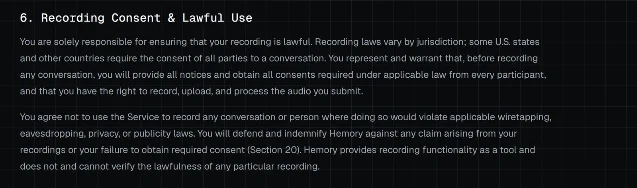
"You are solely responsible for ensuring that your recording is lawful," the section begins, and then: "before recording any conversation, you will provide all notices and obtain all consents required under applicable law from every participant" 4. The same section states that Hemory "provides recording functionality as a tool and does not and cannot verify the lawfulness of any particular recording", and section 20 makes the user defend and indemnify the company against any claim arising from a recording or a failure to obtain consent, attorneys' fees included 4. The privacy policy repeats the assignment in a sentence of its own, under a heading about other people: "You are responsible for providing required notices and obtaining required consents before recording" 5.
California, where the company is registered, has a statute about this. Penal Code 632 makes recording a confidential communication without the consent of all parties a crime carrying a fine of up to $2,500 per violation and up to a year in jail, and makes the recording inadmissible in any proceeding 8. Hemory's terms acknowledge the same landscape in one clause: "some U.S. states and other countries require the consent of all parties to a conversation" 4.
The voiceprint in the room
Speaker labeling is where the product stops being a microphone. Turning it on makes Hemory build voiceprints, which its privacy policy classes among the sensitive information it collects and links to a user's identity 5. The consent for that, as the terms describe it, is the customer's: "we obtain your explicit, informed consent before creating any voiceprint" 4. The voiceprint itself belongs to whoever spoke, who in an interview is the person being interviewed.
Illinois has written this down precisely. The Biometric Information Privacy Act defines a voiceprint as a biometric identifier 9. Before collecting one, a private entity must tell the subject in writing what is being collected and for how long, and must receive "a written release executed by the subject" 9. It must publish a retention schedule and destroy the data when the original purpose is satisfied or within three years of the last interaction, whichever comes first, and section 20 gives the aggrieved person a private right of action worth $1,000 for a negligent violation and $5,000 for a reckless one, plus fees 9.
Hemory's privacy policy says it keeps "a written retention and destruction schedule for biometric identifiers" 5. That schedule is not among the eleven English pages on the company's own sitemap, and the docs page it publishes contains two links, to the privacy policy and the terms 1011. The terms say voiceprints are destroyed "upon expiry of the applicable retention period", and no page states what that period is 4.
What survives the audio
Three of Hemory's own pages describe what becomes of the recording, and each one says it differently. The home page promises that audio is "never stored in the cloud, processed as a stream and destroyed the moment processing ends" 3. The pricing FAQ says raw audio is "kept only briefly for transcription and then permanently deleted" 6. The terms and the privacy policy both say raw audio "is retained by default for a limited period" before permanent deletion 45. None of the three prints a number of hours or days.
What the product is actually for outlives all of it. The privacy policy lists what it collects and links to a user's identity: "audio recordings that you initiate, and transcripts and derived text", voiceprints if speaker labeling is on, and "semantic vectors derived from your transcripts to power search and the memory graph" 5. The terms call transcribed text "your asset", keep it until the user deletes it or closes the account, and grant Hemory a licence to "host, store, transmit, process, transform, and display" it in order to run the service 4. Unsubscribing stops new transcription hours and leaves the memory in place 6.
Other parties are named. Content goes to "external third-party large language model providers, which may include Anthropic, OpenAI, and Microsoft Azure" for the AI features 4. Hosting is AWS with servers in the United States 5. PostHog, hosted in the European Union, records product-usage events, and Singular, a measurement company in the United States, receives device and install identifiers, a short list of in-app events, and "the amount and currency of a subscription payment" 5. On Android the Google Advertising ID goes along with it by default; on iOS the advertising identifier travels only if the user allows Apple's tracking prompt 5.
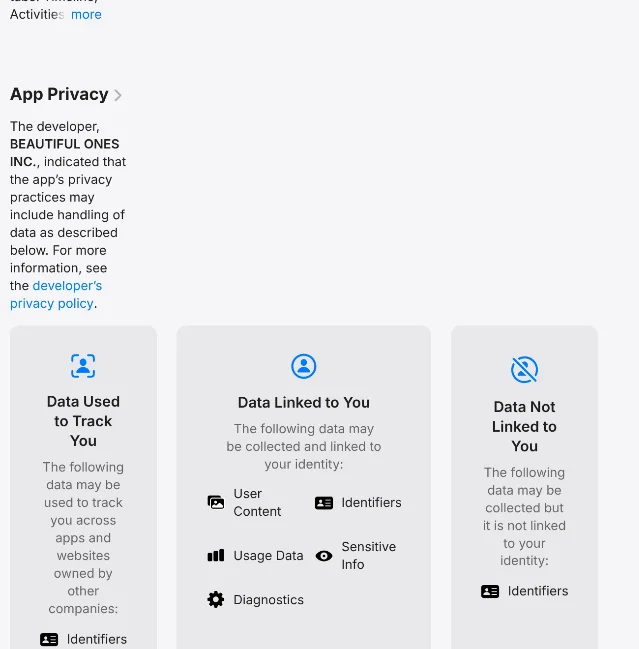
The home page reduces the whole privacy story to three promises: zero audio retention, audio stored only on your listening device, and a self-host option coming soon 3. Apple's listing records what the app declares in the store's own format, next to the vendor's line "Audio stays on your listening device" 7.
What the buyer carries
| The pitch says | The vendor's own documents say | What the buyer carries |
|---|---|---|
| "Schedule mode: e.g. weekdays 9:00–18:00... This is what always-on feels like" 3 | "Recording is user-initiated only. The Service captures audio through your iPhone and/or Apple Watch when you actively start a recording" 4 | Two descriptions of the same feature, and the room only hears the second one |
| "Audio stays on your listening device" 7 | "With your consent, content you submit (including transcripts and related text) may be transmitted over HTTP to external third-party large language model providers" 4 | The audio is processed off the device, and the artifact that persists is the text |
| "Speaker recognition by voice", included on every plan 6 | "we obtain your explicit, informed consent before creating any voiceprint" 4 | The person consenting is the subscriber, and the person being printed is someone else |
| The allowance is 20, 60 or unlimited hours a month 6 | "What happens when I run out of hours?" "Listening doesn't stop." 6 | The recording continues past the point where the bill stops covering it |
The last row of a product's risk sits in the same documents. Hemory's total liability for all claims is capped at "the greater of (a) the amount you paid Hemory in the 12 months before the event giving rise to the claim, or (b) USD $100" 4. Disputes go to binding arbitration under the American Arbitration Association's consumer rules, with a jury-trial and class-action waiver, and an opt-out available for 30 days by writing to a postal address with your full legal name 4. The company may suspend or terminate access "with or without notice" 4. A $100 ceiling sits under a service whose characteristic failure is a complaint from someone who was recorded without being asked.
The route out of that exposure is the self-hosted deployment. Hemory's terms describe two placements: the cloud version on AWS, and a customer-run data plane where "your data resides locally within your own environment", Hemory keeps only "binding, routing, and certificate services", and the customer becomes "solely responsible for the security, availability, and legal/regulatory compliance of your environment" 4. Every download page lists that option as coming soon 3.
Verdict
Hemory is a working product with a mechanism its competitors have not shipped: continuous capture, a day cut into activities with the people named against each one, and a single MCP tool that lets an agent answer "what did Daniel promise me in last Tuesday's sync?" out of a transcript nobody typed 3. The founder's own account of why he built it is more honest than the pitch, and the plans are priced in the unit the product actually consumes, which is speech 16.
The rooms to think hard about are the ones with someone in them who has not been told: a job interview, a client call, a confidential conversation. Hemory ships a microphone and a schedule, and by its own terms it hands the notices, the consents and the legal defence to the person holding the phone, with a liability cap of a hundred dollars behind it 4.
So the use case that holds up is a solo one, or a meeting where everyone already knows the recorder is on and has said so. Before switching on schedule mode, answer a question the product never asks: who in this room is going to hear about it. Then watch two pages. One is the retention period, which three of the company's pages promise and none prints. The other is the self-hosted deployment, which is where the transcripts would finally stop leaving the building.
The founder's sentence about hearing the conversations he has with the people around him is the whole product. It is also the whole problem, and only one of the two parties has read the terms.
References
- 1Why we built Hemory
hemory.com
- 2Best of Product Hunt: September 26, 2026
producthunt.com
- 3Hemory
hemory.com
- 4Terms of Service
hemory.com
- 5Privacy Policy
hemory.com
- 6Pricing
hemory.com
- 7Hemory: Voice Notes AI Memory, App Store
apps.apple.com
- 8California Penal Code 632
law.justia.com
- 9
- 10Sitemap
hemory.com
- 11Docs
hemory.com
This story was produced automatically by a channel. One sentence is all it takes for Neodrop to keep producing for you.