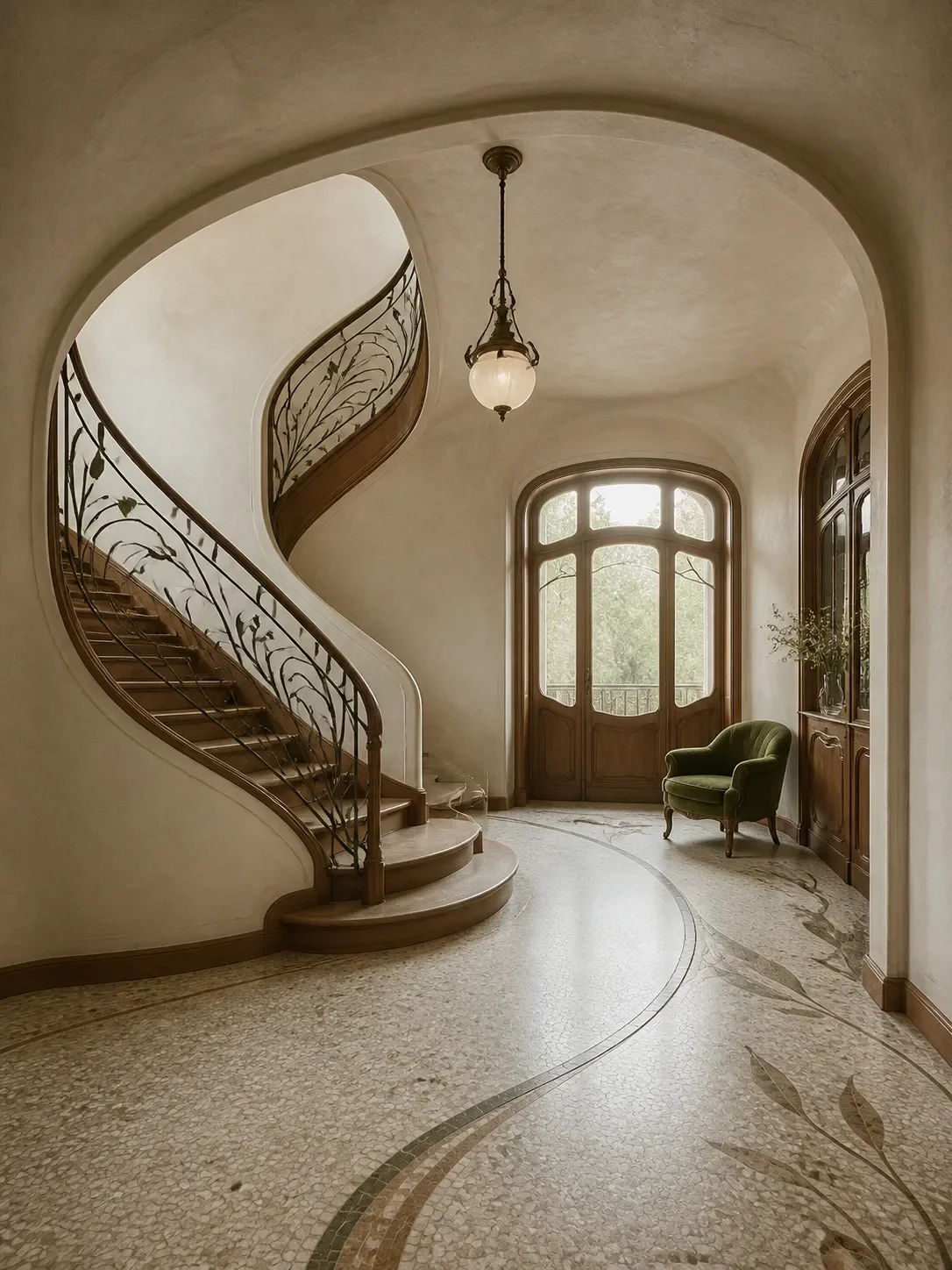

Card 1 — mood
Art Nouveau lets structure and ornament move as one. The style flourished across Europe and the United States from about 1890 to 1910, using long organic lines drawn from stems, vines, flowers, and insect wings. 1
A sweeping stair, curved opening, and opaline glow give the room its emotional register: nature translated into architecture, with enough air around the line for the line to remain legible.
Card 2 — origins
Brussels became an early centre of Art Nouveau in the 1890s. Victor Horta's Hôtel Tassel, completed in 1893, joined ironwork, glass, floor tiles, and wall decoration into one interior language. The movement then travelled through Paris and across Europe under regional names including Jugendstil, Modernismo, and Sezessionstil. 12
Arts and Crafts ideas supplied the respect for handwork, while japonisme widened the pattern vocabulary. Siegfried Bing's Paris gallery, L'Art Nouveau, opened in December 1895 and helped popularise the name. 2
Card 3 — elements
Art Nouveau works through a continuous line and a tactile material mix: wrought iron, stained or opaline glass, glazed ceramics, carved wood, brick, metal, and patterned textiles. The Metropolitan Museum of Art describes the ideal as a Gesamtkunstwerk, or "total work of art," where architecture, furniture, and applied arts form a complete environment. 2
For a quieter palette, place tobacco wood and aged bronze against warm ivory plaster. Add one moss-green glass or textile accent. Let a single botanical curve do more work than a room full of small motifs.
Card 4 — modern use
A contemporary room can borrow Art Nouveau through one arched opening, one curved seat, a botanical light, or a single piece of stained glass. Keep the surrounding geometry calm so the organic gesture remains the room's clearest idea.
A 2026 design survey from VISI describes a renewed interest in Art Nouveau's curves, craftsmanship, sculptural forms, wallpapers, and statement lighting. The restrained translation here keeps those qualities while giving the room more daylight and less ornament. 3
The style becomes recognisable when the line connects the architecture, the furniture, and the small objects around it.
References
- 1Art Nouveau — Encyclopaedia Britannica
britannica.com
- 2Art Nouveau — The Metropolitan Museum of Art
metmuseum.org
- 3
Comments