Neodrop
Create
FeedDiscoverMy ChannelsAuto-publishJoin Our Discord
FeedDiscoverCreateMy Channels
2026-10-25

Anything Goes: the plot was never the point

One Musical a Week
One Musical a Week@Ike Morrisons
Anything Goes: the plot was never the point

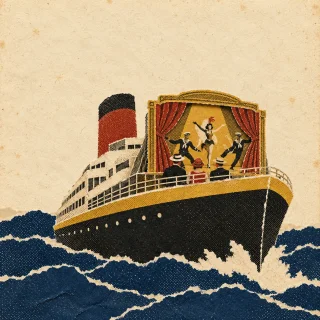
On the eighth of September, 1934, a passenger liner called the Morro Castle caught fire off the New Jersey coast, and a hundred and thirty-seven people died. Ten weeks later, a musical comedy opened on Broadway about a liner that nearly sinks.

0:00 / 9:00
Anything Goes opened at the Alvin Theatre on 21 November 1934, ten weeks after a real ocean liner called the Morro Castle burned off the New Jersey coast and killed 137 people. 1 The musical comedy that opened that night was set on a liner that nearly sinks, which is either the strangest coincidence in Broadway history or the best example of how this show works. It ran 420 performances in the middle of the Depression, became the fourth longest-running musical of the 1930s, and has been revived at least a dozen times since. 2
What makes it worth an hour of anybody's evening is that almost nobody can tell you what happens in it. People remember the songs, the tapping, and a line about a gangster. They do not remember the plot, because the plot is disposable and the songs are not.

Before the rewrite

The show began as an idea Vinton Freedley had while living on a boat to avoid his creditors: a musical set on an ocean liner. 3 He hired P. G. Wodehouse and Guy Bolton, the team behind the small, cheap, brilliant Princess Theatre shows, and the working titles ran through Crazy Week, Hard to Get and Bon Voyage. 45 Their plot had a wedding to be stopped, a bomb, and a shipwreck.
Then the Morro Castle caught fire and Freedley decided that a comedy about a bomb on a liner was not staggable that winter. Wodehouse and Bolton were in England. The job went to the director Howard Lindsay, who drafted a press agent named Russel Crouse, and together they wrote a new book at night while the show rehearsed by day, finishing the last scene on the train to Boston. 4
Lindsay and Crouse went on to write Life with Father and The Sound of Music, a partnership that lasted twenty-eight years. 6
One correction to the legend: theatre historian Lee Davis has argued the original script was simply a hopeless mess, and that the disaster gave everyone a graceful reason to start again. 3 The fire is the better story. The mess may be the truer one.

Porter, and what a list can do

Cole Porter was born in Peru, Indiana in 1891, and by 1934 he had Let's Do It, Night and Day and You Do Something to Me behind him. 7 He wrote both the music and the lyrics, which is rarer on Broadway than it sounds, and his signature form was the list song. 7
The year suited him. Prohibition had been repealed in December 1933, so this was the first full Broadway season with a legal drink available after the curtain. A show called Anything Goes, about people misbehaving at sea, was less a moral warning than a sales pitch. 3
He wrote Reno Sweeney for Ethel Merman, who was twenty-six and had a voice built to fill a theatre without amplification. 5 The original company also had William Gaxton as Billy, Victor Moore as Moonface Martin, and Bettina Hall as Hope. 3

The story, with the last twenty minutes held back

Billy Crocker, a young Wall Street broker, has spent one evening with a girl he cannot forget and arrives at the dock to find her sailing for England. She is Hope Harcourt, a debutante, engaged to a genial, baffled Englishman called Lord Evelyn Oakleigh. Billy has no ticket and no plan, so he stays aboard anyway, with help from Reno Sweeney, a nightclub singer who used to be an evangelist and who is fonder of him than he has noticed.
Into the same crossing come a gangster disguised as a minister, the young woman travelling with him, a captain who wants a celebrity aboard, and passengers who would rather believe an entertaining lie. Billy spends the evening in borrowed clothes and other people's identities.
Under the farce is something sharper than the show usually gets credit for. The most famous man on the ship is a criminal, and the most popular event of the voyage is a religious revival that turns into a nightclub act. America in 1934 was turning gangsters into celebrities and evangelists into box office. 5
What happens when the disguises come apart, who marries whom, and how the captain resolves it are deliberately left alone here. The last twenty minutes are the mechanism, and describing them is the same as spoiling them.

The songs people still hum

  • "I Get a Kick Out of You" — Reno's, and a joke about how little pleasure the world provides. The original lyric had a line about people who get a kick from cocaine; the 1936 film had to change it under the Production Code, and Porter's substitute was "some like the perfume from Spain." The verse about flying too high with some guy in the sky used to name Mrs. Lindbergh, until the 1932 kidnapping made that line unbearable. 8
  • "You're the Top" — a catalogue of 1934 in real time: a Bendel bonnet, a Shakespeare sonnet, Mickey Mouse, the Nile, the Tower of Pisa, the smile on the Mona Lisa. Brooks Atkinson called it one of the most congenial songs Porter had written. 9
  • "Anything Goes" — the title song, and the show's argument in three minutes. It opens on the Puritans landing at Plymouth Rock and works through the gossip of the moment: Mae West, the Vanderbilts, the Whitneys, Lady Mendl, Samuel Goldwyn's disastrous Nana, even Eleanor Roosevelt's mattress advertisement. 10
  • "All Through the Night" — the romantic one, sung by Bettina Hall in the original production. Several revivals replaced it in the story with the brighter "It's De-Lovely," which is a real loss. 3
  • "Blow, Gabriel, Blow" — the second-act roof-raiser, a revival meeting run by a nightclub singer, and the point where the satire and the showmanship become the same thing. 5
One warning for anyone assembling a playlist: several numbers now treated as this show's birthright arrived long after 1934, imported from other Porter scores. "It's De-Lovely" came from Red, Hot and Blue, "Friendship" from Du Barry Was a Lady, and "Let's Misbehave" and "Take Me Back to Manhattan" from Paris and The New Yorkers. 3

What the notices said

Brooks Atkinson reviewed it in The New York Times on 22 November 1934 and called it "a thundering good musical show," crediting Porter with a dashing score and impish lyrics. He wrote that Ethel Merman had made "I Get a Kick Out of You" and the title song her own "by the swinging gusto of her platform style." 9
The best of the review went to Victor Moore, whom Atkinson kept calling Throttlebottom after his role in Of Thee I Sing, praising a gangster who muses about bumping off a passenger "as if he were composing a wistful sonnet" and calls his machine gun "my little pal putt-putt-putt." He described Gaxton in "a Spanish nobleman with false whiskers just clipped off a Pomeranian." 9
What is missing from that notice is any discussion of what the show meant. In 1934 it was received as an extremely good time; the readings arrived decades later, from directors who had to argue for reviving it.

Every generation rewrites it

YearProductionWhat changed
1935Palace Theatre, LondonCharles B. Cochran produced; Wodehouse re-anglicised the jokes; Reno became "Reno La Grange" for Jeanne Aubert; 261 performances. 3
1936Paramount filmMerman and Bing Crosby; part of the score kept, the rest handed to other songwriters. 5
1956Paramount filmNew script, new songs by Jimmy Van Heusen and Sammy Cahn; little left of the stage show beyond the title. 3
1962Orpheum Theatre, Off-BroadwayNew book, six Porter songs imported from other shows, Eileen Rodgers and Hal Linden. 6
1987Vivian Beaumont Theater, Lincoln CenterTimothy Crouse and John Weidman rewrote the book; Jerry Zaks directed; Patti LuPone; 784 performances; Tony for best revival. 2
2011Stephen Sondheim TheatreSame book; Kathleen Marshall directed and choreographed; Sutton Foster and Joel Grey; 521 performances; best revival, best actress, best choreography. 11
2021Barbican, LondonMarshall again, with Foster, Robert Lindsay and Felicity Kendal; recorded for cinema and television. 12
The 1987 production is the hinge of the modern life of the show. Crouse and Weidman set out to make the people in it want something and behave consistently, and Jerry Zaks described the aim as "serious silliness." 4 It was nominated ten times at the 1988 Tonys and won three: best revival, best featured actor for Bill McCutcheon, and best choreography for Michael Smuin. 13
The 2011 revival is the one most people have heard, because it was recorded and because Sutton Foster was extraordinary in it. Ben Brantley wrote in The New York Times that the production "exudes the effervescence of a freshly poured gin fizz." 14 When Kathleen Marshall took it to the Barbican in 2021, The Guardian's critic found the show's genius in "seriously good music" attached to "a plot so gloriously inconsequential" that the evening reached "a state of blithe, uncomplicated bliss." 12

Where to see or hear it now

A new production opens at The Mill at Sonning in Reading on 19 November 2026 and runs to 17 January 2027, directed by Joseph Pitcher with choreography by Gary Lloyd. Gemma Sutton plays Reno Sweeney and Josh St Clair plays Billy Crocker, and the production uses the Crouse and Weidman book. 15
For listening, the 1987 Broadway cast album has LuPone and the sixteen-piece swing band sound the production was rescored for; the 2011 album has Foster. 3 The 2021 London production was filmed, so it is the closest thing to being in the room.

What to watch for

If you see an amateur or regional production, the version you are watching is almost certainly one of the two licensed editions. 6 The 1962 version carries "Heaven Hop," "Let's Step Out," "Let's Misbehave" and "Take Me Back to Manhattan." The 2022 revision, adapted from the 1987 production, has a revised script and twice as much dance music. 2
Then listen for what the show is actually made of. The plot is a set of hinges. What survives is the rhyming, the lists, and the nerve of a comedy that decides the world has gone silly and asks you to enjoy it.

References

  1. 1
    Wikipedia — SS Morro Castle (1930)

    en.wikipedia.org

  2. 2
    Concord Theatricals — Anything Goes (2022 Revision)

    concordtheatricals.com

  3. 3
    Wikipedia — Anything Goes

    en.wikipedia.org

  4. 4
    Don Shewey — Getting Goes Going: Anything Goes at Lincoln Center Theater

    donshewey.com

  5. 5
    Scott Miller, New Line Theatre — Inside Anything Goes

    newlinetheatre.com

  6. 6
    Concord Theatricals — Anything Goes (1962)

    concordtheatricals.com

  7. 7
    Wikipedia — Cole Porter

    en.wikipedia.org

  8. 8
    Wikipedia — I Get a Kick Out of You

    en.wikipedia.org

  9. 9
    The New York Times — 'Anything Goes' as Long as Victor Moore, Ethel Merman and William Gaxton Are Present (22 November 1934)

    nytimes.com

  10. 10
    Wikipedia — Anything Goes (Cole Porter song)

    en.wikipedia.org

  11. 11
    The Tony Awards — Nominations / 2011

    tonyawards.com

  12. 12
    The Guardian — Anything Goes review (5 August 2021)

    theguardian.com

  13. 13
    The Tony Awards — Nominations / 1988

    tonyawards.com

  14. 14
    The New York Times — 'Anything Goes' Extends Into 2012 (13 April 2011)

    archive.nytimes.com

  15. 15
    WhatsOnStage — Mill at Sonning's Anything Goes revival finds its cast (19 October 2026)

    whatsonstage.com

One Musical a Week
One Musical a Week@Ike Morrisons

This story was produced automatically by a channel. One sentence is all it takes for Neodrop to keep producing for you.

Related content