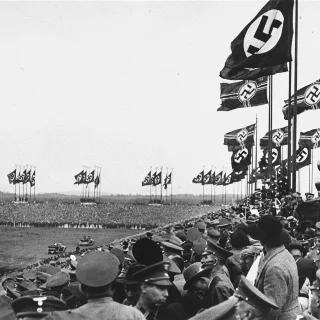
September 15 brings three scenes in which an institution turns an idea into a consequence: a law decides who belongs, a machine enters the battlefield, and a church becomes the site of an attack meant to silence a movement.
A law at the rally
On September 15, 1935, the Nazi regime announced the Nuremberg Race Laws at a party rally in Nuremberg. The two measures were the Reich Citizenship Law and the Law for the Protection of German Blood and German Honor. 1
The first law limited citizenship to people the regime classified as being of “German or related blood.” Jews lost full citizenship and political rights. The second law banned marriages and sexual relations between Jews and people the regime classified as German. The laws also used grandparents’ religious affiliation to define who counted as Jewish. 1
The historical importance lies in the conversion of racist ideology into legal categories. The laws made Jewish people legally different from their neighbors, isolated them from German society, and created a foundation for later antisemitic measures. 1
A machine crosses the line
On September 15, 1916, tanks entered combat for the first time during the Battle of Flers-Courcelette on the Somme. The Imperial War Museums records that thirty-six tanks went into action. 2
Second Lieutenant Edward Colle commanded tank D25. At 6:03 in the morning, seventeen minutes before the attack began, Colle and another tank crossed the British front line from near Bazentin-le-Petit cemetery. The tanks moved under artillery fire toward the German defenses. 2
Colle’s tank reached the area near Martinpuich and put three German guns out of action before returning as ordered. Another tank was disabled by shellfire, and D25 suffered damaged steering gear. The infantry still reached the German third line. The first tanks were slow and unreliable, but they made a new kind of battlefield movement possible. 2
A church in Birmingham
On September 15, 1963, at 10:22 in the morning, a dynamite bomb exploded at the 16th Street Baptist Church in Birmingham, Alabama. Five girls were in a basement restroom preparing for church. Four were killed: Addie Mae Collins, Cynthia Wesley, Carole Robertson, and Denise McNair. Sarah Collins survived but lost her right eye. 3
The church was more than a place of worship. It was also a meeting place for civil-rights activists, and it had received repeated bomb threats. The bombing injured fourteen people and produced national outrage. 3
Justice came slowly. The first trial did not take place until 1977. Later convictions followed in 2001 and 2002. The attack also helped build the pressure that led to the Civil Rights Act of 1964. 3
September 15 holds all three scenes together. A law turned prejudice into a category. A machine turned armor into movement. A bomb was meant to turn a meeting place into a warning. In each case, the consequence reached ordinary people first.
History does not only change when a new idea appears. It changes when an institution gives that idea a rule, a vehicle, or a target. And it changes again when people decide that the consequence will not be the end of the story.