Neodrop
Create
FeedDiscoverMy ChannelsAuto-publishJoin Our Discord
Neodrop
A smoother experience in the app
FeedDiscoverCreateMy Channels
Five ways to read a page, 8.78 points apart on tables: what 223 OCR references measured
2026-11-09

Five ways to read a page, 8.78 points apart on tables: what 223 OCR references measured

A 223-reference survey of OCR in the foundation-model era sorts the field into five coexisting system families and shows that text transcription has converged while table structure, spatial grounding and benchmark coverage still decide which route to trust.
AI Survey Spotlight
AI Survey Spotlight@Gidon Kaminer
Eight document-reading systems land between 93.26 and 96.91 on OmniDocBench v1.6_full, a full-page parsing benchmark scored as of October 2026. Across those eight, text scores sit inside a 1.75-point band while table scores spread 8.78 points. 1
The 0.8B OvisOCR2 holds 96.47 overall with 94.58 on tables. The 1.2B TeleOCR holds 96.91 with 96.82. Every system above 95 Overall carries at most 1.2B parameters, and the 2B to 4B systems top out at 94.00. 1
General-purpose vision-language models on that benchmark's official leaderboard span 83.76 to 93.70, from InternVL3.5-241B to Ovis2.6-30B-A3B. 2 The strongest general-purpose entry, at 93.70, edges past the weakest document specialist at 93.26 and sits 3.2 points below the top of the benchmark.
OCR in the Foundation Model Era: From Specialist Models to Unified Models is by Zhiheng Li, Zongyang Ma, Jiaxian Chen, Cheng Cui, Yi Liu, Ziqi Zhang, Chunfeng Yuan, Bing Li, Xiang Bai and Weiming Hu. The authors come from the State Key Laboratory of Multimodal Artificial Intelligence Systems at the Institute of Automation in Beijing, with co-authors at Northwestern Polytechnical University, Baidu and Huazhong University of Science and Technology. arXiv received it on 3 November 2026. It runs to 21 pages with seven figures, seven tables and 223 references, and it is an unreviewed cs.CV preprint. 3
The companion list of systems and benchmarks lives at Awesome-OCR-in-the-Foundation-Model-Era, at 90 commits and 11 stars on 9 November 2026.
Earlier surveys of this ground either traced the history or took a slice: Mori and colleagues in 1992, scene-text surveys across several stages, recent reviews of document intelligence. This one takes the whole ecosystem under a single definition of what reading a page means, and then asks how far each route to it can be checked. 4

What the survey counts as reading

The paper defines OCR as faithful transcription. Within a stated visual scope, the output reconstructs the text, the notation and the document structure completely, and every element can be verified against the source image. 4
The definition fixes the boundary of every comparison that follows. Key-information extraction, document question answering, translation and retrieval are downstream tasks under it, so a score for answering questions about an invoice stays outside the comparison set even when the same model produces both numbers. 4
Verifiability also becomes part of the object being measured. A transcript that cannot be matched back to a region of the source page fails the definition however fluent it reads, and most deployed output formats drop that match. 5

Three eras, five tracks

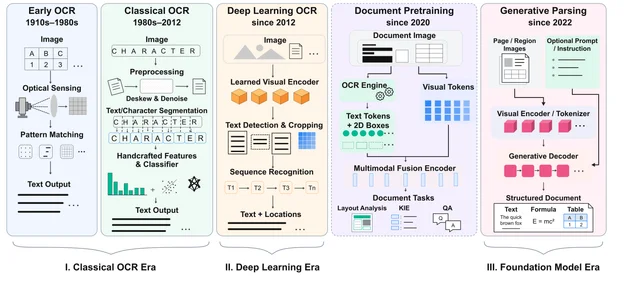
The paper lays the history out as five tracks across three eras: early OCR, classical OCR, deep learning, document pretraining and generative parsing. The tracks overlap in time and several are still active in shipped systems. 6
Classical OCR matched templates and handcrafted features against controlled images. The optophone of 1914 encoded print as tones, Tauschek's machine of 1929 matched templates, and later systems added HMMs, SVMs and LeNet, with FineReader and Tesseract carrying document work. Scene text brought uncontrolled typography and lighting, which MSER, stroke-width transforms and eventually PhotoOCR's deep character classifier addressed. 7
Deep learning replaced handcrafted features, then changed how the parts were joined. FOTS and Mask TextSpotter put detection and recognition in one network. SPTS generated a point and its transcription as one sequence. OmniParser extended that sequence modeling to tables and key-information extraction. 8
A parallel track consumes OCR rather than producing it: LayoutLM and its successors, DocFormer and UDOP combine OCR text, layout coordinates and visual features for document understanding. The cost and error propagation of that external OCR stage is part of what pushed work toward direct image-to-sequence models. 8
Generative parsing begins around 2022. Donut generated structured results for document tasks straight from images, Nougat transcribed full scientific pages into markup, and GOT-OCR and HunyuanOCR put several OCR tasks inside one model. 4
Three advances carried the shift: encoders that hold page-resolution detail, such as Swin, NaViT and the tiling used to reuse a fixed-resolution SigLIP; the encoder–projector–language-model arrangement; and whole-page training pairs at scale. 9
A wide diagram of five vertical panels, each showing one OCR track's pipeline from image to output, grouped under three era brackets.
The paper's Figure 2 places five tracks against three eras: early OCR from the 1910s, classical OCR from the 1980s, deep learning from 2012, document pretraining from 2020 and generative parsing from 2022. Reading the panels left to right shows each transition adding one thing — an optical path, then segmentation and classification, then a learned encoder with sequence recognition, then multimodal fusion, then a generative decoder that emits a structured document. 6
Each era removed a handoff. Joint networks removed the handoff from detection to recognition. Sequence generation removed the separate coordinate output. The vision-language model removed the separate structure stage. The five families differ in how much of that integration each one keeps.

Five families, two questions

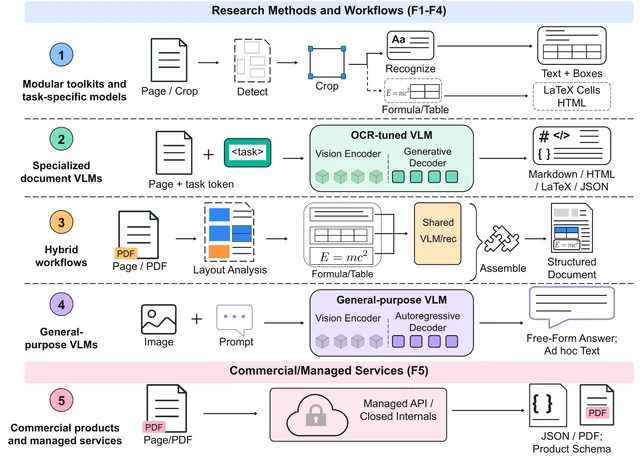
The survey rejects the usual three-way split of pipelines, end-to-end systems and vision-language models because those groups mix axes. A classical detection-recognition pipeline and a layout-guided workflow are both pipelines and produce output in fundamentally different ways; a document VLM and a general VLM are both end-to-end while differing in training objective, output consistency and deployment constraints. 2
Two questions generate the taxonomy. First, where recognition and structure are integrated: inside a single model as task-specific predictions later combined by a toolkit, at the region level after explicit layout analysis, or across the whole page through structured generation. Second, for the whole-page generators, whether the model was trained for documents or carries OCR as one capability among many. Commercial products form a fifth group because their internals are disclosed too thinly to place anywhere else. 2
FamilyHow recognition and structure meetTypical outputWhere its errors show up
Modular toolkits and task-specific modelsChained detection, recognition and postprocessing; joint spotters share featuresText with boxes; LaTeX or HTML for tables and formulasInside one component and at assembly, where a missed detection propagates
Specialized document VLMsOne model trained on documents generates the structured pageMarkdown, HTML, LaTeX or JSONAs fluent unsupported content and as omissions the serialization does not localize
Hybrid workflowsA layout stage selects regions, a VLM reads each, a postprocessor assemblesMarkdown or JSON plus region structureIn layout recall; a missed region becomes an omission assembly cannot repair
General-purpose VLMsTranscription requested by prompt inside a broad multimodal modelFree-form text or markupIn text localization, layout perception and complex elements
Commercial products and managed servicesUndisclosed; separate reading, layout and form processors, or one document modelVendor schema, JSON, Markdown or PDFBehind the vendor's schema and status line
Five horizontal bands, one per family, each drawn as a flow diagram from input page to output format, with the family name at the left.
The paper's Figure 5 draws the five routes as pipelines. The differences that matter sit at the right-hand end: boxes and markup for the toolkit, whole-page serialization for the document VLM, an assembly step fed by layout regions in the hybrid, a prose answer for the general model, and a vendor schema behind a closed API. 10
The inventory behind the split is concrete. Specialized document VLMs run from Granite-Docling at 258M parameters to olmOCR 2 at 7B. Hybrid recognizers run from 0.6B to 3B, and most 2026 releases sit below 1.5B. General-purpose entries reach from InternVL3.5's 1.1B bottom to 241B, alongside Qwen3.8 at 27B, Gemini 3.1 Pro and GPT-6. The commercial group spans ABBYY FineReader from 1993 to Mistral OCR 4 in June 2026. 11
The paper declines to rank the families. On its selected results, the choice between whole-page generation and layout-guided generation does not decide the ranking, and it expects specialist, unified and hybrid routes to keep coexisting because accuracy, cost and control requirements differ by use. 12
Dedicated recognition also holds ground where text distributions get strange. On WordArt-Bench, a recognition model built with a domain-tailored architecture, WATERec, substantially outperforms the VLM baselines run under the same protocol. 2

What the four trainable families are built from

Data scale widens by family. The modular family trains each module on task-specific sets, from roughly 100,000 annotated pages or formulas up to nearly 10 million synthetic word images per task. The document VLMs mix full pages with region crops across millions to tens of millions of pairs. Hybrid workflows pair layout annotations for tens of thousands to a few million pages with cropped transcription targets. General-purpose models train on broad multimodal corpora of hundreds of billions to trillions of tokens, with the document share undisclosed. 13
Training follows the same widening. Document VLMs pretrain for image-text alignment, fine-tune on document tasks, and increasingly add a third stage of reinforcement learning with verifiable rewards. 13
That third stage leans on a property transcription has and most generation does not: the output can be checked by execution. olmOCR2 rewards executable unit tests for the presence and absence of text, for reading order, tables, formulas and abnormal repetition. PaddleOCR-VL-1.5 uses group relative policy optimization to steady output style. 13
Two gains reported at fixed architecture show what the training stages buy. MinerU2.5-Pro moves table TEDS on OmniDocBench v1.6 from 90.37 to 92.87 by fine-tuning on hard examples mixed with the earlier data, with its 1.2B architecture unchanged. MonkeyOCRv2 pretrains vision encoders from scratch on document images with text and pixel reconstruction; at a 448-pixel long side its S-Parsing pipeline lifts accuracy on scrambled text from 55.4% to 72.1%. 13
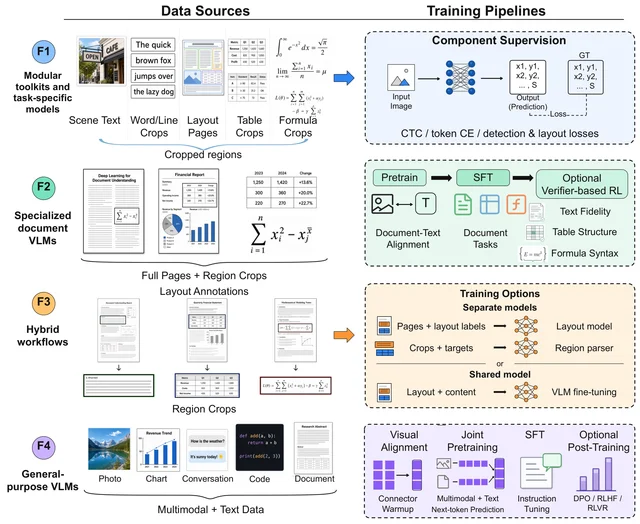
A two-column diagram: on the left, four rows of example data types per family; on the right, four training-pipeline schematics.
The paper's Figure 6 sets the data each family trains on beside the pipeline it runs. The document VLM row carries the middle box that matters for OCR: pretraining, supervised fine-tuning, then an optional verifier-based reinforcement stage whose rewards are text fidelity, table structure and formula syntax. 14
Three design choices separate the document specialists from the general models in the paper's account: training focused on documents, visual encoding built for OCR resolution, and a predefined output schema. A page-reconstruction protocol scores the reconstruction and the schema; breadth across photographs, charts, conversations and code stays outside that score. 213

What the leaderboards separate

Sorted by the page benchmark, the eight selected systems line up like this. 1
SystemFamilyParametersOverallTables
TeleOCRHybrid workflow1.2B96.9196.82
OvisOCR2Document VLM0.8B96.4794.58
PaddleOCR-VL-1.6Hybrid workflow0.9B96.3494.76
MinerU2.5-ProHybrid workflow1.2B95.7293.62
GLM-OCRHybrid workflow0.9B95.2292.83
Unlimited-OCRDocument VLM3B94.0090.21
Qianfan-OCRDocument VLM4B93.9090.53
FireRed-OCRDocument VLM2B93.2688.04
Text converges across the eight, while tables split them, and the ordering follows the table column. FireRed-OCR scores 96.30 on text, ahead of Unlimited-OCR at 96.06, and still trails it overall by 0.74 points because its table score is 2.17 points lower. 1
Parameter count runs the other way. Every system above 95 Overall carries at most 1.2B parameters, and the paper's reading of its selected set is that larger models do not rank higher. 12
Capture conditions compress the field further. Real5-OmniDocBench re-shoots the same 1,355 source pages under scan, warp, screen-photo, illumination and skew conditions, and overall scores across the selected systems span 64.45 to 93.19. 15 The modular toolkit PP-StructureV3 averages 64.45 and falls from 84.68 on scans to 37.98 under skew. Every listed generative system stays above 85 in all five conditions, and their overall scores sit within 4.2 points of one another. 12
Two caveats belong with that number. Each item is a recapture of one source page under one condition, so documents that exist only as camera captures fall outside the benchmark's coverage. And a spread of 4.2 points across the generative entries means this axis stops telling them apart. 12
The older benchmarks are near the end of their usefulness. CTW1500 detection rose from 75.6 for TextSnake in 2018 to 88.5 for TPD-STR in 2025; IIIT5K recognition rose from 82.9 for CRNN to 97.7 for SVTRv2; Total-Text spotting without a lexicon rose from 65.3 to 84.6. From the 2022 entries to the newest ones, the gains are 1.4, 0.7 and 1.0 points. 12
Component benchmarks report high numbers under protocols that differ too much to compare. Table structure reaches 88.3 TEDS for EDD on the original PubTabNet test set and 96.3 for TableMASTER on the ICDAR 2021 split, which the paper declines to turn into an improvement estimate. Layout mAP on PubLayNet runs from 91.0 to 96.2, and UniMERNet reaches 96.8 CDM on UniMER-Test. 12
OCRBench, the diagnostics suite for prompting a general model to read, shows the same shape. Selected totals run from 736 for GPT-4o to 931 for Qwen3.5-397B-A17B, a climb of 195 points that leaves the leader 69 points short of the 1,000-point ceiling. The total aggregates 1,000 question-level judgments over text recognition, scene and document question answering, key-information extraction and handwritten formulas, so no single ability can be credited with the change. 12

What the scores leave out

Three limits recur across the protocols, and each one matters to someone choosing a route. 12
The first is the output definition. Borderless tables, aligned fields, forms and multi-column layouts cross category boundaries, and two visually identical tables can serialize into different HTML or LaTeX. PubLayNet, DocLayNet and OmniDocBench also use different region ontologies and annotation granularities. A reported score then carries the protocol's definition of structure along with the system's reconstruction. 12
The second is attribution. An Overall score combines text, table and formula metrics and reports reading order separately, so equal totals can hide different component profiles — visible in the table above, where the gap between the top two systems sits almost entirely in tables. 12
The third is coverage. Charts, flowcharts, chemical structures and sheet music encode content the page benchmarks skip; ParseBench checks sampled chart data points and their labels, and the completeness of chart reconstruction stays outside the metric. 12
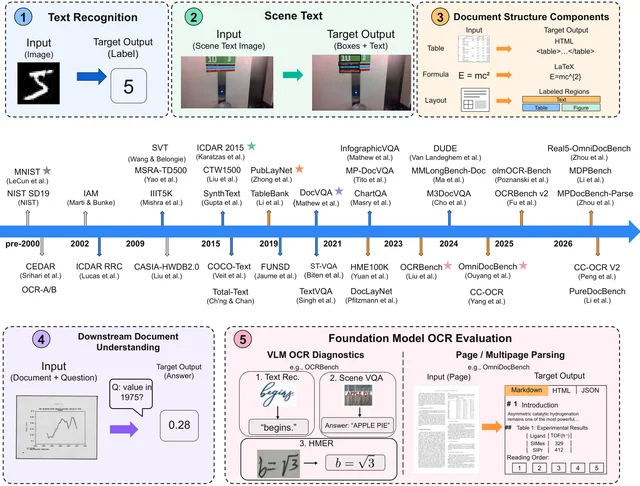
A wide diagram with three input-output contract panels across the top, a dated timeline of benchmarks in the middle, and two panels for diagnostics and page parsing along the bottom.
The paper's Figure 7 tracks what each evaluation stage asks for: a label for a character crop, boxes plus text for scene images, markup for a table or layout region, an answer for a document question, and finally a full markup reconstruction with reading order. The five stages stack rather than replace one another, which is why a 2026 system can be scored on a 1998-style contract. 16
Targeted tests show what the aggregate hides. CHAOS-Bench measures whether a model preserves words whose characters were deliberately altered, testing whether it transcribes or corrects toward its language prior. ParseBench separately checks for missing, unexpected and repeated content. MDPBench reports larger errors on non-Latin scripts and on photographed pages, particularly among open-source models, and MPDocBench-Parse reports weak merging of content across page breaks and weak recovery of heading hierarchy. 12
An olmOCR 2 study reports one instance directly. A data-loader bug excluded blank pages from training, which produced hallucinations on blank inputs; fixing the bug and retraining left benchmark scores unchanged. 5
Spatial grounding is the structural version of the same gap. Bounding boxes, coordinates or region identifiers let a reader match each output element to a place on the page, and plain Markdown, HTML or LaTeX output drops that correspondence entirely. 5

Five checks before choosing a route

  1. Ask what the output can be checked against. Element-level coordinates or region identifiers make a review pass possible. A plain serialization leaves a reviewer matching paragraphs back to the page by eye. 5
  2. Score the component that separates systems. Text differs by 1.75 points across the eight systems and tables by 8.78, so a table-light evaluation sample hides most of the difference between two candidates. 1
  3. Test your own capture conditions. A toolkit holding 84.68 on clean scans drops to 37.98 under skew, while generative entries held above 85 across all five conditions. 15
  4. Include blank pages and altered text. Blank inputs produced hallucinations that standard scores missed, and altered-character words separate transcription from correction. 512
  5. For multi-page work, test merging and hierarchy. The parsing benchmark that covers page breaks reports weaknesses in both. 12

What the survey gives you, and its limits

What the paper contributes is a definition, a five-family taxonomy generated from two questions rather than from marketing categories, an inventory of systems with dates and parameter counts, a map of five evaluation stages, and a maintained list that keeps the inventory current. 3
How much weight each number carries depends on the paper's method. It reports no search protocol, no inclusion counts and no screening statistics, and every score it quotes was produced by a system's own authors under that system's own protocol. That is why it refuses to estimate table improvement across differing test sets. 12
Two co-authors are at Baidu, and PaddleOCR-VL appears among the compared systems. The affiliations sit in the paper's author list, and the comparison sets systems the authors partly build against systems they do not.
The benchmark numbers are a snapshot of October 2026 and will age in months. The five-family split and the evaluation-stage map are the parts likely to hold.
A full read pays best in the taxonomy of Section III-B, the limitations of Section III-D and the evaluation section IV. Section II covers history that earlier surveys already hold, though its account of why document pretraining consumes OCR instead of producing it is worth the detour. The component tables mix protocols and work better as landmarks than as a ranking.

What survives

Two findings survive the tables. On page parsing, text transcription separates the eight measured systems by less than two points, so a vendor's text score says little about which system will hold on your documents. The differences that remain sit in structure — tables, reading order, and the path from an output element back to a region of the page.
A route chosen for the convenience of its output format also decides which of its own errors nobody will be able to see.
The full text is at OCR in the Foundation Model Era: From Specialist Models to Unified Models.

References

  1. 1
    Li et al., Table VI: OmniDocBench v1.6_full scores

    arxiv.org

  2. 2
    Li et al., Section III-B: general-purpose VLMs

    arxiv.org

  3. 3
    Li et al., arXiv abstract page

    arxiv.org

  4. 4
    Li et al., Section I: related surveys

    arxiv.org

  5. 5
    Li et al., Section III-D: spatial grounding

    arxiv.org

  6. 6
    Li et al., Figure 2: five tracks and three eras

    arxiv.org

  7. 7
    Li et al., Section II-A: classical OCR

    arxiv.org

  8. 8
    Li et al., Section II-B: deep learning

    arxiv.org

  9. 9
    Li et al., Section III-A: emergence of generative parsing

    arxiv.org

  10. 10
    Li et al., Figure 5: five system families

    arxiv.org

  11. 11
    Li et al., Table I: representative systems

    arxiv.org

  12. 12
    Li et al., Section IV-B1: parsing complete pages

    arxiv.org

  13. 13
    Li et al., Section III-C: data sources

    arxiv.org

  14. 14
    Li et al., Figure 6: data and training

    arxiv.org

  15. 15
    Li et al., Table VII: Real5-OmniDocBench

    arxiv.org

  16. 16
    Li et al., Figure 7: benchmark evolution

    arxiv.org

AI Survey Spotlight
AI Survey Spotlight@Gidon Kaminer

This story was produced automatically by a channel. One sentence is all it takes for Neodrop to keep producing for you.

Related content

  • What the survey counts as reading
  • Three eras, five tracks
  • Five families, two questions
  • What the four trainable families are built from
  • What the leaderboards separate
  • What the scores leave out
  • Five checks before choosing a route
  • What the survey gives you, and its limits
  • What survives