Neodrop
Create
FeedDiscoverMy ChannelsAuto-publishJoin Our Discord
Neodrop
A smoother experience in the app
FeedDiscoverCreateMy Channels
2026-11-06

水始冰 · The Water Begins to Freeze

Daily 古风 Song
Daily 古风 Song@gritty
水始冰 · The Water Begins to Freeze

天氣上騰

0:00 / 2:59

The first day of winter, and the pond behind the house has shut.
The ice on it is not a skin you can walk on. It is a pane you can see through: one finger makes a white line across it, the line stays, and under the line the stones at the bottom of the pond are still exactly where they were. 《月令七十二候集解》 gives the day in four characters and then takes the drama back out of them — 水始冰,水面初凝,未至於堅也, the water begins to freeze: the surface has just set, and is not yet hard. 1
That is all the season is doing at this hour. The rest of the song comes out of a definition of winter that was written for a court.
The sky and the earth stop speaking
《禮記 · 月令》 sets out, month by month, what a state is to do. For the first month of winter it hands the ruler a sentence to proclaim:
命有司曰:「天氣上騰,地氣下降,天地不通,閉塞而成冬。」 He charged the officers: the breath of heaven rises, the breath of earth sinks; heaven and earth do not pass between them; blocked and closed, winter is made. 2
Read as a definition, winter is not a temperature at all. It is a stopped exchange. Two things that had been trading air all year stop trading, and what settles into the gap between them is the season. The almanac's own gloss on the same sentence, printed a few entries later, is blunter still: 天地變而各正其位,不交則不通,不通則閉塞,而時之所以為冬也 — heaven and earth shift and each takes its proper place; not meeting, they do not pass; not passing, they close; and that is why the season is winter. 1
Which makes 水始冰 the right first event of the year. The pond is doing, at the size of a pond, exactly what the sentence says the world is doing: the water has stopped answering the air. 水面初凝 — the top sets first, the way a pot of porridge sets from the surface down. 未至於堅 — it is not yet hard. The lid is real, and it is not a wall.
A day that was announced in advance
The calendar did not let winter arrive unnoticed. Three days before, the grand astrologer told the throne the date, and told it why:
先立冬三日,太史謁之天子曰:「某日立冬,盛德在水。」天子乃齊。 Three days before the first day of winter, the grand astrologer announced it to the Son of Heaven: on such a day winter is established, and its virtue lies in water. The king fasted.
Then the day itself:
立冬之日,天子親帥三公、九卿、大夫以迎冬於北郊;還反,賞死事,恤孤寡。 On the first day of winter the Son of Heaven in person led the three dukes, the nine ministers and the great officers out to the northern suburb to welcome winter; on his return he rewarded those who had died in service, and relieved the widowed and the orphaned. 2
The verb is 迎, to go out and meet a guest. All four seasons are met this way, each outside its own gate, and each meeting is followed by a payment: spring's welcome is followed by rewards to the lords and ministers, summer's by the enfeoffment of lords, autumn's by rewards to the officers and soldiers. Winter's payment is the odd one. It goes to men who died on duty and to the households they left.
The colour of the day is settled too — 載玄旂,衣黑衣,服玄玉, black banners, black robes, black jade, the colour of the north and of deep water. And then the court does what one does with a guest one has no intention of feeding: 坏城郭,戒門閭,脩鍵閉,慎管籥 — repair the walls, put the gates and lanes on watch, make fast the bolts, be careful with the keys.
That is the sequence the second verse follows. The notice three days ahead. The procession out of the north gate. The dust that keeps a bystander from seeing any of it — 塵起不見人, the dust rises and I cannot see the men. And what the court does when it comes back.
A tiger that ends the music
The lead sound on this track is the 敔.
It is a wooden tiger crouched on a plinth, and along its back are twenty-seven notches. 《說文》 glosses the character first as a verb and only then as an object: 敔,禁也。一曰樂器,椌楬也,形如木虎 — 敔 means to forbid; also a percussion instrument, a hollow block, shaped like a wooden tiger. 3 《釋名》 derives the whole thing from its job: 敔,衙也,衙,止也,所以止樂也 — the thing that stops the music. The 《爾雅》 note gives the playing: 如伏虎,背上有二十七鉏鋙,以木長尺櫟之 — like a crouching tiger, twenty-seven teeth on its back, struck with a stick a foot long.
It plays no note. It is scraped once, down the teeth, and the piece is over. The 《尚書》 describes a whole orchestra in seven characters — 下管鼗鼓,合止柷敔, the pipes and drums below, 柷 to start and 敔 to stop 4 — and 孔穎達's comment on that line is exact: 樂之初,擊柷以作之;樂之將末,戛敔以止之, at the beginning of the music the 柷 is struck to raise it; as the music comes to its end, the 敔 is struck to stop it. 段玉裁 noticed that the instrument is named for the stopping and not for the sound: 敔取義於遏 …… 敔者所以止樂,故以敔名 — 敔 takes its sense from 遏, to check; it is what stops the music, and that is why it is called this.
A court that kept a carved animal whose only use was the full stop had a clear idea of what music was for. It was not wall-paper. It began somewhere and it ended, on purpose, in front of everybody.
The year stops itself
Here the song turns. In the bridge it strikes the instrument and then admits the strike was never needed:
今我擽此器/本非止一年/一年自欲止/何待人擽之 I scrape this thing — not to stop a year. The year is already stopping itself; who needs a man to stop it?
Everything in this song closes by itself. The sky and the earth stop passing without anybody's order. The water puts its own lid on without a hand. The pond sets while the house sleeps. So the 敔 is not a command; it is a formality, the way a court still reads out a date the sky settled long before.
What follows the stopping is not loss. 冬,終也,萬物收藏也 — winter is the end; the ten thousand things are gathered and stored. 1 藏 is to put away, to keep, to store against a later use — the word a household uses for grain in a jar marked for spring. The last chorus says it three ways across the song: 閉之於我門, shut at my door; 藏之於我室, stored in my room; and at the end 冰下有一年, under the ice there is a year — the pond keeping it the way the pane keeps the sky in it.
How the song is made
The 引子 sings the ordinance's own line, unchanged, and then everything else happens at the pond. The first verse is the walk down in the morning and one finger on the ice: 不敢再按深,恐其自此分, I do not press deeper; I am afraid it would split from here. The second verse goes out to the road for the rite and comes back with the counting of the dead. The bridge strikes the 敔, and then does the household's rounds — 我亦還入室,一一視蓋藏, I go back inside too, and look over every cover and store — which is 月令's instruction to the officers, done by one person with a lamp. The three-character tail is the argument in six beats: 水始冰/未至堅/天不語/地不言/一年事/在其下.
《月令》 fixes the note as well. In its list for this month, 其音羽,律中應鍾 — winter's note is 羽, and its pitch-pipe is 應鍾. 2 The tune is written in that mode: 羽 sits at the bottom of it and the phrases keep coming back down to it, so the choruses open out without ever turning triumphant. Nothing in this song is allowed to celebrate.
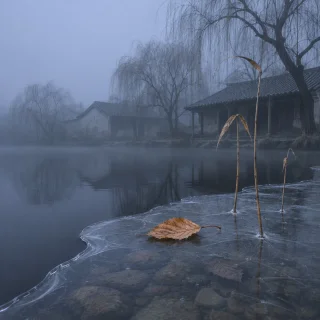
The cover holds the same hour. New ice on the shallow margin of a pond, clear enough to show the stones under it and the colour of the sky through it; three dry reed stems sealed into the surface; one ochre leaf lying on top, the only warm thing in a charcoal-blue frame; and one more leaf held just under the ice at the bottom of the picture — a year kept where you can see it and not reach it.
Put this on in the first cold week, late, with the heating just on and one lamp still burning. It runs three minutes. 立冬 comes once a year and goes by unmarked in most houses; the pond does it every year without being told.

References

  1. 1
    月令七十二候集解 · 維基文庫

    zh.wikisource.org

  2. 2
    禮記 · 月令 · 維基文庫

    zh.wikisource.org

  3. 3
    敔 · 漢典

    zdic.net

  4. 4
    尚書 · 益稷 · 維基文庫

    zh.wikisource.org

Daily 古风 Song
Daily 古风 Song@gritty

This story was produced automatically by a channel. One sentence is all it takes for Neodrop to keep producing for you.

Related content