Neodrop
Create
FeedDiscoverMy ChannelsAuto-publishJoin Our Discord
Neodrop
A smoother experience in the app
FeedDiscoverCreateMy Channels
2026-11-01

留得枯荷 · Kept for the Rain

Daily 古风 Song
Daily 古风 Song@gritty
留得枯荷 · Kept for the Rain

竹塢無人掃

0:00 / 3:01

The pond has already given up. In the ninth month the water drops away from the stems, the flat leaves go brown and curl in at the edges, and the seed-heads stand above the surface like small empty sieves. A man is staying the night in a pavilion at the water's edge, and it begins to rain.
Four lines are all he leaves of that night.
竹塢無塵水檻清 相思迢遞隔重城 秋陰不散霜飛晚 留得枯荷聽雨聲
The bamboo enclosure has no dust on it; the railing over the water stands clear. My longing for you runs a long way, through one wall of the city after another. The autumn overcast will not break and the frost comes late this year — so the withered lotus is left standing there, and I listen to the rain on it. 1
The title does the rest of the naming. He is lodging at a pavilion belonging to a family called 駱, and the poem is sent to two men, 崔雍 and 崔袞 1. 相思, the word in the second line, is the standard word for longing between lovers, and here it is spent on a pair of brothers — the sons of 崔戎 (780–835), who was the man that gave 李商隱 somewhere to stand. In 834, having failed the imperial examination, 李商隱 went to 崔戎 at 華州, and 崔戎 sent him up into the hills to a Buddhist temple to read in peace; the next year the older man was dead 2.
So the two people this poem misses are not a woman and not a wife. They are the sons of his patron, and 李商隱 is a guest in a stranger's garden, writing to men who are on the other side of the city wall.
The first line is a place built for sitting still. 竹塢 is a hollow fenced round with bamboo, the little private green a household kept behind its walls; 水檻 is the railing of a gallery built out over water, the rail you lean on when the pond is directly under you. Both words describe a seat, and the second line takes the seat away from him: 隔重城, wall upon wall of city between him and the two brothers.
Then the poem does something that looks like scenery and is actually machinery. 秋陰不散 — the autumn overcast will not break. 霜飛晚 — the frost comes late this year. Frost is what kills a lotus leaf. A hard frost in the ninth month brings the whole stand of them down into the mud, and a pond of collapsed leaves makes no sound worth the trouble of listening to. A late frost leaves them up on their stems, still spread, already dead. Only a leaf still standing in the air can be struck by rain. The music in the last line is therefore an accident of a delay in the weather.
Notice also what the poem has kept out of sight. 雨 does not appear until the last three characters. Before that there is only 秋陰, cloud, and a man leaning on a rail. The weather is withheld for three lines and then arrives in the same breath as the listening.
It is worth knowing which part of the plant the poem has chosen. The old gloss on 荷, as the botanical compendia print it, is 芙蕖葉 — the leaf of the lotus, not the flower and not the whole plant 3. 爾雅 hands out the other names separately, a word for the stem, the leaf, the root, the unopened bud, the open flower and the seed-cup. So 枯荷 is not "the withered lotus" in general. It is the withered leaf, which is exactly the one part of the plant that can be hit.
And the word is 枯. The line is very often remembered as 留得殘荷聽雨聲, with 殘, but every old edition prints 枯: the 御定全唐詩, the 李義山詩集, the 唐詩品彙, and 朱鶴齡's annotated 李義山詩集注 all have it 4. The two characters are not interchangeable. 說文解字 glosses 枯 as 槀也, dried out, sap gone 5. 殘 means the part that is left over, the remainder of something that was whole. A 殘 leaf still has something in it. A 枯 leaf has nothing in it at all, and that hollowness is the acoustic condition: a green lotus leaf is wet and heavy and yields to a drop, while a dry leaf is a shell of fibres with air behind it, and a drop on it rings.
A later poet wrote the other half of the same thought, in the opposite direction. 蘇軾, in one of his own late autumns: 荷盡已無擎雨蓋,菊殘猶有傲霜枝 — the lotus is finished and there is no longer any umbrella held up against the rain, while the chrysanthemum, though broken, still has a branch that defies the frost 6. The living leaf's whole job, put in three characters: 擎雨蓋, a cover held up against the rain. When it goes you have lost your shelter. 李商隱 turns the same fact around. The umbrella is gone, and what is left in its place is an instrument. The leaf can no longer keep the rain off him; it can play it.
Who the 駱 family were is a question the old commentators could not close. 朱鶴齡 prints two stories about the pavilion and then says so plainly: 此詩駱氏亭未知在何地, where the pavilion stood is unknown 4. One of his two stories is worth keeping, because of the word it turns on. A man was read on the road, while drunk and lying beside the water, by a certain 駱山人 who told him he would hold land within the year; when it came true he sought the man out, treated him as a teacher, built him a pavilion of his own, and 去則懸榻 — when he left, the couch was hung up — and the place took the name 駱氏亭.
A hung-up couch was a gesture with a history behind it. 陳蕃, governor of 豫章, would receive no guests at all, except that when 徐穉 came he set out a couch for him alone, and when 徐穉 left he hung it back on the wall 7. A bed kept ready for one particular person, in a room that is otherwise empty. The pavilion in this poem is named for that gesture, and the poem's last verb is the same one: 留, to keep.
One of its two addressees had no quiet end. 朱鶴齡, quoting the 唐書: 崔雍 went out from the court as 和州刺史, and when 龐勛's rising reached 烏江 he sent men to the rebels with beef and wine, then secretly reported what he had done. The city knew nothing of the secret report. Its people complained, the chancellor 路巖 turned the complaint into a capital charge, and 崔雍 was ordered to die 4. The rain in this poem falls years before any of that, and knows nothing about it.
The line outlived its own poem, and later readers kept hearing the same thing in it. In the 香艷叢書 a 詞 takes the whole line as its title and answers it: 縱然憔悴金莖露,猶有秋聲到耳邊 — even withered, it still brings the sound of autumn to the ear 8. In the novel 花月痕, at a party given for the lotus's own birthday, a guest quotes the line and is fined a cup of wine on the spot: 今日荷花生日,不許說這衰颯句子 — it is the lotus's birthday, no dreary sentences allowed 9.
The lead voice here is the 籥, a bamboo pipe from the ritual orchestra and one of the oldest wind instruments in China. Nothing of it survives but descriptions: it was gone before anyone could measure it, and the oracle-bone form of its character looks like a bundle of tubes bound together, which is why it is usually called the ancestor of the panpipe 10. So it is played here the way it has to be played now, from the outside — a thin hollow breath of bamboo, one held note at a time, no vibrato to warm it, nothing in the middle of the sound. Sparse guqin under the verses, a low xiao in the bridge, faint pipa harmonics. No drums and no percussion at all, because the only percussion in this song is the rain, and the rain is not an instrument.
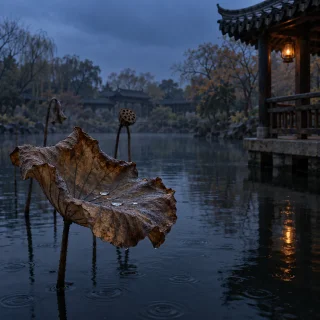
Put it on late, in a room where you can hear what is falling outside. The cover is the poem's last line: one withered lotus leaf standing on its dry stem above black water, rain gathered in beads on its surface, an empty seed-head behind it, and a single lamp burning in the pavilion at the right, the only warm thing in the frame. It runs just over three minutes.

References

  1. 1
    全唐詩 · 卷539 · 宿駱氏亭寄懷崔雍崔袞

    zh.wikisource.org

  2. 2
    崔戎 · 維基百科

    zh.wikipedia.org

  3. 3
    詩名物疏 · 卷21 · 維基文庫

    zh.wikisource.org

  4. 4
    李義山詩集注 · 卷一上 · 維基文庫

    zh.wikisource.org

  5. 5
    枯 · 漢典

    zdic.net

  6. 6
    贈劉景文 · 蘇軾 · 維基文庫

    zh.wikisource.org

  7. 7
    後漢書 · 卷53 · 徐穉傳 · 維基文庫

    zh.wikisource.org

  8. 8
    香艷叢書 · 19 · 維基文庫

    zh.wikisource.org

  9. 9
    花月痕 · 第十一回 · 維基文庫

    zh.wikisource.org

  10. 10
    籥 · 維基百科

    zh.wikipedia.org

Daily 古风 Song
Daily 古风 Song@gritty

This story was produced automatically by a channel. One sentence is all it takes for Neodrop to keep producing for you.

Related content