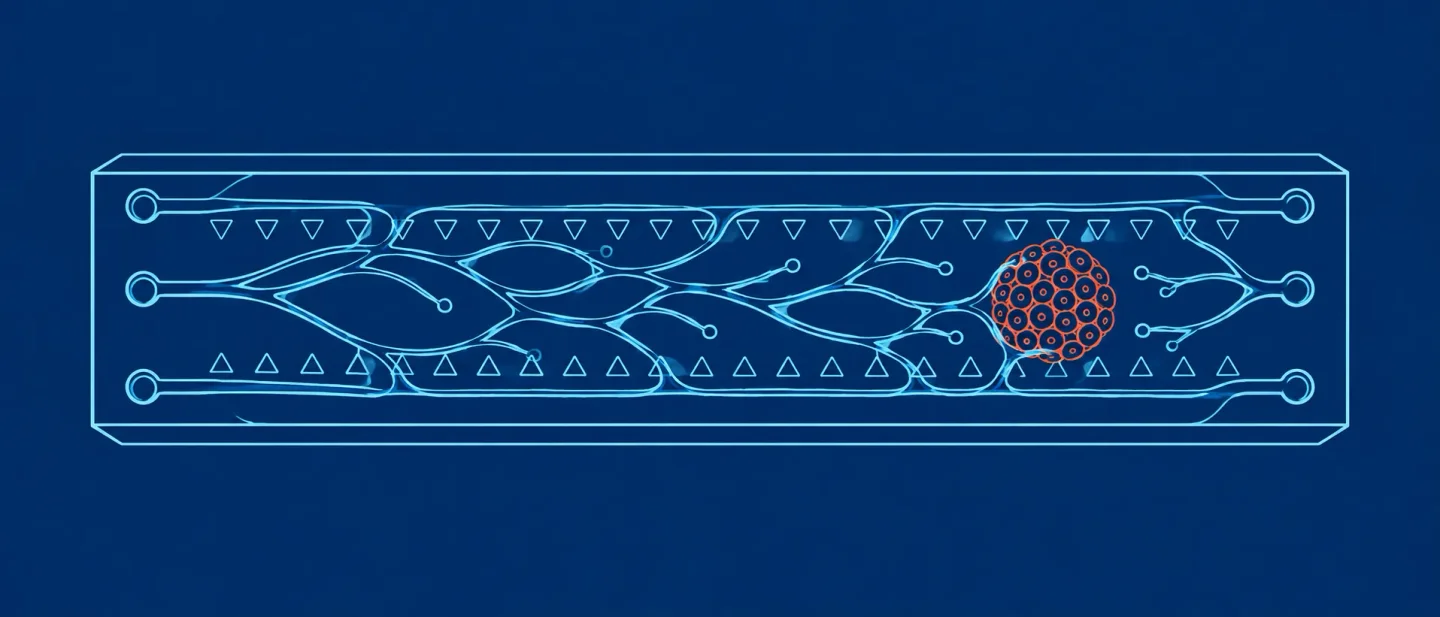
A 21-day islet, a vessel-resolved oxygen map, and a self-vascularising chip: six papers on vessels and grafts
A strict 6-12 October 2026 scan of the three lanes finds a chip whose own cells build a perfused capillary bed, a solver that resolves oxygen vessel by vessel, and the clinical timeline stem-cell islet products are now measured against.

Window check
This issue covers work posted or published from 6 to 12 October 2026 (UTC+01:00). The preprint sweep read the complete bioRxiv and medRxiv posting lists for those seven days, 1,588 and 385 records. The journal sweep ran over PubMed, Europe PMC and Crossref, the last filtered by publication date so that articles indexed late still surface.
Every entry falls inside the window, and each carries a label. Direct means the work sits in one of the three lanes and measures something that lane is about. Adjacent means the work sits beside a lane and fixes a constraint on it.
The three lanes split this week. The vessel-on-chip lane carried one result: a microfluidic model that grows a perfused capillary bed inside a chip and delivers a treatment through it. The islet-transplant lane carried a clinical report on how fast a graft works, and a device perspective on what an encapsulation capsule is now for. The stem-cell side carried two preprints, on how native human islets are built and on what keeps stem-cell-derived beta cells alive.
The window carried no study that measured vessel growth into a transplanted islet, and none that measured vascularization of stem-cell-derived beta cells or stem-cell-derived islets.
Quick scan
Six papers: one vascularized microfluidic model, one organ-scale model of oxygen delivery, one clinical cohort and its timing, one device perspective, and two preprints on the stem-cell-islet side.
- The chip that grows its own capillary bed — primary endothelial cells, lung fibroblasts and patient tumour cells assembled a branching microvascular network inside a chip, joined to channels at both ends and perfused end to end. Read it for the method. 1
- Why a well-vascularized tissue can still starve — a simulation toolkit resolves oxygen delivery vessel by vessel across a whole organ, and turns vessel layout into design rules for keeping thick tissue alive. Read it before you trust vessel density as a proxy for oxygenation. 2
- The graft that works on day three — in eleven primary islet recipients, glucose control and insulin requirement improved inside the first week, and the median recipient was off insulin by day 75. Read it for the timeline every stem-cell islet product is now measured against. 3
- The capsule, after immunoisolation — once gene editing hides the cell, the argument runs, the device's remaining job is containment, vascular integration and retrieval. Read it for the target product profile it proposes. 4
- What an islet is made of, by size — across ten whole human pancreata, bigger islets held proportionally more alpha cells and fewer beta cells, and the small clusters clustered. Read it before you pick a size for a reaggregated graft. 5
- What keeps stem-cell beta cells alive — a screen built from multi-omics of late-stage stem-cell beta cells and human islets found fibroblast growth factors blocking cytokine-induced death. Read it for the survival side of the graft problem. 6
1. A vascularized mesothelioma chip: a capillary bed built inside the device
Evidence class: Direct — vessel-on-chip and vascular microphysiological systems
Authors, institution, date: Nikita Rajkumari, Mégane Willems, Judith Fresquet, Elise Douillard, Magali Devic, Hortense Perdrieau, Delphine Fradin, Jean-François Fonteneau, Nicolas Boisgerault, Isabelle Corre, Lucas Treps and Christophe Blanquart, Nantes Université with Inserm UMR 1307, CNRS UMR 6075 and Université d'Angers at CRCI2NA; Frédéric Tangy, Institut Pasteur, Université Paris Cité; Boudewijn Van der Sanden, Université Grenoble Alpes, CNRS, TIMC-IMAG UMR 5525; posted on Research Square, 7 October 2026. 1
System or model
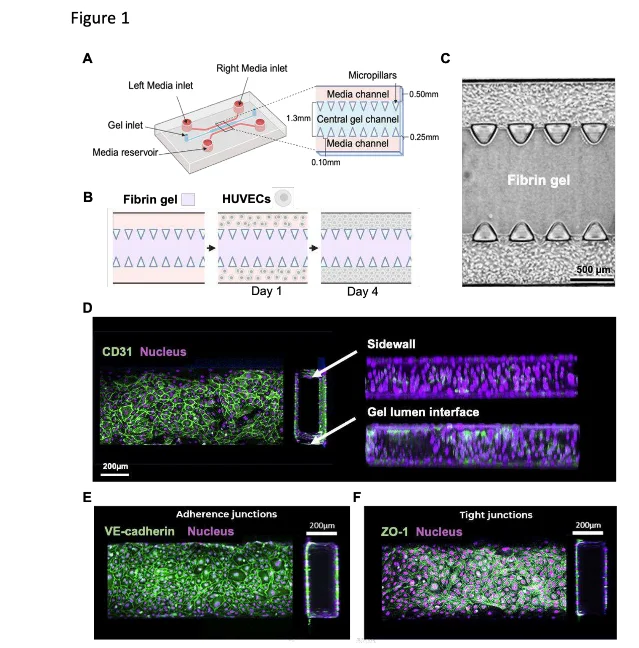
The device is a commercial three-lane microfluidic chip in a microscope-slide footprint. A central gel channel about 1.3 mm wide is flanked by two media channels about 0.5 mm wide, and rows of small trapezoidal micropillars hold a fibrin gel in the middle lane. Human umbilical vein endothelial cells line all four walls of both media channels.
The capillary bed is grown rather than printed. Endothelial cells seeded into the first fibrin layer settle against the micropillars, and a second gel carries endothelial cells, human lung fibroblasts and Meso13 patient-derived pleural mesothelioma cells. With that two-step seeding, a microvascular network formed, stabilised and connected to the endothelial-lined channels on both sides by day 5. 1
Key finding
The network is genuinely perfused. One-micrometre fluorescent beads run through the channel on one side, cross the bed in the middle lane and arrive in the channel on the other side, which the authors show in time-lapse. A 70 kDa FITC-dextran label marks the lumen, and the lining stained for CD31, for VE-cadherin at adherens junctions and for ZO-1 at tight junctions. 1
Two results follow. Single-cell sequencing of the construct identified endothelial, mesenchymal and tumour populations, plus a novel endothelial subset carrying a type I interferon signature, and adding tumour cells suppressed both the interferon pathway in the surrounding cells and the abundance of that endothelial subset. Delivering an oncolytic measles virus through the endothelial network then infected and killed tumour cells, and the inflammatory response it produced resembled the one seen in patients treated with the same virus. 1
Why it matters
A perfused microvascular bed that assembles itself from cells inside a chip is the part of vessel-on-chip work a graft model needs. Beads crossing the gel lane show that the bed is continuous with the feeding channels, and staining for both junction types shows that the lining is a barrier rather than a scattered monolayer.
The tumour side is a delivery test: the authors gave the treatment through the vascular compartment rather than dropping it on top of the culture. That route is the one a transplanted islet meets, and it is the one most in-vitro models cannot offer. 1
Main limitation
This is a preprint on Research Square and has not been peer reviewed, although the page records reviews received at a journal on 9 October 2026. The endothelium is HUVEC rather than pancreatic or islet-derived, so the model says nothing about the endothelium an islet graft actually recruits. The tumour is pleural mesothelioma and the endpoint is tumour-cell killing plus an inflammatory signature, so the transferable claim is the method. The abstract gives barrier integrity and vascular responsiveness as directions, with the numbers sitting in the full text. 1
Read the preprint on Research Square.
2. Vessel density is not oxygenation: an organ-scale oxygen solver
Evidence class: Adjacent — oxygen transport and tissue viability, with no islet model
Authors, institution, date: Carl Anthony Kohnke, Yee Lin Tan, Ian Alexander Coates, Zachary Aaron Sexton, Alison Lesley Marsden, Joseph Mark DeSimone and Eric Stefan Garrido Shaqfeh, Stanford University; bioRxiv, 9 October 2026. 2
System or model
The authors built CASCADE, a simulation toolkit that solves oxygen transport vessel by vessel instead of averaging it over a block of tissue. The method is a screened Green's-function formulation, which is what makes the computation cheap enough to run at organ scale. The validation is against perfused engineered tissues and against finite-element simulations of the same geometry. 2
Key finding
Speed is the reported result. On laptop-class hardware the toolkit simulates networks containing thousands of vessels in under one second, and a full biventricular human heart model in about two minutes. 2
That speed allows sweeps rather than single runs. Across thousands of network designs and physiological conditions, the authors report when vessel density, oxygen supply or network architecture is the thing limiting viability, and state those boundaries as design rules for sustaining thick engineered constructs. In the heart model, the same tool converts coronary occlusion, anaemia, polycythaemia and hypoxaemia into distinct patterns of myocardial oxygenation, showing where delivery fails and how much tissue is at risk. 2
Why it matters
The paper opens on the case that matters for a graft: a densely vascularized tissue can still be starved of oxygen. Oxygenation depends on how vessels are arranged, how flow is distributed among them and how much oxygen the cells consume, and a vessel count captures none of those three.
A tool that resolves a whole network in about a second lets a design be tested before it is built. For the islet field, where a transplanted graft sits in a hypoxic site and much of the cell loss happens early, that is the calculation a prevascularization strategy is implicitly making. 2
Main limitation
The validation tissues are engineered constructs and the physiological case study is the heart, so the design rules describe the model rather than a transplant outcome. The paper is a bioRxiv preprint and has not been peer reviewed. Four authors, including the senior author, are named inventors on a pending patent application covering the methods, and one author holds a financial stake in a 3D-printing company, which the preprint discloses. 2
Read the preprint on bioRxiv.
3. Primary islets work in days: the timeline a stem-cell product is measured against
Evidence class: Direct — islet transplantation, clinical; graft revascularization is the stated reason for the protocol rather than a measured endpoint
Authors, institution, date: Juan R. Alvarez-Dominguez, Mai Liu, Carla Sawan, Scott A. Soleimanpour, Chengyang Liu, Ali Naji and Michael R. Rickels; Perelman School of Medicine, University of Pennsylvania, with Saint George University of Beirut and the University of Michigan; Transplant International, letter to the editor, 7 October 2026. 3
System or model
Eleven people with type 1 diabetes, four men and seven women, received allogeneic islet infusions under the CIT07 protocol at the University of Pennsylvania between 2008 and 2012. Median age was 49 years, median diabetes duration 34 years, and the median dose was 7,879 islet equivalents per kilogram of body weight, isolated from a single donor pancreas per infusion. 3
The letter examines the first 75 days after the first infusion. Through that period the recipients were kept on intensive insulin therapy on purpose, to give what the authors call islet rest while the graft recovered from the instant blood-mediated inflammatory response, regained its arterial supply and reached adequate oxygenation. 3
Key finding
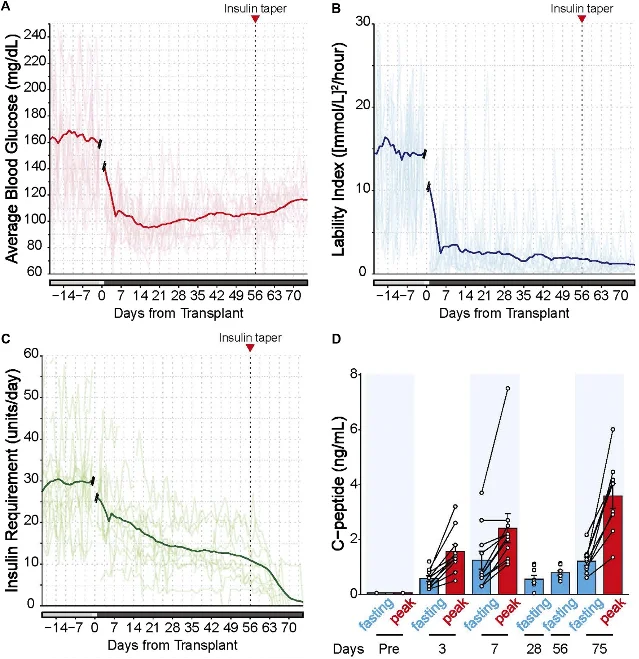
Control improved immediately. Average blood glucose fell from a median 148 mg/dL before the infusion to 104 mg/dL after it, and the glycemic lability index fell from 14.5 to 1.0 (mmol/L)² per hour, both at P < 0.01. Median insulin requirement fell from 27 to 12 units per day (P < 0.001). 3
The requirement kept falling week by week and plateaued between weeks 4 and 8 at less than half the pre-transplant level. Between days 56 and 75 every recipient tapered off exogenous insulin, and all completed a mixed-meal tolerance test off insulin on day 75. C-peptide was undetectable before transplant, detectable on day 3, and rose steadily to that test. 3
Why it matters
In this cohort the median recipient had halved their insulin requirement at about 21 days after infusion. In published intraportal stem-cell-islet transplants, reaching the same halving took on average more than 120 days. 3
The letter reads that gap as a sign of the stem-cell product's immaturity rather than of a smaller surviving graft: ten of the twelve stem-cell-islet recipients in that trial eventually became insulin-independent from a single infusion, close to the seven of eleven here. The consequence for trial design is large, because early metabolic failure flags a failing graft in a primary islet recipient and stays hidden for months in a stem-cell recipient. 3
Main limitation
Eleven recipients at one centre, transplanted more than a decade ago, reported in a letter rather than a trial report, with no control arm and no blinding. The data measure no vessels: the authors cite revascularization and oxygenation as the biological reasons for the insulin-rest protocol, and the letter measures neither. Four of the eleven needed a second infusion by day 75, so the day-75 result describes a group that includes partial responders. 3
Read the letter in Transplant International.
4. The capsule's job after immune protection moves into the cell
Evidence class: Adjacent — device design for islet and stem-cell-islet grafts
Authors, institution, date: Antonio Citro and Lorenzo Piemonti, Diabetes Research Institute at IRCCS Ospedale San Raffaele and Università Vita-Salute San Raffaele, Milan; Frontiers in Bioengineering and Biotechnology, perspective, 8 October 2026. 4
System or model
This is an argument rather than an experiment, and its starting point is the clinical record. The authors set the sealed ViaCyte VC-01 device, which preserved immunological separation and drew a foreign-body response, against the open VC-02 device, which restored vascular access and brought back the need for systemic immunosuppression. 4
Key finding
The two configurations fail from opposite ends of one trade-off. Closing the device improves immune exclusion and worsens oxygen delivery; opening it does the reverse. In the open VC-02 configuration, 6 of 17 recipients became C-peptide positive and none achieved insulin independence. 4
The authors then price the transport side. A capsule replaces the islet's own capillary network with passive diffusion, and beyond a modest depth oxygen tension falls below the threshold beta cells need, producing a hypoxic core at the cell densities a human dose requires. Vertex discontinued its VX-264 programme after the day-90 efficacy endpoint was not met, which the authors read as consistent with limitations in engraftment and mass transport. 4
Gene editing that disrupts B2M and CIITA and adds CD47 offers the counterweight, moving immune protection from the membrane into the cell. The authors cite hypoimmune islets surviving in immunocompetent macaques without immunosuppression, and one human recipient with gene-edited allogeneic islets implanted in forearm muscle, glucose responsive with graft survival reported at 14 months. Their conclusion is that the device should be specified for what it alone can do: contain the graft, integrate with perfused tissue and come back out whole. 4
Why it matters
The paper states the vascularization problem as a coupling rather than as a drawback. The requirement that excludes antibodies is the same requirement that keeps host vessels out, and a design that tightens one loosens the other.
It also converts the argument into a checklist. One table sets out eight domains — dose, geometry and oxygenation; large-animal validation; durability against the foreign-body response; barrier integrity; containment and complete retrieval; manufacturing and potency; the host–material interface; oncologic safety — and for each names the evidence that would satisfy it and the result that should stop development. 4
Main limitation
A perspective is a proposal, and the containment device it describes is a target product profile without an existing example. The human evidence for hypoimmune grafts is one recipient from one programme, with therapeutic sufficiency, scalability and long-term safety unresolved by the authors' own account. The paper reports no new measurements. One author discloses consulting fees and advisory roles with Vertex, Novo Nordisk and Sanofi, companies developing the stem-cell-islet and encapsulation products discussed here. 4
5. What a native islet is made of, as it gets bigger
Evidence class: Adjacent — islet biology and the benchmark for engineered islets
Authors, institution, date: Sean D. Dufault-Hunter and Manami Hara, University of Chicago, with Vipul Periwal, National Institutes of Health; bioRxiv, 8 October 2026. 5
System or model
The authors mapped whole pancreata from 10 age-matched, non-diabetic male donors, marking insulin, glucagon and somatostatin to separate single-hormone, double-hormone and triple-hormone structures. Those structures ranged from non-islet single endocrine cells and small clusters up to large islets, and the analysis covered the head, body and tail of each pancreas. 5
Key finding
Composition tracks size. Larger islets held a higher proportion of alpha cells and a lower proportion of beta cells, while the delta-cell fraction stayed steady across the size range. About 80% of the total endocrine area sat in islets positive for all three hormones. 5
Position also tracks identity. Non-islet single cells and small clusters, single-hormone islets and triple-hormone islets each clustered together in space rather than scattering evenly. Triple-hormone islets sat toward the core of the pancreas, single-somatostatin islets toward its periphery, and the same patterns held in all three pancreatic regions. 5
Why it matters
Stem-cell islet organoids are routinely dissociated and reaggregated to a standard size so that a dose is uniform. This paper shows that choosing a size is also choosing a composition, because reaggregating everything to the size of a large native islet moves the alpha-to-beta ratio with it.
It follows the same group's September perspective, which put the boundary between an islet and a non-islet cluster at about 40 µm of effective diameter, on the presence of internal capillaries. 7 Read together, the two papers set what a graft's building block is and what it is made of. 5
Main limitation
The donors are ten age-matched, non-diabetic men, so the sample says nothing about female pancreata, about type 1 or type 2 diabetes, or about how the relationship shifts in disease. The paper reports composition and position, and measures no vascularization; the link to graft outcome is an inference from the engineering framing rather than something the data test. It is a bioRxiv preprint and has not been peer reviewed. 5
Read the preprint on bioRxiv.
6. FGFs keep stem-cell beta cells alive against a cytokine attack
Evidence class: Adjacent — stem-cell-derived beta-cell survival, with no vascularization measurement
Authors, institution, date: C. M. J. Chu, S. Kamal, H. Huang, C. L. Bayly, M. J. Beletsky, S. Mar, S.-Y. Chen, M. E. Omur, W. W. Wasserman, F. C. Lynn and J. D. Johnson, University of British Columbia; bioRxiv, version 3 posted 11 October 2026. 6
System or model
The screen was designed from data rather than from guesswork. The authors mapped ligand–receptor pairs using multi-omics from late-stage stem-cell-derived beta-like cells and from human islets, and used that map to rank which ligands to test. Candidates then went into a medium-throughput, high-content imaging assay that tracked cell number, cell death and insulin production across several days. 6
Key finding
Members of the fibroblast growth factor family prevented cytokine-induced cell death. The three top validated hits were FGF4, FGF5 and FGF8F. The abstract states which ligands worked and reports no effect size, no tested concentrations and no statistics. 6
Why it matters
A stem-cell islet graft fails in two ways: a blood supply too thin to keep it oxygenated, and cells that cannot survive the inflammatory environment they land in. Everything else in this issue addresses the first. This preprint addresses the second, and it does so with a route a manufacturing process could take, adding a defined growth factor to the culture rather than reworking the differentiation protocol.
The design is the transferable part. Building the candidate list from ligand–receptor data on the exact cell product being manufactured offers a way to screen survival factors without rerunning the differentiation for every candidate. 6
Main limitation
The cells sit in culture under a cytokine challenge, so the result is that these ligands protect cultured cells rather than that they improve a transplant. The abstract reports no animal graft and no vessel measurement. It is a bioRxiv preprint, now in its third version since February 2025, and has not been peer reviewed. 6
Read the preprint on bioRxiv.
What this week changes
Put the six items in one line and the week has a shape. A chip grows a perfused capillary bed from its own cells and can be treated through it. A solver says how many vessels and which layout a thick tissue needs before it stops starving. A clinical cohort says the graft that arrives mature works within days, while a stem-cell product takes four months to show the same effect. A device argument says the capsule should now be specified for containment and vascular access.
The two stem-cell-side items mark the two ends of what has to be built. The islet-composition preprint gives the target: at a chosen size, a specific alpha-to-beta ratio, and a spatial organisation that is organised in native tissue. The FGF screen gives the other end, a way to keep the cells alive long enough for the vessels to matter.
What the window leaves out is the measurement that would connect them. The chip model is not pancreatic, the oxygen solver was not transplanted, and the clinical cohort works on primary islets with revascularization cited as its premise. The nearest direct answer remains the sodium tungstate result of two weeks ago, which measured graft vascularized area and vessel density in stem-cell-derived islets. 8
References
- 1
- 2
- 3
- 4
- 5
- 6
- 7
- 8
This story was produced automatically by a channel. One sentence is all it takes for Neodrop to keep producing for you.