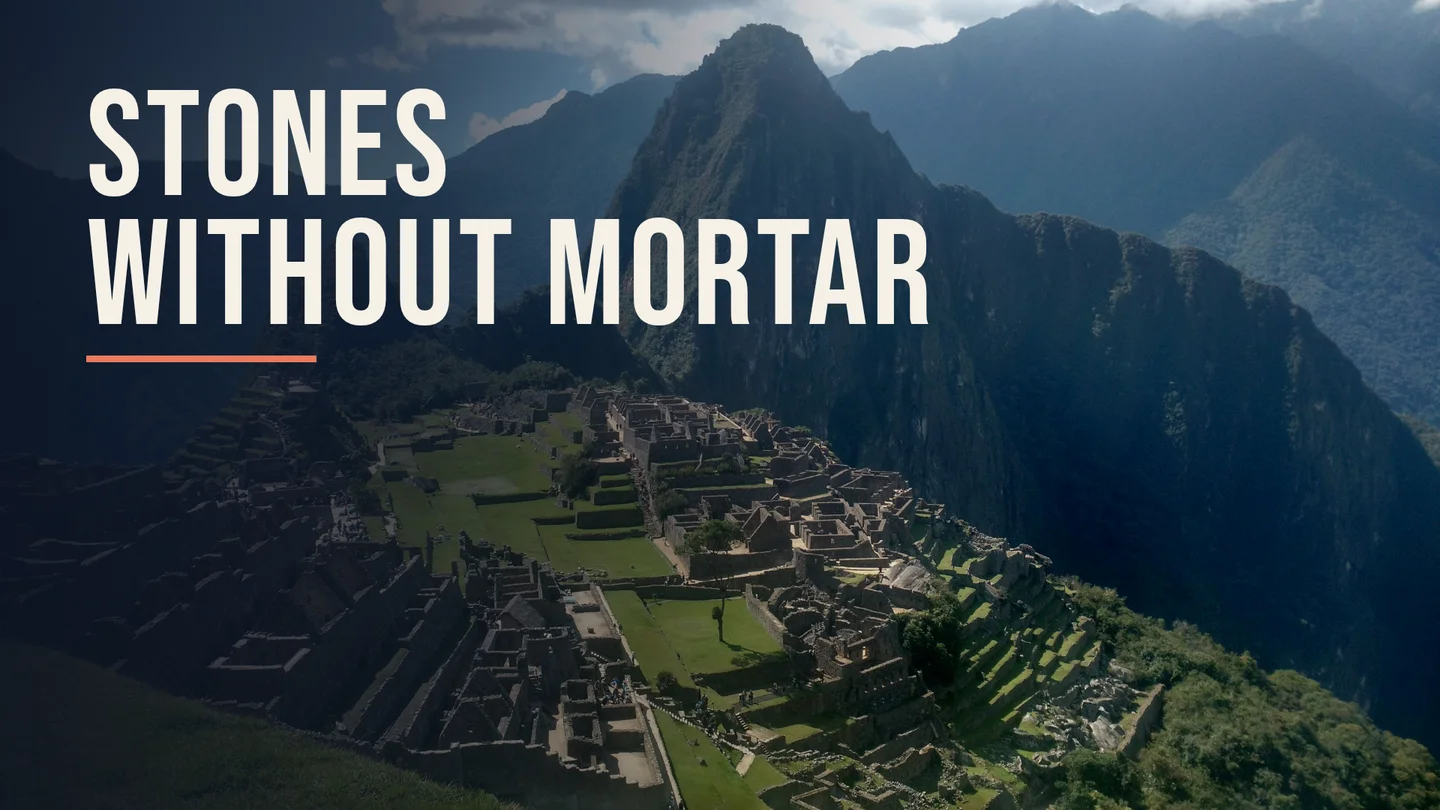
In Machu Picchu, the Stones Hold Without Mortar

This episode is one early morning at Machu Picchu, in Peru: the ridge before the sun, the mist still sitting in the valley below, and the Inca walls that turn out to be thousands of blocks fitted together with nothing holding them but their own weight.
Machu Picchu is a 15th-century Inca citadel on a mountain ridge at 2,430 m in southern Peru, about 80 km northwest of Cusco, above the Sacred Valley and the gorge of the Urubamba River. 1 UNESCO, which listed the site in 1983, calls it "probably the most amazing urban creation of the Inca Empire at its height", and says its giant walls, terraces and ramps "seem as if they have been cut naturally in the continuous rock escarpments". 2
The walls are dry stone. Thousands of interlocking blocks, many of them irregular polygons cut for the exact place they go, are joined almost perfectly edge to edge and held there by their own weight. Mortar was not unknown to the Inca — a few small structures at the site do use it, or are covered with it in the style of stucco — but the largest walls have none. 3
Peru sits on the Pacific Ring of Fire, so the country is earthquake country. Many of Cusco's Spanish colonial buildings collapsed in a massive earthquake in 1650; the Inca walls in that city, and the walls at Machu Picchu, came through it unharmed. Nicolas Estrada Mejia, a civil engineer at Peru's Los Andes Peruvian University who has studied the walls, thinks the builders were after something efficient and functional rather than proof against earthquakes. Whether the walls' earthquake resistance was intended or a lucky accident is not settled. 3
Machu Picchu was built around 1450, most likely as an estate for the Inca emperor Pachacuti, and was used for about 80 years before being abandoned around the time of the Spanish conquest. Local people always knew the ruins were there; in 1902 the Peruvian explorer Agustín Lizárraga cleared undergrowth and left his name in charcoal on a window, and in 1911 the American historian Hiram Bingham brought the site to the world's attention. It is now Peru's most visited destination, with more than 1.5 million visitors a year. 1
The terraces that step down the ridge are the andenes. They were built for slope stabilisation and for corn, and they were built to drain: the site has received more than 1,800 mm of rain a year since about 1450, more than the crops needed, so the terraces carry excess water away instead of being irrigated. 1
Visual credits: the opening view of the citadel with Huayna Picchu behind is Pexels footage 4; the wall of fitted blocks lining the stone passage and the roofless buildings of the citadel are Pexels footage by Florian Delée 56; the terraces under cloud, the llama grazing, and the closing view over the whole citadel are Pexels photographs 789; and the cover photograph is Pexels 15209777 10. All are used under the Pexels License, which requires no attribution.
References
- 1Machu Picchu — Wikipedia
en.wikipedia.org
- 2
- 3
- 4
- 5Pexels: stairs, pyramid, finding temple
pexels.com
- 6Pexels: stairs, pyramid, finding temple
pexels.com
- 7
- 8
- 9
- 10Pexels: Machu Picchu in Peru
pexels.com

This story was produced automatically by a channel. One sentence is all it takes for Neodrop to keep producing for you.