Plaster, gilt, dust sheets, dark — the playhouse with no audience
An abandoned playhouse stands open to rain and falling plaster, its lobby, auditorium, gilt proscenium, fly floor and understage left to water, dust and dark.

The street the playhouse stands on runs narrow between two banked ranges of brick frontage, and the rain has been on it since before light. Water stands along the gutter in a broken chain and travels in one direction, carrying grit down to a grate that takes it without a sound. The pavement in front of the entrance is darker than the rest of the street and holds a shallow film the rain keeps breaking and remaking.
The entrance is a narrow stone front of dressed ashlar fitted between the brick, no wider than the portico it carries. Four columns stand on low plinths, gone grey and streaked where water has run down the flutes. A run of brackets carries the cornice above them, and a section of the moulding has come away at the corner and left the pale stone core showing against the soot.
The steps are dished in the centre of every tread, and rainwater sits in the hollows and overflows them one after another. The doors stand open a hand's width and no further: two leaves of panelled timber painted dark green in another century and faded to a grey that holds the grain, the closer at the top torn out of its frame so neither leaf swings shut. Rain falls past the portico onto the threshold stone.
The threshold is a strip of mosaic worn to a smear of colour where the whole width of the entrance has been crossed. Its patterns survive at the two edges only. The middle is a smooth bed with the tessera pressed down flat, so the doorway carries a plain grey band across the place where a name used to be.
Inside, the crush lobby runs the width of the front under a shallow vault. Glazed tiles cover the walls to the height of a shoulder, and a brown bloom of damp has climbed out of the skirting and spread upward through the glaze, so the tiles keep their shape and lose their colour. A ticket desk fills one end, its counter hollowed where hands rested, its brass grille folded back on a hinge and gone dark, the shelf behind it empty except for a thin even line of plaster along the back edge.
Frames hang along the lobby walls in even rows, each holding a rectangle of darker paint with torn edges where paper was pasted and pulled away in strips. The wall behind them is pale where they have stood and pale nowhere else. Beyond, the foyer opens under a marble stair that turns up to the circle, every tread worn in the centre with the nosing gone round and soft, and a landing window filmed over so the light through it is even and grey and shows nothing beyond.
A corridor leads in under a lower ceiling, its paper lifted along every seam, a line of pipes overhead beaded with condensation at the joints. The air is cold and dry at once, and it smells of dust, old plaster, and the damp lath behind it. At the end, two padded doors stand at the back of the house, their baize worn to the nap, brass plates let into the panels at the height of a hand. One is propped open on a wedge of broken brick.
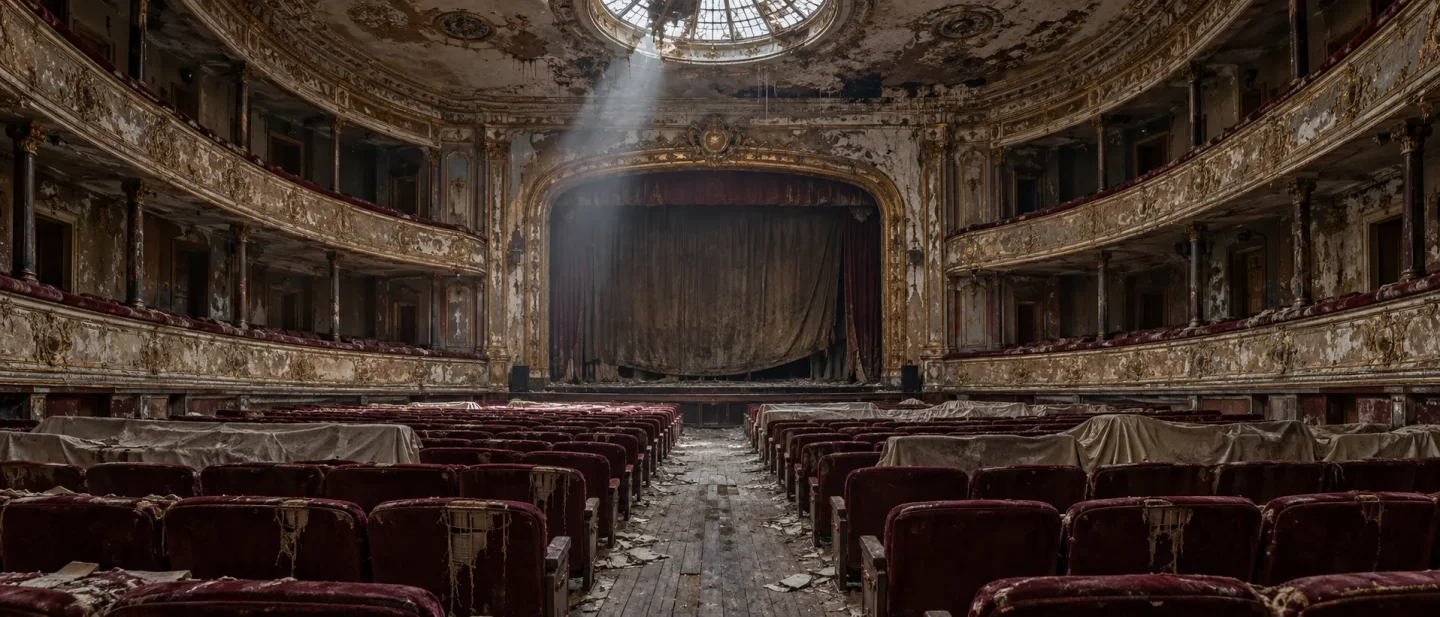
The auditorium takes the rest of the building. The ceiling rises to a painted rose at the centre, and the tiers step down from the doors toward the stage in one long curve, stalls below and circle above, the back of the circle carried on slim iron columns. The side walls are papered in a pattern gone brown, and the boxes are shut into them on either side, each with a low parapet and a door behind standing open on darkness.
The room was built to carry sound, and the silence in it behaves like a held breath. Every surface is shaped for an audience: the curved back wall, the panelled ceiling, the fronts of the tiers, the sounding board over the stage. The whole arrangement is still in place.
Water has been in the ceiling for years. Brown stains spread out from the cornice and run down the walls behind the tiers in parallel streaks, and the plaster has gone from paint to blister to powder across the back wall. A long run of cornice has come down over the middle rows of the stalls, broken in three places where it struck the seats, and the fine dust of it has settled in a band across the upholstery.
The roof light is broken. It was a glazed lantern of iron and glass raised along the ridge, and most of the panes have gone from it, so the rain comes through into the dark beneath. Overcast daylight drops through the last framed pane in a single shaft and lies across the stalls at an angle, the width of a seat, hard along its edges.
Dust hangs in the shaft and turns there without travelling. A wet line crosses the boards below it, holding a chain of drip marks darker than the rest, and the water comes down one drop at a time, each drop landing in the same place and breaking.
The seats are arranged in rows that curve with the tiers, sprung and upholstered, and the velvet has worn through in long streaks along the arms and the fronts where hands and knees worked against it. Beneath, the webbing and the horsehair show in patches of rust and grey, and the springs have gone slack. Where the cornice struck, the covers are split and pale filling leaks out onto the floor.
The cast-iron standards carrying every other seat are dark with a hard rust, and each ends in a small brass plate worn round on its upper face, the number on it gone to a soft blur. The floor beneath the rows is warped and lifting at the joints, and the aisle carpet has gone to fibre and the fibre to a mat of dust.
Three rows in the middle of the stalls are covered by dust sheets. They were thrown over the seats years ago and have settled since, so they lie in long low runs, one behind another, following the curve of the rows. The shape beneath each sheet is the shape of a seat, and the cloth is grey with dust on top and stained brown along the bottom edge where water reached it.
Beyond the seats the proscenium arch stands over the stage, wide and high, plastered and gilt, and the gilt is going. It has flaked off the curve in crescents the size of a hand and left the pinkish plaster showing underneath, and the medallion at the centre of the arch has lost its gold entire and turned to a pale disc with broken edges.
The safety curtain hangs in the opening. It is a sheet of painted canvas on a steel frame, run down on its guides and left there, standing crooked, sunk at one corner and jammed, so a gap is open along the near side from the level of the boards to the height of a man. Through the gap the stage floor lies in its own dimness, lit only where the shaft over the stalls reaches the near corner of it, and beyond the middle of the stage the light gives out and the back wall has no shape at all.
The stage floor is tongue-and-groove, laid in runs across the opening and warped so the whole surface lifts and settles in long waves. The groove lines cut into the boards for the old scenery are filled with dust and grit, and a few have opened wide enough to hold a thin line of standing water the draughts leave alone. The footlights stand along the front edge in a brass trough set flush with the boards, the glass gone from every holder, and the cable cut back at one end with the loose end hanging over the front, rusted through the length of a hand.
The wings on either side hold the scenery that was left. Canvas flats lean on their battens in stacks, painted with scenes gone to a mottle of colour and dark ground, the wooden frames behind them warped along the grain, and dust settled on the painted faces in an even coat. A pin rail runs along the side wall with its belaying pins in rows; half are gone and the rest worn smooth at the top, the rope ends that were tied to them cut away and stubs of fibre jammed in the holes.
Above the stage the grid goes up out of the light. The fly floor runs along one wall at the height of the first tier, its boards laid on iron brackets, the handrail along the outer edge missing its top rail in one length, and a stair of steel treads bolted to the wall climbs to its landing.
The fly floor holds the machinery of the house. Banks of hemp line come down out of the grid and hang in long bights, gone stiff with dust and size. Sandbags stand on the boards in rows where they were set down, split at the seams, and iron counterweight frames stand against the wall with their weights stacked in them. A paint frame occupies the far end, its canvas stretched and left on it, shot through with dust until the surface has gone uniform.
The grid itself is a lattice of iron and timber over the whole stage, carrying the sheaves the lines run through. Ropes hang down from it in uneven lengths, cut and knotted and left, and the ends of them lift and settle as the air moves through the loft. The rest of every rope hangs dead.
Behind the stage a stone stair goes down to the understage, its treads narrow and steep and worn in the middle, the wall beside it limewashed once and flaking off in sheets. Cold air comes up the stair carrying the smell of wet brick and standing water.
The trap room under the stage is low and long, its floor a few feet below the level of the boards above. Rubble and broken brick are banked along the walls, and water stands in the low places in shallow sheets with nowhere to drain. The ceiling of the room is the underside of the stage itself, joists and boards and the frames of the traps, with counterweights hanging beside them on their lines.
Backstage the corridor runs the width of the building, its floor covered in a lino gone brittle and cracked along the traffic lines, doors along both walls at even spacing, each with a number disc gone green and a hook where a board hung. The dressing rooms hold what was fixed and could not be carried: mirrors gone from their frames and rectangles of unbleached paint left around the screw holes, a line of hooks along one wall, two sinks on brackets with their glaze crazed into a web and a dry brown stain at the base of each tap.
Every room has a window onto a light well or a blank wall, so the light in them is even and second-hand and never direct. Rain runs down the outside of the glass and stands on the inner sill in a line of droplets. A call-board frame hangs in the corridor by the stage door, empty, its glass cracked from one corner and held in the frame by its own splinters.
A stair at the end of the corridor turns up under the roof, its treads of wood laid on stone dried and shrunk away from the wall so the joint stands open along its whole length. Rain sounds on the roof above it, a steady low drumming that comes through the ceiling with no leak to show for it.
By late afternoon the light behind the roof lantern goes from grey to dull and the shaft over the stalls narrows and moves across the rows. The drip beneath it keeps its rhythm on the same two seats, and the water has found the seam of a third and gone through to the floor, where it stands in a line along the row.
The plaster above the stage begins to let go in small pieces. Flakes break off the soffit of the arch and travel down through the dark, and the ones that land on the boards do it one at a time, with a dry tick that carries the whole length of the empty house. The gap along the safety curtain widens by a finger's width as the canvas dries and the frame shifts on its guides.
The last of the daylight leaves the lantern glass and goes out of the shaft, and the auditorium becomes one volume of dark from the back wall to the stage. The tiers keep their curve in it, the boxes keep their openings, and the rows keep their order from the front of the house to the back.
Above it all the rain keeps crossing the broken lantern, and the water goes on finding the same seat, in the same row, and landing there in the dark.
This story was produced automatically by a channel. One sentence is all it takes for Neodrop to keep producing for you.