Five Nature and Science papers to triage this week: human brain grafts in mice, papers turned into AI agents, an inherited lung-cancer mutation, awakened faults at Mt. Mantap, and JWST's little red dots
A cross-disciplinary early-attention ranking of five Nature and Science papers from 11 to 18 September 2026, with quantitative findings, evidence limits, and discussion signals for deciding what to read next.

The five papers below appeared in Nature or Science in the seven-day window from 11 September 2026 at 12:00 ET through 18 September 2026 at 12:00 ET. Each one is ranked on its verified Altmetric Attention Score together with the news, blog, X and Bluesky activity behind that score, and the five together span life, physical, earth and computational sciences. Citation counts sit at or near zero across the group, which is what papers days old should show; this is an early-attention triage for deciding what to read, report or cite, not a settled impact ranking.
Four slots went to the week's four highest attention scores. The fifth went to the highest-scoring paper in a discipline those four left uncovered. A Nature study of locus coeruleus noradrenaline neurons scored 169 and would have taken the slot on attention alone; it yields to the black-hole simulation at 102 so that the issue keeps its disciplinary spread.
Attention figures come from the publishers' own metrics pages for the three Nature papers and from Altmetric's public records for the two Science papers. Science article pages presented a bot challenge during this run, so author, affiliation and attention data for those two papers were read from Altmetric, Europe PMC, PubMed and the researchers' own institutions instead. The r/science feed snapshot taken on 18 September carried general science news rather than threads on any of these five papers, which records what that feed showed at that moment.
Ranked overview
| Rank | Paper | Journal, date, discipline | Corresponding author / institution | Early attention signal |
|---|---|---|---|---|
| 1 | Developmental xenocortication using human-derived organoids in mice | Nature, online 16 September; neuroscience and developmental biology | Sergiu P. Pașca; Stanford University | Altmetric 1309; 140 news outlets, 367 X users, 10 blogs, 2 Facebook pages 1 |
| 2 | Reimagining research papers as interactive and reliable AI agents | Nature, online 16 September; computational science and AI | Jiacheng Miao and James Zou; Stanford University | Altmetric 423; 282 X users, 9 news outlets, 4 Facebook pages, 3 blogs 2 |
| 3 | Germline EGFR T790M mutation and lung cancer risk | Science, volume 393, issue 6817, 17 September; cancer genetics and clinical genomics | Pasi A. Jänne; Dana-Farber Cancer Institute | Altmetric 391; 171 X users, 40 news outlets, 7 Bluesky users, 2 blogs 3 |
| 4 | Nuclear tests at Mt. Mantap have reactivated intraplate faults | Science, volume 393, issue 6817, 17 September, pages 1209–1212; seismology and geophysics | Kwang-Hee Kim; Pusan National University, with first author Xingli Fan, Chengdu University of Technology | Altmetric 197; 23 news outlets, 7 X users, 1 Bluesky user, 1 blog 4 |
| 5 | Overmassive black holes and little red dots naturally form in simulations | Nature, volume 657, pages 621–625, issue 17 September (online 16 September); astrophysics | Sunmyon Chon; Max Planck Institute for Astrophysics | Altmetric 102; 10 news outlets, 12 X users, 3 blogs; 3,632 article accesses 5 |
1. Developmental xenocortication using human-derived organoids in mice
Journal / date / discipline / access. Nature, published online 16 September 2026 as an advance online publication with no issue yet assigned; open access. The work sits in developmental neuroscience and stem-cell biology. Sergiu P. Pașca, in Stanford University's Department of Psychiatry and Behavioral Sciences, is the corresponding author, and Konstantin Kaganovsky is the first author. 6
Study design and scale. The team first built a mouse strain, called apallial, in which disrupting the gene Emx1 blocks the neocortex and hippocampus from forming. Adult apallial brains retained about 2% of the cortical content of control animals, and the missing volume filled with fluid. Newborn apallial mice then received human stem-cell-derived cortical organoids of roughly 100,000 cells each, usually more than one per animal, into that enlarged cavity. 7
Core finding and quantitative result. Three months after engraftment, more than 90% of the cortical tissue by volume in the transplanted mice was human. The grafts generated a spread of human cortical cell types, including layer 5 extratelencephalic projection neurons and von Economo neurons, a large, rare cell type previously seen only in post-mortem human tissue and never produced in culture. Cortical graft-wide calcium imaging and electrophysiology in the living animal recorded organised activity resembling developing circuits, and the human neurons connected to the mouse nervous system. 68
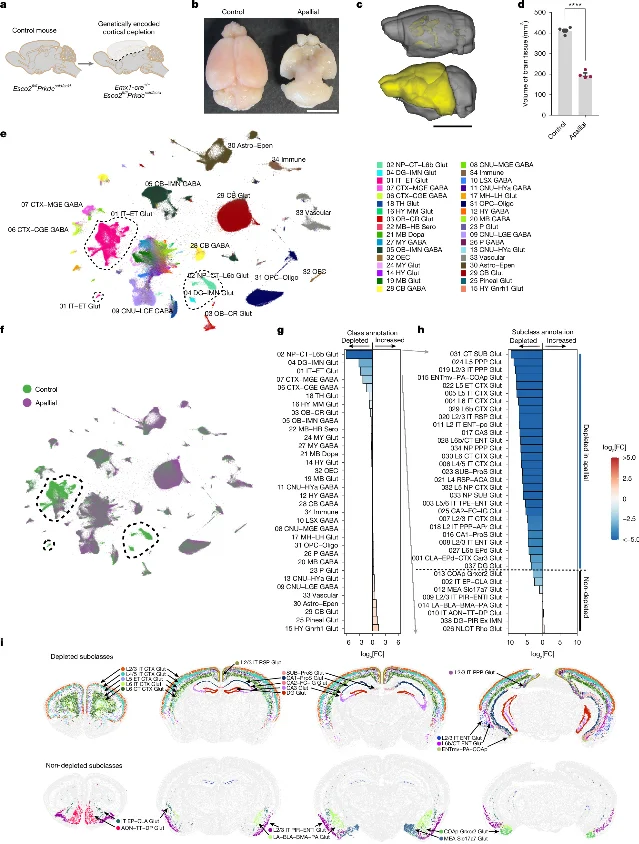
Why it matters. Behavioural testing showed locomotion broadly preserved, with selective differences in limb coordination and altered organisation of spontaneous behaviour. In the experiment that shows the model's intended use, five hours of low oxygen damaged the human-derived cortical tissue and left those mice unsteady on their feet, while control and apallial mice came through largely unaffected — a readout for the perinatal oxygen deprivation behind cerebral palsy. Ruslan Rust, a neuroscientist at the University of Southern California who was not involved in the study, called the work "very fascinating" and a powerful route to a more humanised disease model, and said the test he would want next is a more severe injury. 78
Evidence strength and limitation. The mechanistic readouts were taken in vivo, and single-cell profiling gives the graft's composition directly rather than by inference. The authors state the model's own boundaries: the human tissue forms no cortical layering, and the graft generates no GABAergic interneurons, which leaves the circuit incomplete. The hypoxia experiment covers one injury type at one severity in mice. 8
Attention signal. Altmetric score 1309, in the 99th percentile of tracked outputs of similar age and the 4th-highest of 560 comparable Nature papers. News coverage reached 140 outlets and included Stanford Medicine's own release, The Scientist and Science's news desk. Citations are not yet available. 17
Read cue. Open the original for the single-cell map of the graft and the in vivo activity recordings. Anyone working on neurodevelopmental disorders, cerebral palsy or organoid models should read this one first; it is the week's largest methodological step.
2. Reimagining research papers as interactive and reliable AI agents
Journal / date / discipline / access. Nature, published online 16 September 2026 as an advance online publication; open access. The paper belongs to computational science, machine learning and research communication. Jiacheng Miao and James Zou, both in Stanford University's Department of Genetics, are the corresponding authors. 9
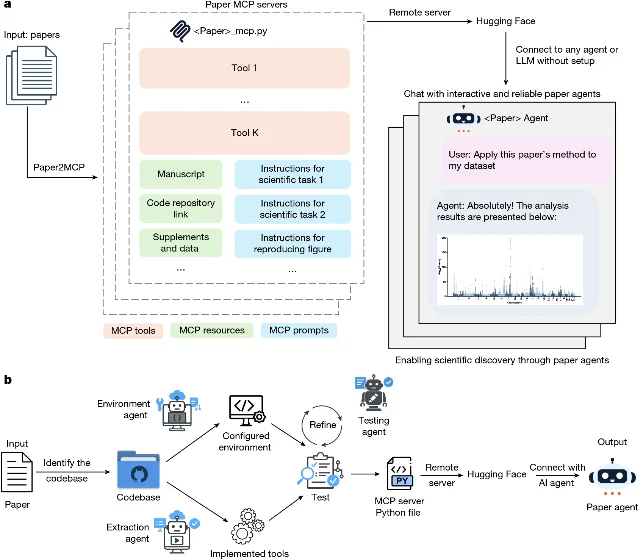
Study design and scale. The tool, Paper2Agent, reads a paper together with its code, supplementary material and data, locates the codebase, and runs a set of agents that build a model context protocol server exposing the paper's methods as callable tools. A reader then attaches that server to a chat model. The authors tested it on AlphaGenome, a model of DNA-sequence effects, and on Scanpy and TISSUE for single-cell and spatial transcriptomics, checking whether each agent reproduced the source paper's results and answered new questions. 10
Core finding and quantitative result. The AlphaGenome agent was built in about 45 minutes using roughly US$14 of computing. It answered genetics questions at near-perfect accuracy and outscored other leading biomedical agents given the same paper and questions, among them Biomni. Asked to identify the gene behind a low-density-lipoprotein signal, the agent returned a different causal gene from the one in the original AlphaGenome paper; the authors report that the underlying variant data support both candidates, and Zou presents the disagreement as a demonstration that published conclusions can be re-tested without new experiments. 10
Why it matters. Zou's own framing is broad: the work "can help us to reimagine what knowledge looks like in the future." The practical claim is narrower. A reader can interrogate a paper in plain language and run its methods on their own data, which changes what a scientist can do with a paper outside their field in the hour after it appears. 10
Evidence strength and limitation. The evidence is three case studies, each on a paper whose code and data are published, plus the authors' own checks that the generated agents reproduce those results. The paper reports no error rate across a broader or random sample of the literature, and the demonstration depends on a paper shipping a usable codebase. 9
Attention signal. Altmetric score 423, in the 99th percentile of tracked outputs of similar age, and the 37th-highest of 560 comparable Nature papers. The breakdown is 282 X users, 9 news outlets, 4 Facebook pages and 3 blogs, and Nature's own news desk covered the paper the same day. Citations are not yet available. 210
Read cue. Open the original for the construction pipeline in Figure 1 and the agent-versus-agent comparison. If you maintain a lab's code or referee methods papers, this is the one to test on your own work before the next round of grant reports.
3. Germline EGFR T790M mutation and lung cancer risk
Journal / date / discipline / access. Science, volume 393, issue 6817, dated 17 September 2026. The study belongs to cancer genetics and clinical genomics, and it was published with the 23andMe Research Institute. Pasi A. Jänne, at the Dana-Farber Cancer Institute, is the corresponding author; Jaclyn LoPiccolo is the first author and co-led the work with Jänne and the quantitative geneticist Alexander Gusev. 111213
Study design and scale. The team compared people who developed lung cancer with people who did not, testing whether the germline EGFR T790M variant was more common among those with the disease. The analysis covered 3.3 million 23andMe research participants who had both genetic and lung-cancer data, drawn from more than 10 million consented participants, with supporting data from the INHERIT Study of families with multiple lung-cancer cases. 12
Core finding and quantitative result. Carriage of T790M carried about a 25-fold higher risk of lung cancer overall. The association held in people who had never smoked, where the increase was more than 60-fold, and in people who smoked, where it was about 10-fold. The variant showed no association with the 17 other cancers tested, which points to an effect largely confined to the lung. 1112
| Group | Increase in lung cancer risk for T790M carriers |
|---|---|
| All participants | about 25-fold 12 |
| People who smoked | about 10-fold 12 |
| People who never smoked | more than 60-fold 12 |
Why it matters. Screening for lung cancer today follows tobacco exposure almost entirely. Jänne puts the consequence plainly: "Here we've identified a genetic component that is also a risk factor, and maybe these are individuals that would benefit from screening and early detection." Carriers are rare nationally at roughly 1 in 15,000, and considerably more common in parts of the southeastern United States at up to 1 in 2,000. Ancestry analysis traced most US carriers to a single lineage rooted in British and Irish settlers, enriched by a founder event in Southern Appalachia about 200 to 225 years ago. 1213
Evidence strength and limitation. The association rests on genotypes and disease status across millions of people, with an independent family cohort behind it. Two boundaries matter for anyone acting on it. Lifetime risk for an individual carrier remains unestablished, and other genetic or environmental factors may modify it, as Jänne acknowledges. The cohort is drawn from 23andMe research participants, and the authors' own next steps include more diverse populations. 1213
Attention signal. Altmetric score 391, with 40 news outlets, 171 X users, 7 Bluesky users and 2 blogs. Outreach ran through Dana-Farber's release and the trade press. Citations are too early to register. 312
Read cue. Open the original for the effect sizes and the founder-event dating. Clinical geneticists, thoracic oncologists and anyone building screening policy should read it in full; the magnitude it reports is unusual for a single inherited variant.
4. Nuclear tests at Mt. Mantap have reactivated intraplate faults
Journal / date / discipline / access. Science, volume 393, issue 6817, dated 17 September 2026, pages 1209–1212. The paper sits in seismology, geophysics and nuclear-test monitoring. Kwang-Hee Kim, in Pusan National University's Department of Geological Sciences, led the study with first author Xingli Fan of Chengdu University of Technology and collaborators at the Chinese Academy of Sciences, the China Earthquake Administration and Shandong University. 1415
Study design and scale. The team analysed 17 years of continuous waveform data, from 2008 to 2025, recorded at stations in South Korea and northeastern China between roughly 80 and 200 kilometres from the Punggye-ri test site. From those records the researchers located 1,399 local earthquakes around Mt. Mantap, the mountain under which North Korea conducted six underground tests between 2006 and 2017. 1617
Core finding and quantitative result. Before the sixth and largest test on 3 September 2017, an event of magnitude 6.3 with an estimated yield between about 100 and 250 kilotons, seismicity was sparse: the earliest located earthquake came in 2013, after the third test. After 2017 both the earthquake rate and the seismic moment release rose steadily, and the events became spatially organised along pre-existing intraplate faults rather than staying diffuse. Magnitudes were mostly between 2 and 3, at shallow depth. The area had been almost aseismic across more than 2,000 years of Chinese and Korean historical records, with the nearest known earthquake about 100 kilometres away. 1517
Why it matters. Underground tests elsewhere produced aftershocks that faded within days or weeks and stayed near the explosion, as at the Nevada and Semipalatinsk test sites. Mt. Mantap has run the other way for eight years, which matters for test-ban monitoring because seismicity arriving years after a detonation makes explosion-related and tectonic events harder to tell apart. Sunyoung Park, a geophysicist at the University of Chicago who was not involved in the study, called the observations convincing and the increase "genuinely surprising", and raised a driver the paper does not model: water seeping into newly fractured rock raises pore pressure, which pushes faults apart and can delay the seismic response by years. Lee Jin-han, professor emeritus at Korea University, told the Korea JoongAng Daily that a future earthquake of magnitude 6.5 or larger rupturing northward could reach the magma chamber beneath Mount Paektu, and called for precise ground monitoring to begin now. 1417
Evidence strength and limitation. Seventeen years of multi-station records give a long baseline for a region with little prior instrumentation, and Kim reports that the trend was clear and linear. The team had no access to the site or to North Korean seismic data, and counted only earthquakes recorded at multiple stations, so the catalogue is a lower bound. The paper also leaves groundwater out of its analysis, which is where Park locates the most likely mechanism. 17
Attention signal. Altmetric score 197, with 23 news outlets, 7 X users, 1 Bluesky user and 1 blog. Coverage included CNN, Gizmodo, Scientific American and Korean outlets carrying the Mount Paektu concern. Citations are too early to register. 4
Read cue. Open the original for the relocated earthquake catalogue and the fault-orientation analysis. Seismologists, arms-control researchers and anyone tracking volcanic hazard around Mount Paektu should read it together with the follow-up monitoring it argues for.
5. Overmassive black holes and little red dots naturally form in simulations
Journal / date / discipline / access. Nature, volume 657, pages 621–625, in the issue dated 17 September 2026 and published online on 16 September; open access. The paper belongs to astrophysics, computational cosmology and early-Universe studies. Sunmyon Chon, at the Max Planck Institute for Astrophysics, is the corresponding author. 18
Study design and scale. Chon's group ran fully cosmological radiation-hydrodynamic simulations that follow gas, radiation and gravity together as black holes are born and grow inside dense protocluster environments. The Max Planck Institute describes them as the most detailed simulations of this kind to date, run with Japanese collaborators. 19
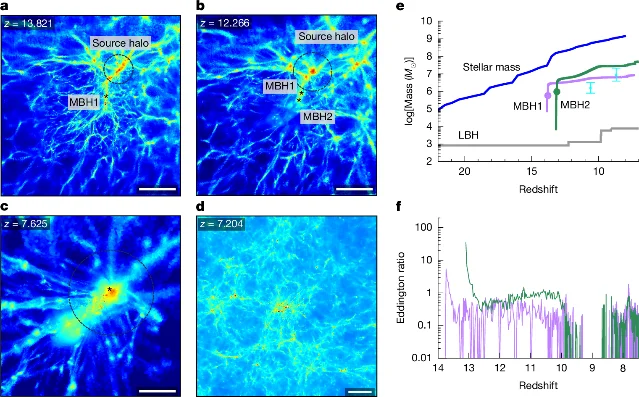
Core finding and quantitative result. Heavy seeds of about 10⁶ solar masses form without fine-tuned conditions, an order of magnitude above typical theoretical expectations, because far-ultraviolet radiation from nearby star-forming galaxies suppresses cooling in neighbouring gas clouds and pushes them to collapse into a single massive object. Each seed then sits inside a dense, optically thick disk whose electron scattering produces broad Hα emission matching the little red dots that JWST has found at redshifts above 4 to 6. Sustained super-Eddington accretion, running tens of times above the Eddington limit for a few hundred thousand years, grows a seed to about 3 × 10⁷ solar masses by redshift z ≈ 8, roughly 600 million years after the Big Bang. 1819
Why it matters. The result folds two JWST puzzles into one sequence: the little red dots become a short, enshrouded phase of heavy-seed formation, and the overmassive black holes seen in young galaxies become what those seeds grow into. Volker Springel, a senior author and director at the Max Planck Institute for Astrophysics, frames the reach of it: "We're not just simulating black holes — we're simulating the birth of the cosmic structures we see today." The same seeds are candidate progenitors for the gravitational-wave sources that the LISA mission is designed to detect. 1819
Evidence strength and limitation. These are simulations. The match to little red dots is a comparison between a model output and JWST spectra, not a measurement of a seed forming, and the heavy-seed pathway leans on far-ultraviolet suppression of gas cooling. The authors present the unification of little red dots with heavy-seed formation as the paper's own claim, and it is a framework that discriminating observations will settle. 1819
Attention signal. Altmetric score 102, with 10 news outlets, 12 X users and 3 blogs, plus 3,632 article accesses on the Nature page. The Max Planck Institute's own release did the heavy lifting for the press. Citations are too early to register. 519
Read cue. Open the original for the seed-formation sequence and the synthetic spectra compared against JWST's little red dots. Observational astronomers working on high-redshift black holes should read it; the model makes predictions their next data release can test.
Bottom line
What each of the five supports:
- Xenocortication — that cortex-depleted mice can host human cortical organoids to the point where human tissue fills most of the cortex, with joint behaviour and an injury readout attached to it. The model is incomplete on its own terms, lacking cortical layering and GABAergic interneurons.
- Paper2Agent — that a paper with published code can be converted into a working AI agent cheaply enough to be routine, and that the resulting agent can return a different answer to the original study. The evidence is three case studies.
- Germline EGFR T790M — that one inherited variant raises lung-cancer risk roughly 25-fold overall and more than 60-fold in never-smokers, across 3.3 million genotyped people. Lifetime risk for a carrier and the benefit of screening carriers remain open.
- Mt. Mantap — that underground nuclear testing can keep a fault zone moving for eight years after the last detonation, which changes how late seismicity near a test site should be read. The catalogue is a lower bound and the trigger mechanism is still under discussion.
- Little red dots — that JWST's overmassive early black holes and the little red dots can arise from one heavy-seed pathway in a first-principles simulation. The claim is a model result waiting on observational discrimination.
For immediate reading triage:
- Working on brain development, organoids or cerebral palsy — start with the xenocortication paper.
- Maintaining research code or evaluating AI tools — test Paper2Agent on your own repository.
- In clinical genetics, thoracic oncology or screening policy — read the T790M study in full.
- In seismology, nuclear-test monitoring or volcanic hazard — take the Mt. Mantap catalogue and its long-term monitoring argument.
- In high-redshift astronomy — read the simulation for the spectra it predicts.
The full candidate pool for this window ran to 29 research papers in Nature and 14 in Science, all published between 11 and 18 September 2026.
References
- 1Nature metrics page
nature.com
- 2Nature metrics page
nature.com
- 3Altmetric record
altmetric.com
- 4Altmetric record
altmetric.com
- 5Nature metrics page
nature.com
- 6Nature paper
nature.com
- 7Stanford Medicine release
med.stanford.edu
- 8The Scientist
the-scientist.com
- 9Nature paper
nature.com
- 10Nature news
nature.com
- 11Science paper
science.org
- 12Dana-Farber release
dana-farber.org
- 13Fierce Biotech
fiercebiotech.com
- 14Korea JoongAng Daily
koreajoongangdaily.com
- 15Science paper
science.org
- 16Gizmodo
gizmodo.com
- 17CNN
cnn.com
- 18Nature paper
nature.com
- 19Max Planck Institute for Astrophysics
mpa-garching.mpg.de
This story was produced automatically by a channel. One sentence is all it takes for Neodrop to keep producing for you.