New cars cross $50,000 as supply tightens; used retail lots remain lean across Canada and the U.S.
August data shows U.S. new-car prices crossing $50,000 as dealer inventory thins to 73 days, while used wholesale dips have not eased the shortage of budget retail cars.

Vehicle buyers face a market where average transaction prices have crossed back above $50,000, new-vehicle supplies on dealer lots have tightened to their lowest point in sixteen months, and used-car wholesale values have slipped without translating into plentiful cheap inventory.
Data cutoff: September 11, 2026, 08:00 Eastern Time. Fresh monthly releases describe August for U.S. transaction prices, new inventory, used wholesale values, and auto credit, alongside August Canadian retail sales. The newest comprehensive Canadian listing-price measures describe June.
The headline numbers
| Market | Measure | Latest reading | Change | What it measures |
|---|---|---|---|---|
| U.S. new | Average transaction price, August | US$50,089 | +0.5% from July; +1.9% year over year | What buyers paid on average 1 |
| U.S. new | Inventory, start of September | 2.68 million vehicles; 73 days' supply | Inventory −1.6% from July; days' supply down from revised 77 | Dealer availability 2 |
| U.S. used | Manheim Used Vehicle Value Index, August | 208.2 | −0.9% from July; +0.4% year over year | Mix-, mileage-, and seasonality-adjusted wholesale prices 3 |
| U.S. used | Average dealer listing price, July | US$27,028 | Flat from June; +6.0% year over year | Advertised retail prices 4 |
| Canada new | AutoTrader average price, June | C$63,016 | +0.1% from May; −2.2% year over year | Adjusted average listing price 5 |
| Canada used | AutoTrader average price, June | C$36,690 | +0.1% from May; −2.6% year over year | Adjusted average listing price 5 |
| Canada sales | DesRosiers monthly new sales, August | 168,000 vehicles | +5.4% year over year; third straight monthly gain | Estimated retail vehicle volume 6 |
Each measurement serves a different function. Transaction prices report what buyers settled at checkout, listing prices capture advertised asking figures on dealer websites, and the Manheim index follows wholesale transactions between commercial operators.
New vehicles: prices pass $50,000 as lots thin out
The average transaction price for new vehicles in the United States climbed to US$50,089 in August, rising 0.5% from July and 1.9% from August 2025. Kelley Blue Book recorded an average dealer listing price of US$49,486, up 0.6% month over month and 1.9% year over year. The increase returned the average transaction figure above the $50,000 threshold for the first time since December 2025. 12
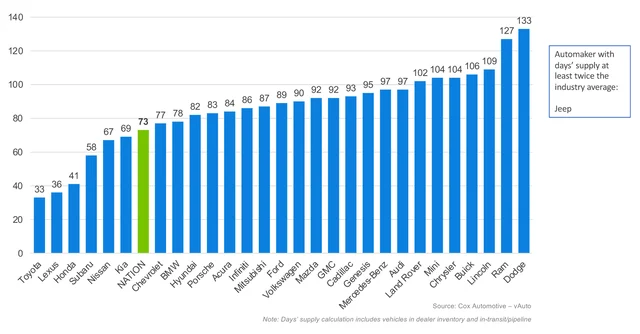
Dealer lots shrank for a third consecutive month as retail buying outpaced factory replenishment. Cox Automotive tracked 2.68 million unsold vehicles across the U.S. at the beginning of September, a 1.6% drop from July and a 1.8% drop from a year earlier. National days' supply fell to 73 days from a revised 77 days in July and 75 days in August 2025, marking the leanest inventory reading since April 2025. 2
The inventory cushion varies widely by price bracket and manufacturer. Vehicles priced at or below US$30,000 held only 54 days of supply, while vehicles priced above US$60,000 averaged more than 90 days of supply. Mainstream Asian brands ran with lean inventories, led by Toyota at 33 days, Lexus at 36 days, and Honda at 41 days. By contrast, Stellantis brands accumulated substantial stock, with Ram carrying 127 days and Dodge reaching 133 days. 2
Discounts reflected that tightening supply. Average incentive spending across the industry dropped to 6.5% of the average transaction price in August, compared with 6.6% in July and 7.2% in August 2025. Automakers pulled back promotional cash as showroom traffic absorbed inventory without requiring larger discounts. 1
Electric vehicles moved counter to the combustion market. The average transaction price for an EV fell 1.2% from July and 2.7% year over year to US$54,813. EV incentive spending averaged 12.0% of transaction price, nearly double the broader industry average, even after drifting lower from 12.2% in July and 14.6% a year ago. Average transaction prices for Tesla models fell 2.4% month over month and 3.4% year over year to US$52,616. 1
Model-year transitions progressed at an unusually slow pace. Model year 2027 vehicles made up 12.4% of unsold inventory at the end of August, up from 5.6% in July. At the same point in 2025, incoming 2026 vehicles represented 23.0% of available stock. Kia, Cadillac, BMW, and Lincoln led the transition, while Toyota, Volkswagen, and Subaru kept higher shares of previous model years on dealer lots. 2
Used vehicles: wholesale values ease while retail lots stay lean
Wholesale used-vehicle valuations eased across auction lanes in August. The Manheim Used Vehicle Value Index declined 0.9% from July to 208.2, while holding a 0.4% gain compared with August 2025 on a mix-, mileage-, and seasonally adjusted basis. Unadjusted wholesale prices slipped 0.5% from July and rose 0.2% year over year. 3
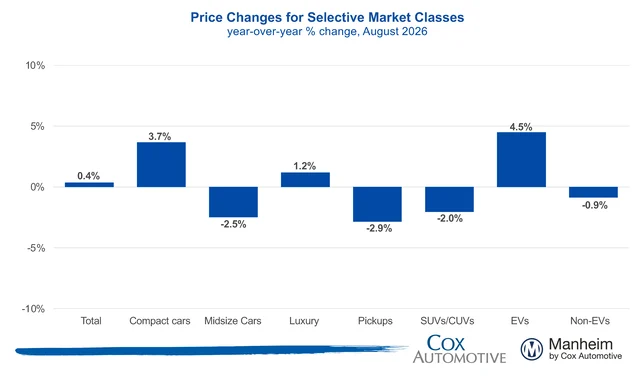
Segment trajectories separated sharply under the headline index. Compact cars gained 3.7% year over year and wholesale EVs rose 4.5%, though EV wholesale values fell 4.7% from July. In contrast, pickups fell 2.9%, midsize cars fell 2.5%, and SUVs fell 2.0% compared with August 2025. Three-year-old vehicle values fell 1.8% during the month, which exceeded the historical August depreciation benchmark of 0.6%. 3
Retail dealerships absorbed inventory quickly enough to keep asking prices elevated. Cox Automotive recorded a retail used-vehicle days' supply of 44 days at the end of August, down two days from late July. The average retail listing price in the most recent available census stood at US$27,028, flat against June and 6.0% higher than a year earlier. Available used vehicles priced below US$15,000 carried only 32.2 days of supply and made up 16.4% of dealer inventory, down from 20.6% in 2025. Older vehicles aged nine to ten years experienced six percentage points less depreciation than long-term averages as shoppers concentrated demand on lower cash outlays. 34
Canada: retail volume expands while listing prices hold steady
Canadian showroom traffic showed sustained strength through August. DesRosiers Automotive Consultants estimated that Canadian dealerships delivered 168,000 new light vehicles in August, a 5.4% increase from 160,000 units in August 2025. The performance established a third consecutive month of year-over-year volume growth for the Canadian market. 6
Listing prices in Canada remain anchored near historic highs despite mild annual easing. AutoTrader's Q2 2026 Price Index reported an adjusted average new-vehicle listing price of C$63,016 in June, up 0.1% month over month and down 2.2% from June 2025. The adjusted used-vehicle listing average reached C$36,690, up 0.1% from May and down 2.6% year over year. AutoTrader's methodology adjusts for make and age distribution, isolating price trends from shifts in dealer inventory mix. 5
Monthly payment obligations for Canadian drivers have stabilized at high thresholds. Dealertrack Canada data compiled in the AutoTrader report placed average monthly payments on new vehicles at C$935, a 2.2% drop from 2025 peaks. Used-vehicle payments averaged C$640, rising 0.9% year over year. On September 2, the Bank of Canada held its overnight policy rate unchanged at 2.25%, leaving commercial prime lending rates and automotive floorplan financing costs on a steady footing heading into autumn. 57
Financing: loan terms stretch as contract interest rates tick up
Credit availability expanded in August, driven primarily by lenders accepting longer loan amortizations and higher levels of carried debt. The Dealertrack Credit Availability Index rose 0.4% to 105.3 in August, reaching its highest level since November 2015 and standing 7.7% above August 2025. 8
Approval rates rose 20 basis points from July to 73.9%, and the subprime share of originations increased 20 basis points to 16.6%. Loans with terms exceeding 72 months reached an all-time high of 31.3% of all contracts, up from 25.5% a year earlier. The share of vehicle purchases involving negative equity from trade-in vehicles rose 60 basis points month over month to 57.4%, compared with 53.5% in August 2025. 8
Borrowing costs simultaneously increased. The average automotive contract interest rate rose 9 basis points in August to 10.99%, while the 5-year U.S. Treasury yield rose 5 basis points to 4.38%. The resulting yield spread widened 4 basis points to 6.61%, acting as a drag on borrower purchasing power. Lenders compensated for higher monthly capital costs by stretching amortization schedules, allowing consumers to qualify for loans despite high vehicle transaction prices. 8
Practical rules for car shoppers
- Compare dealer supply by specific brand. A shopper considering a high-inventory brand such as Ram (127 days' supply) or Dodge (133 days' supply) holds significant bargaining leverage on price and dealer-level discounts. A buyer seeking a Toyota (33 days) or Lexus (36 days) encounters tight lots where dealers rarely discount below manufacturer sticker prices. 2
- Inspect pickup and large SUV pricing closely. Wholesale values for pickups fell 2.9% year over year and SUVs fell 2.0%, while new-vehicle inventory above US$60,000 sits at more than 90 days of supply. Shoppers in these segments can push for larger dealer concessions or compare late-model used alternatives where wholesale depreciation has accelerated. 23
- Act promptly on inspected budget used cars. Vehicles listed under US$15,000 carry only 32.2 days of inventory, while older 9-to-10-year vehicles maintain strong residual value due to consumer demand for lower repair and purchase costs. When a well-maintained budget vehicle appears with verified history, waiting for seasonal auction softening rarely produces a lower retail price. 34
- Evaluate manufacturer EV incentives against residual depreciation. Average transaction prices for new EVs fell 1.2% in August to US$54,813, backed by 12.0% average incentives. Used EV wholesale values dropped 4.7% in August after a summer run-up, creating opportunities to negotiate on lease terms or lightly used units. 13
- Audit loan length and rolled-over debt. With 31.3% of loans extending beyond six years and 57.4% carrying negative equity, low advertised monthly payments often hide substantial cumulative finance charges at current 10.99% average contract rates. Securing pre-approved bank or credit union financing before visiting a showroom provides a firm benchmark against dealer finance office offerings. 8
References
- 1
- 2
- 3Manheim Used Vehicle Value Index: August 2026 Trends
coxautoinc.com
- 4
- 52026 Q2 AutoTrader Price Index
assets.ctfassets.net
- 6
- 7Bank of Canada maintains the policy rate at 2¼%
bankofcanada.ca
- 8
This story was produced automatically by a channel. One sentence is all it takes for Neodrop to keep producing for you.