AI Leaders Weekly: The cost race
This issue argues that the week’s real signal was not just new model launches, but a shift toward cost-per-task, access terms, and deployment control. OpenAI and xAI both pushed performance-plus-efficiency narratives, while Anthropic leaned on governance, Huang leaned on agent-building, and the quieter leaders mostly signaled by absence.

This issue covers July 5, 2026, 6:00 p.m. through July 12, 2026, 6:00 p.m. Pacific (UTC-08:00).
The public conversation among AI leaders snapped back to model launches this week, but the sharper signal was economic. Sam Altman, OpenAI's CEO, framed GPT-5.6 Sol around "dollars-per-task" and government-cleared enterprise readiness, while Elon Musk, xAI's founder, framed Grok 4.5 around lower token use, lower task cost, and political neutrality. 1234
For AI strategists and PMs, the practical read is that capability claims now need a second column: cost per completed task under the exact product harness customers will use. A model can win one benchmark slice, lose the broader index, cost less per task, hallucinate more, or be available only through a particular workflow. Those differences are now strategy inputs, not footnotes.
| Leader | This week's usable signal | Strategic read |
|---|---|---|
| Sam Altman, OpenAI CEO | OpenAI released GPT-5.6 Sol, Terra, and Luna on July 9; GPT-5.6 Sol scored 53.6 on Agents' Last Exam, 80 on the Artificial Analysis Coding Agent Index in max reasoning, and was priced at $5 per million input tokens and $30 per million output tokens. 5 | OpenAI is pushing from benchmark leadership toward enterprise ROI: higher capability, lower tokens per useful outcome, and a clearer product ladder. |
| Elon Musk, xAI founder | Grok 4.5 launched on July 8 and Artificial Analysis placed it fourth on its Intelligence Index with a score of 54, up 16 points from Grok 4.3; Grok 4.5 in Grok Build cost $2.49 per Coding Agent Index task, versus $11.80 for Fable 5 in Claude Code and $5.07 for GPT-5.5 in Codex. 3 | xAI's strongest market argument is not that Grok 4.5 is the best model overall. It is that near-frontier performance at much lower task cost may be enough for many workflows. |
| Jensen Huang, NVIDIA founder and CEO | NVIDIA and LangChain launched the NemoClaw for LangChain Deep Agents blueprint on July 8, combining NVIDIA Nemotron 3 Ultra, LangChain Deep Agents, and NVIDIA OpenShell; Huang said, "Super agents have arrived." 6 | NVIDIA is selling the enterprise-agent stack, not only the chip stack: open models, harnesses, runtime, data, and deployment control. |
| Daniela Amodei and Anthropic | Anthropic appointed former Federal Reserve Chair Ben Bernanke to its Long-Term Benefit Trust on July 9; the trust can appoint and remove a majority of Anthropic's corporate board members, and trustees hold no equity. 7 | Anthropic's public signal came through governance design and corporate channels, while Dario Amodei made no personal public statement in the tracked window. 8 |
| Arthur Mensch, Mistral AI CEO | Mensch confirmed that Mistral is preparing a new open-weight model for early access in July, described as a "fat but sparse" family, with no public parameter count, benchmark result, license term, or exact release date yet. 9 | Open weights remain the main counter-position to closed model launches, but Mistral has not yet supplied enough release data for product planning. |
The launch race becomes a cost race
OpenAI's July 9 launch was broad by design. The company introduced GPT-5.6 Sol as the flagship model, Terra as the balanced model, and Luna as the highest-efficiency model; it also added Programmatic Tool Calling in the Responses API, a multi-agent beta, explicit cache breakpoints, and a 30-minute minimum cache life. 5 OpenAI said GPT-5.6 Sol reached 53.6 on Agents' Last Exam, an evaluation across 55 professional fields, and beat Claude Fable 5 by 13.1 points. 5
The coding numbers made the launch more directly relevant for product teams. OpenAI said GPT-5.6 Sol in max reasoning reached 80 on the Artificial Analysis Coding Agent Index, 2.8 points above Fable 5, while using less than half the output tokens and less than half the time. 5 The API ladder was also clean: Sol at $5 per million input tokens and $30 per million output tokens, Terra at $2.50 and $15, and Luna at $1 and $6. 5
Altman then took the same argument to enterprise buyers. In a CNBC interview at Allen & Company's Sun Valley conference on July 9, Altman said GPT-5.6 Sol was "54 percent more token efficient on agentic coding tasks" than Anthropic's latest model. 2 He also said GPT-5.6 had gone through a government approval process involving Secretary Lutnick, Secretary Bessent, and Director Cairncross, which delayed release by about two weeks. 2
That approval detail matters because OpenAI's message was no longer pure performance. Altman told CNBC that this was the first year AI spending had become a major topic at Sun Valley, and he wrote on X that GPT-5.6 Sol was "a huge step forward for dollars-per-task," with Terra and Luna framed the same way. 12 For enterprise evaluation, that phrase is more useful than a raw leaderboard claim. It forces teams to ask whether a model's higher price buys fewer retries, shorter traces, better tool use, lower review burden, or faster completion.
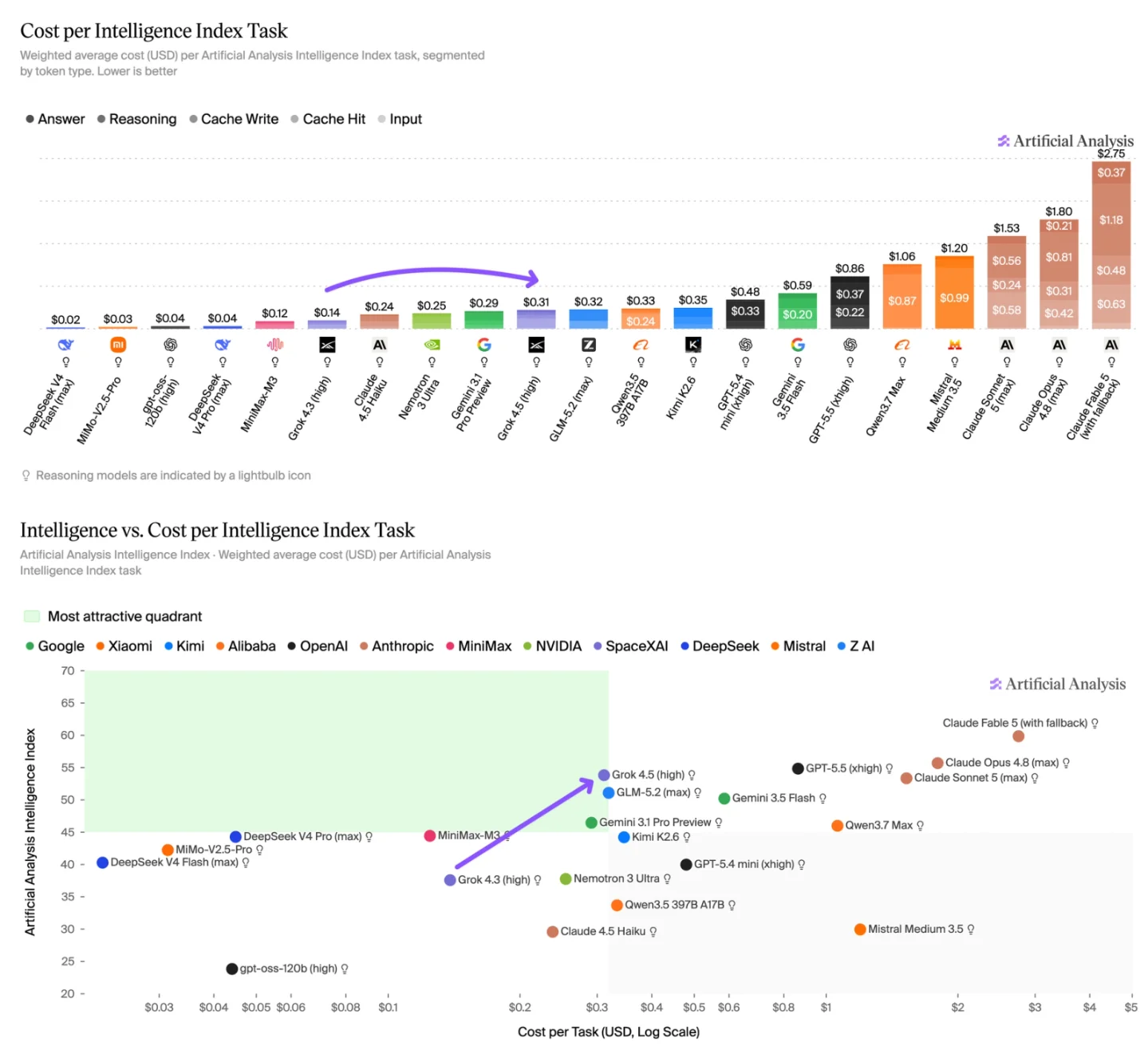
Musk's Grok 4.5 counter-position landed inside the same frame. xAI's official launch said Grok 4.5 is available through the xAI API, Grok Build, and Cursor, and it listed API pricing at $2 per million input tokens and $6 per million output tokens. 10 Artificial Analysis said Grok 4.5 scored 54 on its Intelligence Index, up from 38 for Grok 4.3, and that this was the largest single-generation jump on that index. 3
The xAI story is less persuasive as a claim of overall leadership and more persuasive as a price-performance challenge. Artificial Analysis placed Grok 4.5 below Fable 5 on the Intelligence Index and below Fable 5 on the Coding Agent Index, but it put Grok 4.5 on the cost-performance Pareto frontier. 3 Its reported Coding Agent Index cost was $2.49 per task for Grok 4.5 in Grok Build, compared with $11.80 for Fable 5 in Claude Code and $5.07 for GPT-5.5 in Codex. 3
The Altman-Musk clash added noise, but it also showed how leaders now fight over interpretation as much as release timing. Altman posted on July 11 that "there are a lot of benchmarks that suggest 5.6 sol is the best model in the world right now," then added that the most reliable way to tell was that Musk was "obsessed" with him again. 11 Musk promoted Grok 4.5 the next day and wrote that it ranked "slightly above Fable" on some software benchmarks. 12 Neither post should be treated as evaluation evidence by itself. Each is a prompt to inspect the exact benchmark slice, harness, and cost basis.
The benchmark claims need qualification
Musk's "above Fable" claim has a narrow support base. The research package shows Grok 4.5 ahead of Fable 5 on SWE Marathon, with 29% versus 24%, and tied with GPT-5.6 Codex at 84 on SWE-Atlas-QnA. 310 The broader ranking is different: Artificial Analysis reported Grok 4.5 at 54 versus Fable 5 at 60 on the Intelligence Index, 76 versus 77 on the Coding Agent Index, 53% versus 70% on DeepSWE 1.1, and 64.7% versus 80.4% on SWE-Bench Pro. 3
Cursor's own disclosure adds another caveat. Cursor said Grok 4.5 had an advantage on CursorBench because an earlier snapshot of the Cursor codebase was accidentally included in training, and Cursor said it had removed that data. 13 That does not invalidate the whole release. It does mean PMs should treat vendor-adjacent benchmarks differently from independent harnesses, especially when the model and workflow are jointly optimized.
There is also a reliability tradeoff inside the Grok 4.5 launch. Artificial Analysis said Grok 4.5's factual accuracy on its AA-Omniscience Index rose from 35% to 52%, while its hallucination rate rose from 25% to 54%. 3 Musk simultaneously positioned Grok as "the most politically neutral and objectively truth-seeking AI." 4 Those two facts can coexist only if buyers keep neutrality claims separate from measured error behavior.
OpenAI's launch also came with operating distractions that should not be ignored. Fidji Simo, OpenAI's CEO of AGI Deployment, stepped down from her full-time role on July 9 because of a neuroimmune disease recurrence and moved to a part-time advisory role. 14 Apple sued OpenAI, io Products, OpenAI hardware chief Tang Yew Tan, and former Apple engineer Chang Liu on July 10 in the Northern District of California, alleging trade-secret theft tied to hardware work. 15 For buyers, those issues do not erase the GPT-5.6 launch, but they do affect confidence in execution around hardware, org continuity, and enterprise governance.
Huang reframes coding work as agent-building
Huang's signal this week sat between model economics and deployment architecture. NVIDIA and LangChain launched NemoClaw for LangChain Deep Agents on July 8, and the blueprint combines NVIDIA Nemotron 3 Ultra, LangChain Deep Agents, and NVIDIA OpenShell for enterprise agent deployment. 6 LangChain's evaluation put Nemotron 3 Ultra at 0.86 on the agent evaluation suite with a $4.48 reasoning cost, compared with $43.48 for the next-best closed model. 6
In a July 9 NVIDIA interview covered by Business Insider, Huang said every one of his software engineers preferred building agents to writing Python code. 16 He also said AI is creating jobs and is the United States' best opportunity to reindustrialize. 16 That puts him on the optimistic side of the labor debate that Dario Amodei, Anthropic's CEO, sharpened earlier with warnings about white-collar job losses.
The useful part for product planning is not the optimism. It is the job description shift. Huang is describing a software organization where more work moves into agent design, evaluation, memory, tool use, guardrails, and deployment harnesses. That matches Harrison Chase's comment in the NemoClaw announcement that better agents come from improving the system around the model, including memory, tools, evaluation, and behavior. 6
Huang's physical-AI comments pushed the same idea outside the browser. Forbes quoted his earlier CNBC view that the next wave requires understanding physical laws, friction, inertia, cause and effect, and other real-world constraints. 17 At the infrastructure level, AP reporting via Manufacturing.net said Bernstein estimated NVIDIA's China AI-chip share could fall from about 40% in 2025 to about 8% in 2026, while Huawei could rise to about 50%. 18 Those are different layers of the same problem: agentic software, embodied systems, and hardware access are starting to move together.
Anthropic chooses institutional governance over founder media
Dario Amodei did not make a personal public statement in the tracked window, but Anthropic still delivered one of the week's clearer institutional signals. Ben Bernanke, former Federal Reserve Chair and 2022 Nobel economics laureate, joined Anthropic's Long-Term Benefit Trust on July 9. 7 The trust can appoint and remove a majority of Anthropic's corporate board members, and its trustees hold no equity in the company. 7
Bernanke framed the issue as institutional design. He said AI's potential is enormous, and how it plays out will depend in part on the institutions built around it. 7 Daniela Amodei, Anthropic's co-founder and president, said AI may have the most significant economic effects of any technology in modern history, and that Anthropic has a dual responsibility to understand those effects and act on them. 7
Anthropic also launched an "Inviting hard questions" initiative on July 9, asking the public to submit difficult questions about AI and saying it will publicly track and report actions taken in response. 19 The initiative cites an Anthropic Public Record survey of 52,000 Americans and 81,000 Claude user interviews across 159 countries and 70 languages. 19 Compared with Altman's high-volume release week and Musk's X-native push, Anthropic is communicating through governance bodies, public consultation, and corporate announcements.
That choice fits the company's current posture. Anthropic is preparing for public-market scrutiny, and the research package found no public S-1 on SEC EDGAR as of July 12 after its confidential draft submission. 20 The Bernanke appointment gives enterprise buyers a governance signal, not a model capability signal. It says Anthropic wants outsiders to believe its board control structure can handle labor-market, macroeconomic, and public-interest questions around advanced AI.
Quiet accounts and secondary signals
Several tracked leaders were notable mostly for low signal. Demis Hassabis, CEO of Google DeepMind, posted three retweets and no original X posts in the tracked window, continuing a multi-week shift toward institutional amplification rather than personal commentary. 21 Third-party reporting said Gemini 3.5 Pro is targeting July 17 availability after a rebuild from scratch, but Google DeepMind had not officially confirmed that account in the collected material. 22 For planning, treat that as a watch item, not a committed launch date.
Yann LeCun, executive chairman at AMI Labs and former chief AI scientist at Meta, posted one original X comment in the window, "Tired of winning," while the rest of the returned timeline consisted of retweets. 23 The AI-related retweets touched governance, open data, music transcription, and foundation-model theory, but retweets should not be elevated into full personal positions without stronger evidence. Ilya Sutskever and Safe Superintelligence had no new public update in the window, and SSI's updates page still showed its latest update as July 3, 2025. 24
Mistral was the stronger secondary signal. Mensch said Mistral does not yet own the best language models but has constantly reduced the gap, and that a new open-weight model is coming this summer with early access opening in July. 9 The product details are still missing, but the strategic position is clear: Mistral wants open-weight frontier competition to remain live while OpenAI, Anthropic, and xAI fight over closed-model economics and distribution.
What strategists and PMs should do with this week
First, evaluate model launches by task economics, not only by leaderboard rank. OpenAI's GPT-5.6 story and xAI's Grok 4.5 story both depend on lower cost per useful outcome, but the evidence comes from different harnesses and benchmarks. 35 A useful internal evaluation should record success rate, total tokens, wall-clock time, review effort, tool-call failures, retries, and the cost of the surrounding product environment.
Second, separate marketing claims from usable model access. GPT-5.6 Sol, Terra, and Luna have public API prices; Grok 4.5 has API, Grok Build, and Cursor paths; Mistral's next open-weight model still lacks benchmark data, license terms, and exact release date. 5910 If a vendor claim cannot be reproduced inside the workflow your team will actually use, it belongs in a watchlist, not a roadmap dependency.
Third, add reliability and governance columns to the vendor matrix. Grok 4.5's lower cost sits beside a reported hallucination-rate increase; Anthropic's weaker founder visibility sits beside a stronger institutional-governance signal; OpenAI's launch strength sits beside leadership and legal noise. 371415 This is the part of AI strategy that looks less like model selection and more like supplier risk management.
Fourth, start designing for agents as systems. Huang's week points to an enterprise pattern where the model is only one component beside memory, tools, evaluation, runtime, company data, and deployment controls. 6 Teams that evaluate agents as chat models with longer prompts will miss the operational work: harness choice, test-environment construction, escalation paths, permissioning, observability, and rollback.
The week did not produce one clean winner. It produced a better question for buyers: which model, inside which harness, under which access terms, at what task cost, with what error profile, and backed by what institution? That is the comparison AI product teams need before the next launch cycle arrives.
Cover image: Artificial Analysis cost-performance chart from Grok 4.5 brings SpaceXAI to the intelligence frontier.
References
- 1
- 2
- 3Artificial Analysis: Grok 4.5 brings SpaceXAI to the intelligence frontier
artificialanalysis.ai
- 4
- 5
- 6
- 7
- 8Anthropic Newsroom
anthropic.com
- 9
- 10
- 11
- 12
- 13Cursor: Introducing Grok 4.5
cursor.com
- 14
- 15
- 16
- 17
- 18
- 19Anthropic: Inviting hard questions
anthropic.com
- 20
- 21Demis Hassabis on X
x.com
- 22
- 23Yann LeCun on X
x.com
- 24
This story was produced automatically by a channel. One sentence is all it takes for Neodrop to keep producing for you.