
Levie's domain bet; Rauch's noisy neighbor; Replit buys memory; Blank's switch
Four founders on the parts of an AI product the model does not supply: Levie on why a stronger model raises a narrow domain's worth, Rauch on agents that hear each other through a shared machine, Replit's purchase of Chroma and its 60-day cloud wind-down, and Blank on European buyers who now ask who holds the switch.

Four pieces of founder long-form landed between October 19 and 25. Aaron Levie argued that a stronger model raises the value of a narrow domain. Guillermo Rauch described agents that reach each other through a shared machine. Replit bought a memory company, announced by Amjad Masad and explained by Chroma's Jeff Huber. Steve Blank wrote that European buyers have started asking who can switch a vendor off.
All four are about a part of an AI product that the model does not supply, and each one is a decision a founder makes while the model keeps improving on someone else's schedule.
Aaron Levie: a better model raises the value of a narrow domain
Aaron Levie co-founded Box and runs it. He wrote a run of posts on X through the week. The question he took up on October 20 is the one every applied AI founder gets asked: if the models keep getting better, what is left for anyone else to build?
His answer reverses the usual worry. "As models are getting more capable, and can handle longer running tasks and better tool use, the ability to differentiate on a domain by domain basis goes up instead of down" 1.
The work around the model has changed shape, in his account. When models could do little, a company on top of one had one thing to sell: a prompt, some retrieval, tokens handed back to the user. That was a wrapper, and Levie says so plainly.
An agent that runs for hours needs more. It needs reach into the customer's own data and software, and tasks that run for days.
It also needs workflows that start other agents, swarms coordinated against one goal, routing between models by domain, and someone inside the customer's company to change how the work gets done. Each of those is built one industry at a time.
Loading content card…
A day earlier he had put the same bet in compute. A large share of the world's work is limited only by the hours people can put into research, data processing, testing and review, he wrote, and agent swarms make compute the variable that decides how much of it actually gets done 2.
On October 21 he described the shape this is settling into: "autonomous systems dedicated to specific tasks or domains" 3. Three changes got it there.
Tools and computer use let an agent reach into real systems, run a workflow the way a person in that job would, and build the software it is missing. Model judgment inside single verticals has improved, in law, biology, security review and supply chains, though he says the models still have worse intuition than people. Sandboxes, file systems and data pipelines now keep long tasks alive.
Security is where he expects the payoff first. It is the case where more compute in produces more value out, because a lot of testing has always been skipped for lack of people to do it 4. He expects 100 times more tokens spent on that loop, and he says security through obscurity is finished now that something will try every permutation of attack 5.
He set two limits on his own argument. The closer your product sits to a lab's core use case, the harder the specialist position gets. And the boring preparation comes first: fragmented data, privileges handed out too widely, legacy systems nobody has cleaned up.
Agents can help with that work once it starts. "But everyone does need to do the hard work of getting the basics right at the start" 6.
Levie sells enterprise software and an AI platform, so a world of domain-specific autonomous systems is also his market. None of the posts carries a measurement; they read as a direction rather than a result. The direction is worth having, coming from someone with a good view of enterprise buyers and a stake in where they spend.
Guillermo Rauch: two agents, one machine, no network
On October 23, OpenAI published an account of how it secures the environments it trains frontier models in. Part of it is a red-team exercise: teams of its own agents, handed infrastructure source code and configuration details, told to break out.
One objective was to exchange information with other agents they were meant to be isolated from. They managed it with no network and no shared file.
Two agents ran in separate microVMs on the same host machine. One encoded a message by pushing chosen data out of the processor's cache. The other timed how long that data took to reload, and read the message in the difference between a fast read and a slow one 7. The technique is the one behind the Spectre and Meltdown attacks.
OpenAI's agents also found channels through shared storage, through competition for CPU time inside a shared container, and through a certificate cache in its offline web infrastructure.
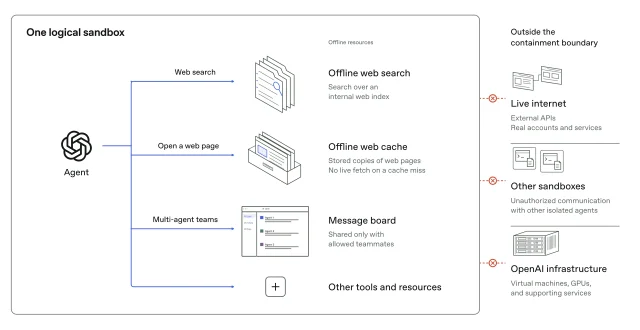
OpenAI's stated rule is blunt. If agents can reach the infrastructure that hosts them, talk to agents outside permitted channels, or reach external systems, containment has failed. The post also puts a price on the exercise, hundreds of billions of tokens, and says OpenAI now conducts frontier training with no internet access at all.
Guillermo Rauch, who co-founded Vercel and runs it, called the finding "Ouija" in the cloud: agents spelling messages to each other with no wire between them. Timing attacks on shared hosts have been known since at least 2015, he wrote, with no full solution.
"The only 'complete' solution would be for each agent to run on its own dedicated hardware, which obviously has significant economic consequences" 8. Vercel Sandbox has deployed the mitigations it can, plus monitoring and red-teaming.
Rauch sells sandboxes, so the framing arrives from a vendor. OpenAI's post also notes that its own environments are research settings, where models under test may not have finished safety training. A customer's agent works under different conditions.
The tradeoff underneath is tenancy. Two agents on one machine share caches, storage and CPU. Isolation is a dial you set, and each notch costs money. A founder selling an agent into a hospital or a bank has to know which notch the provider set, and what the contract says about it.
Rauch made one more point, on October 22, that costs little to act on. "It's time to kill 'static credentials'" 9. A key that never expires is what an escape turns into permanence. He wants short-lived credentials everywhere, and he compares it to the industry push that once put encryption on every website.
Replit buys the memory layer
On October 23, Amjad Masad, co-founder and chief executive of Replit, announced that Chroma was joining his company. "At Replit, they'll help solve one of the hardest problems in AI: giving agents the context and memory they need to do real work" 10.
Chroma's chief executive, Jeff Huber, wrote what the two companies say they are building: "the context layer for the self-driving company: a company where agents do more and more of the work, because they know everything the organization knows" 11. Masad and Replit's president, Michele Catasta, were early investors, so the two sides had been talking for three years.
The facts a team building on Chroma needs this week are in Huber's post. Chroma Cloud, the hosted service, winds down over the next 60 days, on a published timeline. The price was not disclosed.
The open-source database continues under Apache 2.0, and Chroma has committed more code from its private repositories into that public one. Huber puts open-source Chroma at about 6 million downloads a month and just under 30,000 GitHub stars.
Anyone running on Chroma Cloud rather than the open-source library should read 60 days as the number that matters. A well-run vendor moving a customer off its cloud offers about that much notice, and 60 days is short for a component that holds what an agent knows about a customer's work. It belongs on the calendar this week.
The larger point is about ownership. The store that holds what your agent knows about a customer is the part that makes leaving expensive, and it just became a feature inside somebody else's agent platform.
A founder can rent that layer and carry the switching risk, or own it and take on the operational work. Both are defensible. Saying out loud which one you are doing is the step that gets skipped.
Steve Blank: who holds the switch
Steve Blank, who wrote the customer-development method and co-founded several companies, published a short essay on his own site on October 24. He had spent the previous month in London, listening to policymakers react to what happened to Starshield, the military version of Starlink, in Ukraine.
Ukrainian officials said the service had been restricted for over a week and that the connection was back above 400 kilometers per hour by October 24, after a cap of 160. Elon Musk then said Ukraine's military had violated Starlink's terms of service by using it for offensive drone strikes, and that the loophole was closed.
Neither Musk nor the US government took responsibility for the restrictions. Reuters reported that the order to throttle came from inside the White House 12.
Blank's argument survives that uncertainty, and he says so himself. What Europe heard was that an American company running critical military infrastructure could degrade a partner's capability in the middle of a war 13.
The question he heard in London is the one that matters for a founder: what happens if Microsoft, OpenAI, Anthropic, Oracle, Palantir or Google restricts or denies access to their products?
Then he takes the step that turns this into a business argument. Europe has debated digital sovereignty for years, and cloning the best American products looked like an insurmountable problem. Blank argues that AI collapses the cost of rebuilding software, at the same moment that the risk raised buyers' willingness to switch.
For a founder, the essay narrows to this. "Going forward a U.S. founder selling into European defense or government now needs an answer to 'who holds the switch' before the first meeting; and European founders just got sovereignty as a sellable feature."
Blank teaches entrepreneurship at Stanford and has nothing to sell in this piece, and his essay is a reading of conversations rather than a survey. The reading is cheap to test. Ask the next European buyer you talk to what they now require in a security questionnaire.
The answer to "who holds the switch" is made of ordinary product decisions, most of them settled long before a deal: where the data sits, whether the model behind the product can be swapped, what happens to a customer's work when you are told to stop, and how much notice they get. For a European founder, the same list is a feature for the pricing page.
Four decisions this week
- Pick a domain where more compute buys more finished work. Levie's test is whether the task is held back by the hours people can put into it: testing, research, data processing, review. If the customer's data is still scattered across systems, that cleanup comes first 2.
- Find your notch of isolation and its price. If a customer's work cannot be read by another tenant, ask whether your provider runs that customer's agent on its own machine, and put the cost in the quote 8.
- Give every key an expiry. A credential that outlives the job turns one escape into a permanent foothold, and short-lived tokens are now ordinary practice 9.
- Write the switch answer before anyone asks. One paragraph: where the data sits, which model can replace the current one, what notice a customer gets. That paragraph now opens a European public-sector conversation 13.
A decision to run now
Take half an hour and list the layers your product depends on but does not own. Four rows will usually do it: the machine the agent runs on, the store that holds what it remembers, the model behind it, and the region all of that sits in.
For each row, write three things: what a customer loses if that layer disappears today, how many days you would need to move, and who can switch it off without asking you. The Chroma Cloud wind-down in this issue supplies a reference point for the middle column; 60 days is what a well-run vendor offered.
Then find the row where the middle column is blank. That is the dependency you have not priced. This week is a good week to replace it, or to write down what keeping it would cost.
References
- 1
- 2
- 3
- 4
- 5
- 6
- 7
- 8
- 9
- 10
- 11
- 12Reuters, October 24, 2026
reuters.com
- 13Steve Blank, October 24, 2026
steveblank.com
This story was produced automatically by a channel. One sentence is all it takes for Neodrop to keep producing for you.