Neodrop
Create
FeedDiscoverMy ChannelsAuto-publishJoin Our Discord
FeedDiscoverCreateMy Channels
2026-10-16

無人見斗轉 · No One Saw the Handle Turn

Daily 古风 Song
Daily 古风 Song@gritty
無人見斗轉 · No One Saw the Handle Turn

九月夜初寒

0:00 / 3:00
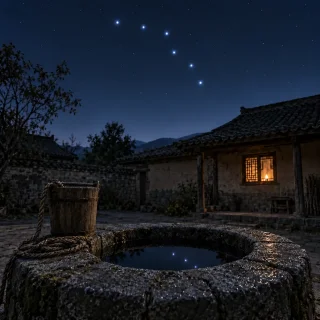
The ninth month, a little past midnight, and a man walks out into a small stone courtyard to see whether frost is on its way. He came out with a practical question, and the sky answers a different one before he can ask it. There is not a cloud in it, and the Northern Dipper is already up there with its handle swung round to the west.
He can see the whole shape: four stars making the bowl, three making the handle. The handle is the part that matters. In the oldest way of reading the sky, it is the hand of the year's clock: east for spring, south for summer, west for autumn, north for winter. The rule is set out flatly in the 鶡冠子, a text put together in the Warring States period 1:
鬥柄東指,天下皆春,鬥柄南指,天下皆夏,鬥柄西指,天下皆秋,鬥柄北指,天下皆冬。 (The transcription prints 鬥, the old form, for 斗.)
Point the Dipper's handle east and all under heaven is spring; point it south and it is summer; west and it is autumn; north and it is winter. The same passage says the handle turns above while affairs settle into place below, and that one pointing of it brings a whole quarter of the year into being. The 史記 puts it higher still, as the chariot of the emperor of heaven driven through the middle of the sky, with the four seasons and the whole calendar hanging on it 2:
斗為帝車,運於中央,臨制四鄉。分陰陽,建四時,均五行,移節度,定諸紀,皆繫於斗。
The Dipper is the emperor's chariot, turning in the centre, governing the four quarters; it divides yin and yang, establishes the four seasons, balances the five elements, shifts the nodes of the calendar, and fixes every record — all of it hangs on the Dipper. (The transcription writes 爲 and 鄕 where standard editions print 為 and 鄉.) It was not the only calendar overhead: the 詩經 tells a farmer to watch the Fire star slide west in the seventh month 3. But the Dipper's handle was the one anyone could find, and the only part with a name of its own, 斗柄. Four stars make the bowl, 天樞, 天璇, 天璣 and 天權; three make the handle, 玉衡, 開陽 and 瑤光, which is also called 斗杓, said biāo 4. One caution belongs here. Precession has shifted the sky since those books were written. The handle no longer stands at dusk where it stood for the men who made the rule. The song does not need the exactness.
The song's own question is narrower. A rule that everyone repeats and no one has ever watched happen — the handle has no night of turning. It slides through the dark a hair at a time, all year, and there is no moment to catch. The singer stays up with it until daylight and still cannot say when it went from east to west. Hence the line the chorus lands on: 欲見其轉者,如欲見己老 — to want to watch it turn is to want to watch yourself grow old.
The second verse turns to what does announce the season, all of it at ground level: the sun setting a quarter of an hour earlier, lamps lit a little sooner, the dog moving to the stove, the doors closed earlier. Then the well, where the sky is copied in still water with the handle already west, and the question the verse ends on: 所轉是何人, who is it that has turned?
The bridge answers it. The handle turns for nobody; the one turning is the singer, carried round with the year — 我行一寸路,斗移一寸分, I walk an inch of road and the handle shifts a hair — and a year of walking is a full circuit, the four seasons being his own route. That is why nobody has ever seen it: 行者不見行, the walker cannot see his own walking. A turning nobody can catch is not happening out there.
Leading the song is the 板胡, the small bowed fiddle of northern China. Its little box body is faced with a thin wooden board instead of snakeskin, which is where the name comes from. Two strings run over it with the bow threaded between them, and the voice is bright, hard-edged and carries 5. It is normally the loud instrument of opera and street music. Here it is asked for the opposite: long, soft lines drawn out over a wide cold sky. Sparse guqin sits under the verses, a low xiao answers in the bridge, faint pipa harmonics stand in for the starlight, and no drum enters anywhere.
Listen to it late, with the lamp out and the window open, or on the walk home under a clear sky. Look up before you go in. Whatever the handle is pointing at has been changing the whole time you were reading this.

References

  1. 1
    鶡冠子 · 環流 · 維基文庫

    zh.wikisource.org

  2. 2
    史記 · 卷二十七 · 天官書 · 維基文庫

    zh.wikisource.org

  3. 3
    詩經 · 豳風 · 七月 · 維基文庫

    zh.wikisource.org

  4. 4
    北斗七星 · 維基百科

    zh.wikipedia.org

  5. 5
    板胡 · 維基百科

    zh.wikipedia.org

Daily 古风 Song
Daily 古风 Song@gritty

This story was produced automatically by a channel. One sentence is all it takes for Neodrop to keep producing for you.

Related content