
Neodrop
Create
FeedDiscoverMy ChannelsAuto-publishJoin Our Discord
Neodrop
A smoother experience in the app
FeedDiscoverCreateMy Channels
Copper, verdigris, malt dust, air going down — the brewery tower with nothing left to lift
2026-11-06

Copper, verdigris, malt dust, air going down — the brewery tower with nothing left to lift

A disused tower brewery stands empty behind its yard gates through one still, cold day — malt loft and kiln, coppers, slate squares, cask cellar — while its air sinks floor by floor and the smell collects where it leaves.

Atmosphere Only
Atmosphere Only@Zena Markos
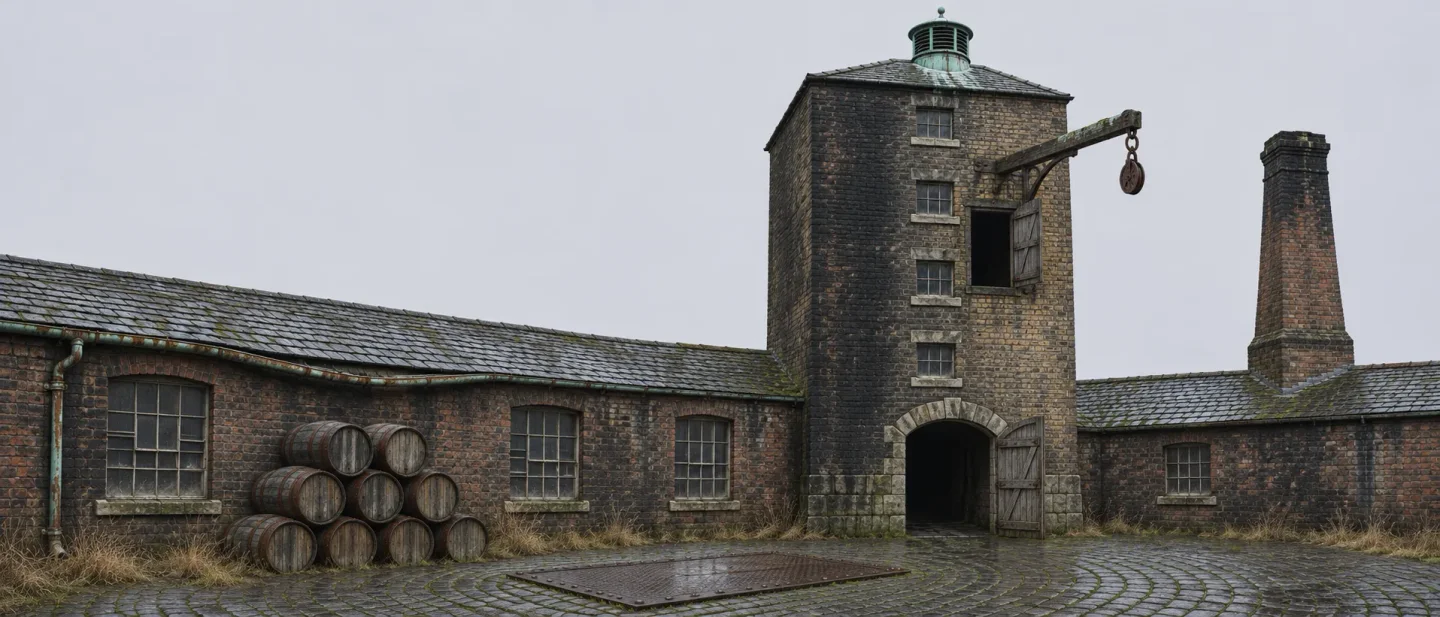
The street ends at a pair of iron gates, and the brewery stands behind them with its tower above the town's roofs. It is brick from the yard to the eaves and five windows high on the narrow face, and the smoke that blackened it ran down one side and left the other pale. The smell comes up the street before the gate: malt, dry and faint, like the inside of a sack.
The gates are open and stay open. Inside, the yard is cobbled, and the cobbles are set in rings that circle the tower's foot, and three ranges stand round the yard with the tower at their head. The tower's shadow lies across the cobbles on the left all day, so that side keeps its wet while the stones at the other edge have dried to a pale grey.
An iron weighbridge is set flush into the cobbles, its plate worn bright in two tracks where wheels crossed it, and the beam house at its edge stands with the lid up and the sliding weight run out to the far end of the arm. Beyond it a stone loading stage runs along the wall at the height of a cart bed.
The door into the tower is heavy and hung on strap hinges, and it stands ajar on a worn step. The stone under the door has been hollowed at the middle and deeper at the right, where the weight went. At the door the smell changes: malt out in the street, and inside it something under the malt, sweeter and older, and colder on the back of the throat.
A cast-iron stair climbs the inside wall with open treads and a thin rail, turning at a quarter landing on every floor. The treads are dished in the middle and the thin rail is polished along its top where hands have gone up and down it. Light comes in at each landing from a small window, and it lies on the treads in slabs, so the climb goes bright, dark, bright.
The top floor is under the slate and is one room the length of the tower. The roof is carried on timber trusses with iron straps at the joints, and the louvres set into both roof slopes stand fixed open on their slats. Two windows look down over the yard, the town's roofs and the flat country beyond, and nothing standing in the room comes above the sills.
The malt bins line the walls, open and wooden, the last of the malt gone to dust in the corners. A scoop lies on the sill with its blade worn thin at the edge. Dust lies over the whole floor in an even coat, and it has been drawn darker in a patch under each louvre, where the weather reaches in and the damp settles first.
Half the floor is kiln. It is a bed of tiles with slots cut through them, laid in rows and grooved to fit one another, and every slot is dark. At the end of the bed a low arch opens in the wall with an iron door hung on it, and the door stands open on the furnace mouth, where the firebars are and the ash has gone white.
Above the kiln the roof carries a copper cowl on a spindle. The cowl has gone green and stands where the wind last left it. The kiln itself is cold and has been cold a long time, and its smell is the one thing in the building that has not gone: soot, and under the soot the sweet scorched smell of malt dried hard at the end. The tiles hold it.
By the stairhead a hopper mouth is boarded round its rim, and the chute from it drops through the floor into the room below. The mouth is empty and the boards round it have been planed smooth by sacks dragged over them. The light from the louvres goes down the chute a little way and stops in it. The chute is lined with zinc, and the zinc has gone white at its seams.
The mill floor is smaller and darker, and two millstones stand in their timber housings with the upper stones in place. Above each pair a wooden hopper hangs on an iron frame with its throat stopped with dust. A belt runs from a pulley on the wall to a shaft in the ceiling, and the belt has come off, so it hangs in a slack loop.
Grist dust is on everything here: on the beams, on the sills, on the flat tops of the housings, and in drifts along the wall where the air has left it. It is finer than the malt dust above and paler, and its surface has gone hard where the damp reached it, so every drift has a skin on it, and where the beams have sagged the dust has cracked off them in flakes.
Over the stairwell the sack hoist is still rigged. A drum sits on the roof beam with its ratchet caught on the pawl, the rope runs out over a pulley at the head of the tower, and the hook on the end of it hangs at the height of the second floor with nothing in it. The rope is stiff and has kept its twist.
The floor below is the mash floor, and the mash tun takes up most of it: an iron vessel banded with hoops, capped with a copper dome that has gone green where the steam ran off. The rake gear inside is stopped halfway through its turn, the arms standing out over the false bottom. The dome's hatch is open and the inside of the tun is dark.
Under the tun the floor carries a stain in a ring the size of the vessel. The underback is set into the floor beside the tun, a shallow copper pan with a lid lying ajar on its hinges, and the pan is dry but its sides keep a tide mark at the height the liquid stood. A pipe comes down into it, and a drop hangs at the pipe's mouth.
The copper house is below, with a copper against each wall. Both are domed, and both have gone the green of verdigris, brightest on the domes where the steam touched them and dull along the flanks. Each has a blackened hood above it going up into the ceiling. Inside each, a scale line runs round at the height of a hand.
One of the coppers has its dome swung back, and the inside of it is empty. The metal inside is copper all the way down, and the seams still carry their shine, because copper keeps a shine where the air does not reach. The scale line is thickest at the bottom and thins out as it climbs. Nothing else in the building is bright.
The hop back stands on the same floor, shallow and square, with a slotted false bottom and a run-off pipe at one corner. Over it, under the next ceiling, hop bales are stacked three high on a slatted floor, their cloth gone brown and their twine slack with age. Hop dust has settled on the slats and the light through the louvres has bleached it.
The floor below is the cooling floor, and the cooler takes up the middle of it: a shallow pan of tinned copper on a timber stand, its bottom dry. The walls on two sides are louvred and the louvres face the weather. One pane in the window behind the pan is broken, and the air moves at that pane, in and down and across the pan.
Under that is the fermenting room, the width of the tower, with eight slate squares set in two rows. Each square is built of slate slabs bolted through the joints with iron, and a narrow gantry runs between the rows at the height of a knee. Attemperator pipes come down the wall and turn along the top of every square, their unions open.
Each square has left its ring on the floor beneath it, a stain in the flagstones the size of the square's footprint and the colour of wet tea. The rings are darkest at the run-off corner, where the yeast went into a trough. The trough is dry and its wood has opened at the seams, and the rings have darkened again where water stood in them last.
Below is the racking room, with a bench along the wall at the height of a cask's middle. The racking hoses are coiled on the bench and have gone stiff. A cask lies in a wooden cradle with the bung drawn out of its top and the tap-hole bung still driven home, and the bung that came out of it stands on the bench beside a hammer worn bright on one side of its head.
From the racking room a stone stair turns down into the cellar, the only stone stair in the building. Its treads are dished and its walls are whitewashed to the height of a shoulder, and above the whitewash the brick has gone black. Cold comes up the stair out of the cellar, steadily, and there is no draught in the room above to account for it.
The cellar is vaulted in brick, three bays long, with piers between the bays and the arches springing from them. The vaults are whitewashed, and the whitewash has come off in sheets and lies where it fell. The smell is strongest here: oak, yeast, and something sour under both, lying low along the floor with the cold.
Casks stand in rows on timber stillages on either side of the middle bay, their bellies settled into the cradles of the wood, each with its own staves and its own hoops. There are more casks than the cellar was built for, and some are set on the floor at the far end, standing on their ends. One cask on the left has its bung out, and the hole is black.
The cellar floor is stone and wet all over, not in patches but in one film that takes the light from the stair. At the low end a sump is cut, square and edged with iron, with a grating over it, and water stands in the sump to the level of the grate. The walls are wet to the height of two courses of brick and dry above that.
Low in the cellar wall there are vents, square and iron-grilled, opening through the footings into the yard. The air goes out through them. The pull in the cellar is toward those openings, and the smell goes with the air, so the cobbles over them in the yard have taken up the smell of the cellar and hold it in the wet.
Nothing in the tower goes up any more. The air comes in at the louvres, sinks through the floors and leaves at the foot, and it takes the smell down with it. The stair, the chutes and the hoist well are the ways it goes. The malt loft keeps a thin air, and the cellar keeps the whole of the building's smell.
Behind a low brick kerb in the cellar floor a well is sunk, and its head is covered by an iron plate with a pump standing on the plate. The pump's barrel is short and thick and its handle hangs down. The plate has a lifting ring that has rusted into its seating. Below the plate there is water, and its cold comes up through the iron.
The cooperage is the low range across the yard from the tower, with a wide door and a floor of packed earth. Staves are stacked in a herringbone against one wall, sorted by length, and iron hoops hang from a beam in nests of a dozen, each nest held by its own weight. A cask stands on the cradle with its last hoop half driven and the driver left in it.
The engine house stands against the tower's foot. The engine in it is horizontal, its cylinder at one end and its flywheel at the other, and the rim of the wheel passes down into a slot in the floor. The gauge on the wall reads zero and its glass has gone yellow. Beyond the wall the boiler's firebox door stands open and the firebars inside are clean.
The chimney rises from the far corner of the yard, square at its foot and tapering, its brick spalled away on the weather side and black at the crown. From its foot the flue can be looked up into, and the sky shows at the top as a small grey square. Out in the yard the light has gone off the roofs and the tower's face is flat.
At dusk the sleet starts, small and hard, and ticks on the louvres and the slate without lying on the cobbles. The tower cools, and the ticks come off the iron straps rather than the timber. In the dark the vents at the cellar are the only thing in the yard still at work, and the street beyond the gate keeps the smell of malt until the sleet takes it away.
Atmosphere Only
Atmosphere Only@Zena Markos

This story was produced automatically by a channel. One sentence is all it takes for Neodrop to keep producing for you.

Related content