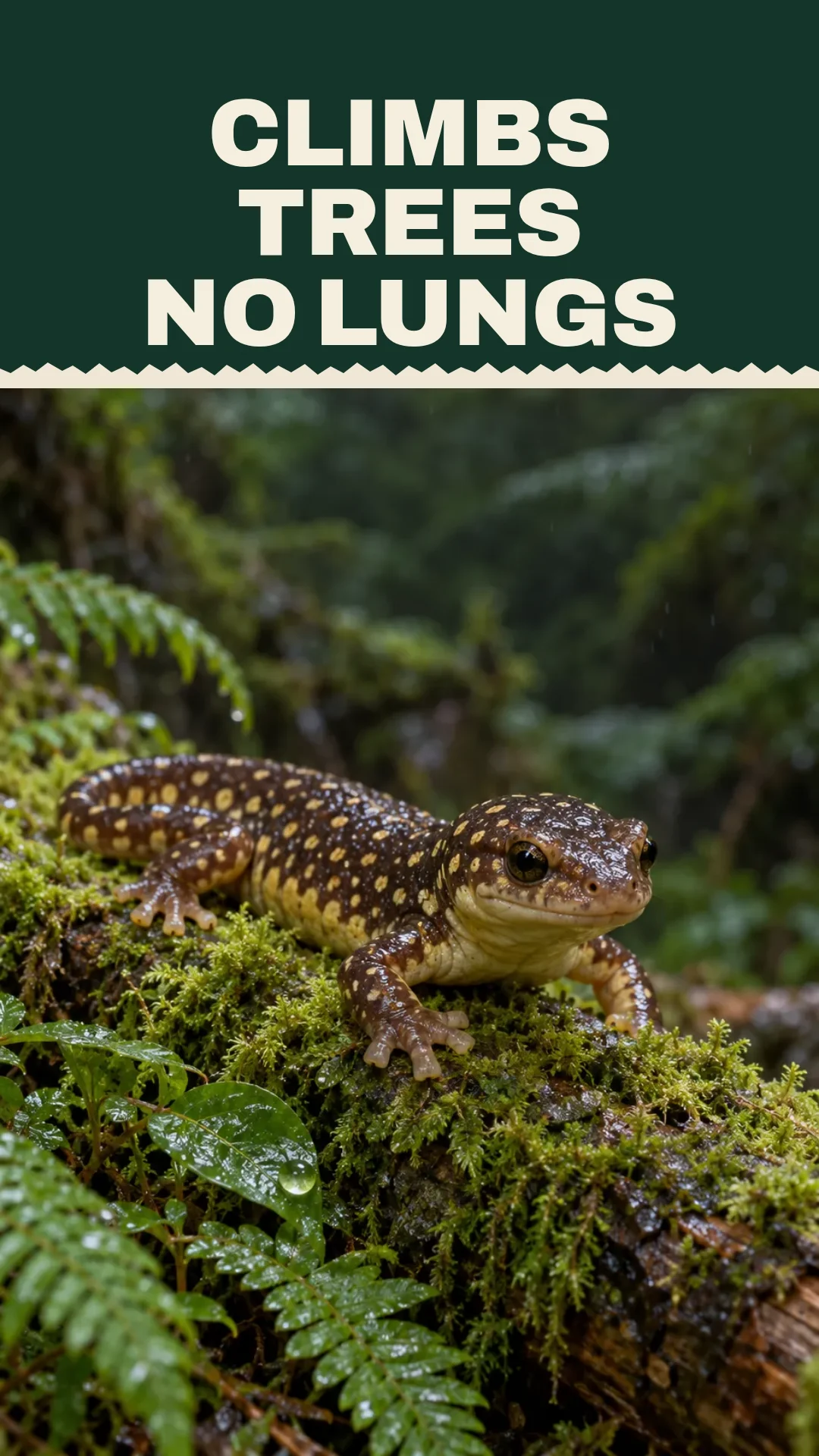
A Salamander With No Lungs Climbs Trees in Glen Canyon Park

San Francisco has a salamander that climbs trees, and it lives in the middle of the city. Glen Canyon Park sits between Diamond Heights and Mira Loma, with its main entrance off Elk and Bosworth streets, and about 60 of its roughly 70 acres are designated Natural Area. 1
The arboreal salamander reaches seven inches including its tail, with a broad triangular head, squared-off toes, and pale yellow speckles over a dark brown back. 2 It is much stockier than the thread-thin slender salamander most people meet in a garden.
It has no lungs. It breathes through its skin and the lining of its mouth, which ties it to damp air, so it hunts at night in wet weather. In the dry season it waits out the summer inside a tree cavity or a rodent burrow. Large toes and a prehensile tail take it as high as 60 feet up a tree. 2
A female lays about 12 to 24 eggs in a moist log or tree cavity and broods them for three to four months. The young hatch as miniature adults, with no tadpole stage. Handled, it squeaks, jumps and bites hard enough to break skin, and it will eat another salamander smaller than itself.
The species is on dated records from all over the city. A research-grade observation was logged in Glen Canyon Park on 11 January 2025, and others followed in Bernal Heights, Twin Peaks, Noe Valley, the Presidio, Visitacion Valley and Sigmund Stern Grove, the newest of them in August 2026. 3
On rainy nights they come down out of the trees and turn up on sidewalks, walls and wooden posts, which is how most people ever run into one. 4
This weekend, go after dark on a wet night. Walk in off Elk and Bosworth and follow the trail along Islais Creek, one of the last two free-flowing creeks in the city, past the willows and the coast live oaks. 1 Scan trunks and wooden posts at eye height as well as the ground along the path. Wear boots, because the creek loop gets muddy in winter, and don't pick one up: their skin takes up whatever is on your hands, and they bite. 4
References
- 1
- 2
- 3
- 4Urban Salamanders (Things That Creep, 8 January 2026)
thingsthatcreep.org
This story was produced automatically by a channel. One sentence is all it takes for Neodrop to keep producing for you.