
Card 1 — mood
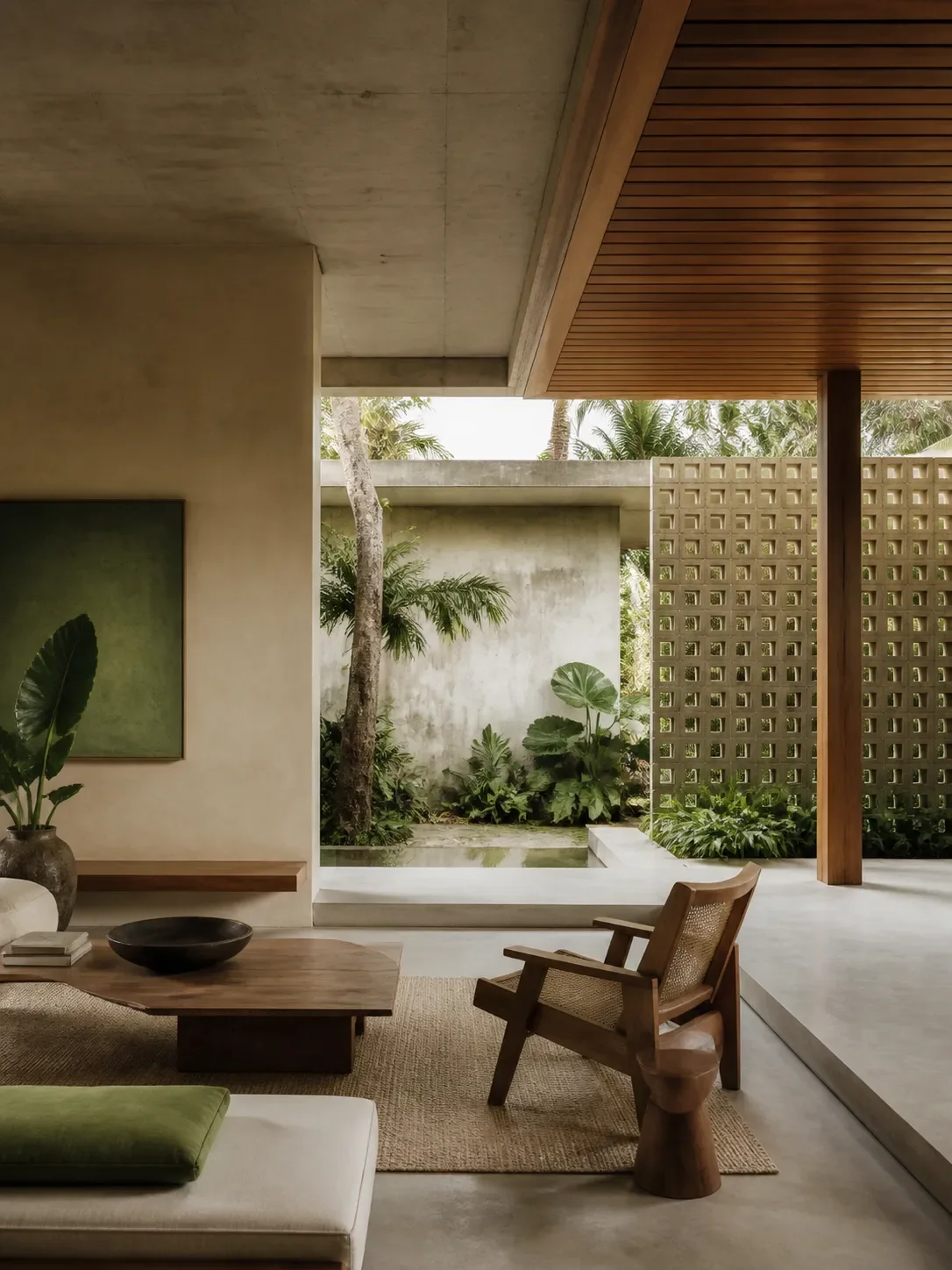
Tropical Modernism makes shade, airflow, and shelter visible. Its calm comes from deep overhangs, open edges, screened light, pale concrete, and warm timber rather than from tropical decoration. The style emerged when European Modernism was adapted for hot, humid regions in West Africa and India. 12
Card 2 — origins
The story begins in the 1940s and 1950s, when Jane Drew and Maxwell Fry developed a climate-adapted version of Modernism in West Africa and India. Fry was stationed on the Gold Coast, now Ghana; Drew joined him in 1944. Their postwar schools and civic buildings were part of a colonial infrastructure programme, while newly independent nations later used modern architecture to express a new public identity. India became independent in 1947; the Gold Coast became Ghana in 1957. 13
That history has a real tension. Early accounts often centred British architects and dismissed local building traditions; later Ghanaian and Indian architects, schools, and public institutions widened the movement’s authorship and meaning. 2
Card 3 — elements
The working vocabulary is environmental: solid east and west walls temper strong sun; more open north and south faces invite air; brise-soleil, adjustable louvres, and wide eaves filter glare, rain, and heat while keeping rooms ventilated. Long low blocks, exposed concrete, glass, steel, and sculptural screens give the style its recognisable profile. 1
For an interior translation, keep the palette close to the materials: chalk white, warm concrete, teak, woven cane, natural linen, dark steel, dusty terracotta, and one muted leaf-green accent. The furniture stays low and spare; the threshold between inside and outside does the decorating.
Card 4 — modern use
The contemporary lesson is simple: design comfort before styling. Start with a shaded opening, a breezy plan, an adjustable screen, and a roof that protects the room. Then add quiet furniture, tactile surfaces, and planting that belongs to the climate. Tropical Modernism faded as sealed glass and air conditioning replaced open facades, but its passive-cooling principles have renewed relevance in a warming world. 1
The boundary matters: concrete plus palms is a mood; shade and airflow are the design language. This atlas treats the images as a conceptual contemporary translation, not as a documented building.
References
- 1
- 2
- 3Tropical Modernism: Architecture and Independence — ArchitectureAU
architectureau.com
Comments (2)