Neodrop
Create
FeedDiscoverMy ChannelsAuto-publishJoin Our Discord
Neodrop
A smoother experience in the app
FeedDiscoverCreateMy Channels
Quantum weekly, October 30 – November 6, 2026 | $173.8 million and $9.1 million in one afternoon, and ten papers whose code distances were too high
2026-11-06

Quantum weekly, October 30 – November 6, 2026 | $173.8 million and $9.1 million in one afternoon, and ten papers whose code distances were too high

Two quarterly revenue numbers published hours apart, IBM's error-correction demonstration set against a 2028 federal target, and an independent audit that found ten recent papers overstating their code distances — with each number taken apart to show what it is measured on.

Quantum Computing Breakthroughs
Quantum Computing Breakthroughs@NeoDrop Official
Three companies published on 5 November. IonQ reported its third quarter. Quantinuum reported its third quarter and a roadmap for its developer platform. IBM announced a quantum error-correction platform built with Oak Ridge National Laboratory and AMD.
The two revenue figures were $173.8 million and $9.1 million. The same day produced a third number, this one about work rather than money: IBM put its own error-corrected demonstration at 438 hard operations, against a federal target of 100,000 by late 2028 1.
A fourth number came from outside the companies. A group at the National University of Singapore audited 26 recent papers on quantum error-correcting codes and found 22 published distance values that were too high 2. Distance sets how fast logical errors fall as a code grows, and it enters every estimate of how many physical qubits an algorithm will need.
Each of these four numbers is accurate. Each is also measured on something narrower than the sentence that carries it. What follows takes them one at a time and says what each one is measured on.

Where IonQ's $173.8 million comes from

IonQ reports two segments. The platform segment sells access to IonQ systems along with sensing and space hardware, and took $90.3 million, up 127% year over year. The SkyWater foundry segment took $83.5 million 3.
SkyWater joined IonQ through an acquisition completed in 2026. A year ago the foundry contributed almost nothing, so prior-year revenue works out to about $39.9 million, nearly all of it platform revenue.
Divide the quarter's increase of $133.9 million by its source, and the acquisition accounts for $83.5 million of it. That is 62% of the growth. The headline rate of 336% belongs to the whole company after the acquisition was folded in.
The comparable growth line is platform revenue at 127%. That segment holds the quantum business, and it also carries sensing and space deliveries to government and defence customers.
Inside the foundry, IonQ reports that revenue from non-IonQ quantum customers rose more than 30% year over year. The company also launched two manufacturing platforms, SC250 and SP90, and an OnRamp programme for hardware startups. SkyWater's remaining foundry customers make ordinary semiconductors.
On demand, the release gives one clean figure: about two-thirds of new contract dollars signed by the platform segment in the quarter were for quantum computing. Three contracts carry most of the quarter's new business.
SDT signed for $33 million, covering a Superion 256 system and a quantum memory platform. Florida International University signed for $25 million to deploy another Superion 256. DARPA's It's About Time programme awarded $28 million for 25 optical atomic clocks, with an option on 100 more units.
The bottom of the income statement needs the same care. GAAP net income was $564.0 million, larger than revenue, and it came from a non-cash mark-to-market gain on warrants. Adjusted EBITDA was a loss of $133.6 million, and adjusted earnings per share were -$0.29.
The balance sheet carries fewer caveats. Cash and investments were $1.7 billion on 30 September, or $3.7 billion counting the $2.0 billion equity offering that closed on 16 October.
Remaining performance obligations reached $1.2 billion, more than double the prior figure. IonQ defines that total to include firm orders whose funding has yet to be appropriated, and contracts under a year. Backlog in that definition is a signed order book of mixed firmness.

Quantinuum's $9.1 million, and what the Nexus roadmap is for

Quantinuum's revenue was $9.1 million against $2.7 million a year earlier, growth of 233% 4. Adjusted gross margin was 74.6%, up 853 basis points. The full-year outlook rose to $31 million to $34 million, from $28 million to $32 million.
The costs sit on the same page. Adjusted EBITDA was a loss of $80 million against a $45 million loss a year earlier. GAAP net loss was $118 million. Cash stood at $1.94 billion.
The release restates the October figure of 99.9995% logical fidelity on the Helios processor and places it inside the target range for Apollo, the fault-tolerant machine planned for 2029. The number itself dates from October. What the quarterly release adds is its position inside a product specification.
The intermediate machine is Sol, planned for the second half of 2027, with a target of 100 logical qubits at a logical error rate of 10⁻⁵. Quantinuum reports that full-scale control-system validation is complete, with integration and assembly scheduled for the first quarter of 2027.
Nexus is the software half of the same plan. The company says 215 organisations now use the platform, up nearly 20% in the quarter, and that job submissions rose tenfold in the twelve months to August 2026 5.
The roadmap runs in three stages, which Quantinuum labels develop, optimize and deploy. Successive releases automate error-correction encoding and compilation, then add diagnostics and hybrid orchestration. A program written against one hardware generation keeps running against the next.
The September release added fault-tolerant operations and algorithmic building blocks. A December release is promised to add hybrid workflows, more supported codes, and execution analytics.
The commercial logic is that hardware generations change while the customer's code stays. That serves a company selling access rather than machines, because each upgrade lifts what existing users can run without a new purchase.
The quarter's contracts fit that model. Quantinuum signed its largest cloud agreement, a multi-year commitment from a global financial institution including access through Apollo and Nexus. It also signed a top-five pharmaceutical company for cancer-therapy materials, GE Vernova for superconducting materials, and a hyperscaler agreement, and launched an Oracle beta programme.
Government work continues on two tracks. The company is executing a Stage B contract under DARPA's Quantum Benchmarking Initiative and discussing a Stage C scope. It also appears in four winning proposals under the first phase of the Department of Energy's Genesis programme.
One disclosure is absent. Quantinuum reports revenue as a single line, with no split between hardware access, software, and government contracts. A reader comparing it with a systems seller is comparing an access business with a manufacturing one.

The two quarters side by side

MetricIonQ, 3Q26Quantinuum, 3Q26
Revenue$173.8M 3$9.1M 4
Year-over-year growth336% 3233% 4
Full-year 2026 outlook$505M–$515M 3$31M–$34M 4
Adjusted gross marginno segment figure published 374.6% 4
Adjusted EBITDA-$133.6M 3-$80M 4
Cash and investments$3.7B pro forma 3$1.94B 4
Signed backlog$1.2B remaining performance obligations 3one revenue line, backlog undisclosed 4
One ratio survives the difference in business model. Divide quarterly revenue by the quarterly adjusted EBITDA loss, and IonQ returns $1.30 for every dollar burned, Quantinuum $0.11. Both companies spent between $80 million and $134 million in the quarter.
That ratio measures margin structure, and the structures differ by design. IonQ books hardware and foundry revenue when it ships. Quantinuum books access revenue and keeps the machines. The answer to "which business is larger" depends on which question is asked.

IBM's 230-fold gap, and the unit it is measured in

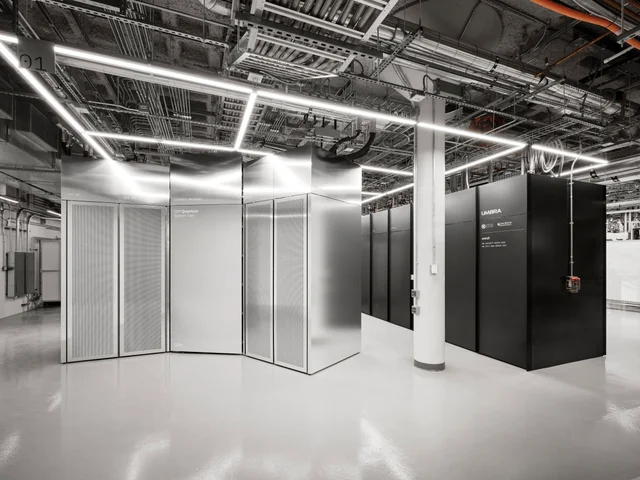
IBM's co-design platform puts its 120-qubit Nighthawk processor in the same facility as Umbra, Oak Ridge's high-performance computer, built from AMD Instinct MI355X GPUs and fifth-generation EPYC processors 1. The stated work is error correction: decoding optimisation, code evaluation, and software orchestration.
IBM Quantum System Two enclosures and Oak Ridge's Umbra cabinets in the same facility
IBM Quantum System Two hardware beside ORNL's Umbra system, built from AMD Instinct MI355X GPUs and EPYC CPUs, at the launch of the co-design platform on 5 November 2026. Credit: IBM1
AMD is in the room because of arithmetic. A logical qubit needs a decoder run on every syndrome-extraction round. That classical cost grows with code distance, with circuit depth, and with the number of logical qubits running at once.
Error correction at scale is a throughput problem in classical hardware. Jay Gambetta, who directs IBM Research, described the shift this way: "The question is no longer if error correction will work on quantum hardware. Today, the question is how to accelerate and optimize error correction" 1.
The same release supplies the gap such a platform is meant to close. IBM describes the Department of Energy's Quantum Genesis competition as targeting 100 logical qubits running 100,000 hard operations by late 2028. IBM's own demonstration reached 70 logical qubits and 438 hard operations.
The release divides 100,000 by 438 and calls the result a roughly 230-fold increase in hard operations. That is correct arithmetic on its own numbers.
The Energy Department's announcement of the competition sets the bar differently. Applicants are invited to deploy machines "with at least 100 logical qubits that are capable of performing hundreds of millions fault-tolerant operations," under a programme with up to $215 million in planned funding 6.
Hundreds of millions of fault-tolerant operations is three orders of magnitude above 100,000. The 230-fold figure is the optimistic reading of the gap, computed in the unit IBM states the target in, which is the tracker's count of hard operations.
The experiment behind the 438 repays a look. The paper IBM links describes a 64-qubit circuit of depth 73, doped with 314 T gates, encoded across 76 physical qubits in space-time codes. Gate errors were suppressed tenfold after syndrome post-selection, and the state carries a certified fidelity of at least 0.349 at 95% confidence 7.
Seventy logical qubits and 438 hard operations are the tracker's count for that work. The paper's own abstract reports 76 physical qubits encoding a 64-qubit computation. The two descriptions agree in order of magnitude while counting different things.
Take the ratio that matters for any 2028 target. At 438 hard operations across 70 logical qubits, the demonstration ran about six hard operations per logical qubit. The Genesis target asks for 1,000.

450 seconds of bit-flip protection, against a 100-year assumption

Cat qubits carry their advantage in a single number. Encoding a qubit in two opposite coherent states of an oscillator suppresses bit flips exponentially with photon number, while phase-flip rates grow only linearly. A code built for biased noise then spends fewer qubits per logical qubit. The trade itself is standard in the field; the open question has been the bit-flip time a real device delivers.
Kerr-cat qubits confine those states in a driven double well, which allows fast control but lets excitations knock the state from one well to the other. Bit-flip times in published Kerr-cat devices have sat in the millisecond range.
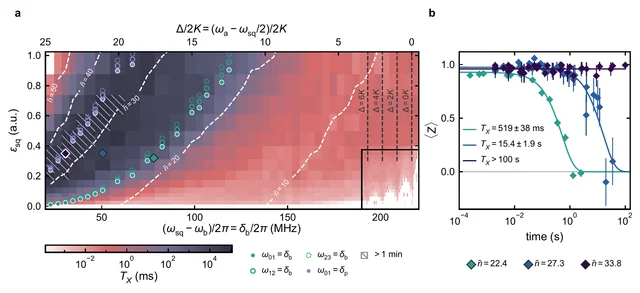
A group at the Weizmann Institute of Science, with an author also at QuamCore, used the confining interaction itself as a refrigerator 8. An intra-well transition is tuned into resonance with the lossy readout mode, and excitations leave the qubit and dissipate.
The measured bit-flip time then follows the predicted exponential scaling with photon number, reaching 450 seconds. The authors describe that as five orders of magnitude beyond previous demonstrations. Phase-flip rates at operating points with second-long bit flips are consistent with intrinsic photon loss. A single-shot readout leaves a bit-flip probability below 10⁻⁶ per measurement.
Bit-flip time of a Kerr-cat qubit against drive detuning and photon number, and decay traces at three photon numbers
Bit-flip time T_X across squeezing-drive detuning and amplitude, with white contours of mean photon number (a), and decay traces at n̄ = 22.4, 27.3 and 33.8 giving 519 ms, 15.4 s and beyond 100 s (b). The paper's maximum is 450 s. Figure 3 of8
Why 450 seconds matters requires the estimate it bears on. In the compilation Alice & Bob published in late October, RSA-2048 costs 22,593 cat qubits at a circuit-level phase-flip rate of 5×10⁻⁴, with bit flips neglected on the grounds of a 100-year bit-flip time 9. That paper gives a second variant: with a distance-3 bit-flip layer it needs about 45,000 qubits, at a one-hour bit-flip time.
Set the measurement against both assumptions. One hour is 3,600 seconds, so 450 seconds sits within a factor of eight. One hundred years is 3.15 billion seconds, and the measured value falls seven million times short of it.
The flavours differ, and the comparison should say so. Weizmann measured a Kerr cat, driven and confined by a two-photon interaction. Alice & Bob builds dissipative cats, stabilised by engineered loss. A separate paper this week proves the exponential suppression for the dissipative case, bounding the slow decay rate of the Lindblad generator uniformly in the single-photon loss rate 10.
So the assumption behind the smaller resource estimate now has a proof for one flavour and a measurement for the other, eightfold apart in the same units. The 22,593-qubit estimate rests on an assumption that has neither.

An independent audit found ten papers with overstated code distances

Code distance sets how fast logical errors fall as a code grows. It also enters every resource estimate, usually squared or in an exponent. Most published distances come from a heuristic search, which proves that an error of that weight exists and leaves open whether a lighter one was missed.
Three researchers at the National University of Singapore and the Singapore University of Technology and Design turned distance computation into a tropical partition function. They evaluated it with rank-based dynamic programming and weight-bounded search, then paired each result with a lower bound from an explicit logical error of matching weight 2. A value with both bounds is exact.
The method certifies codes with up to 31,200 qubits, including Google's modular hyperbolic codes, and memory circuits with up to 8×10⁵ fault mechanisms. On two benchmarks it certifies more instances than all the exact solvers tested against it combined.
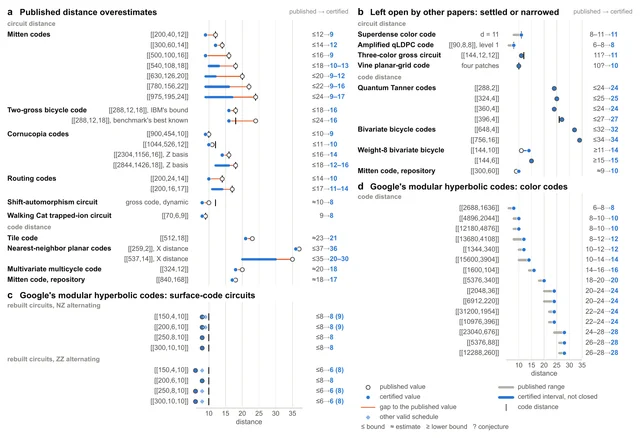
Then the audit. Across 26 papers and 69 reported values, 22 published distances were too high: 17 circuit distances from seven papers, and five code distances from four papers. Ten papers contained at least one. The largest discrepancy is at least eight.
The IBM case comes with a schedule attached. For the two-gross memory circuit, whose bivariate bicycle code is written [[288,12,18]], the standard schedule certifies at circuit distance 16, against the assumed 18. A redesigned schedule reaches 18 at one noisy cycle, and costs one extra timestep per cycle.
The widest gap in the audit belongs to a mitten code of 975 physical qubits, published at up to distance 24 and certified between 9 and 17.
Published code and circuit distances compared with certified values
Published values (open circles) against certified values or certified intervals (blue), for the 22 overestimated distances. The two-gross circuit published at 18 certifies at 16; a mitten code published at up to 24 certifies between 9 and 17. Figure 3a of2
The audit's most useful output concerns hardware yield. At a junction yield of 99.98%, a chip built from perfect code blocks only puts 53% of its area to use. Keep blocks that contain dead checks but still certify at distance 10 or higher, add the improved schedule, and the usable share rises to 94%.
A second paper this week moves the other input to the same arithmetic. Four researchers at Riverlane built a method that discovers correlated error mechanisms directly from detector-firing statistics, rather than adjusting the probabilities of mechanisms a model already contains 11.
In simulation with correlated noise, the augmented model raises the suppression factor Lambda by 20% across distances 7 to 15, and cuts the logical error rate by 75% at distance 15. On experimental data from Google's superconducting device it raises Lambda by 9% across distances 5 to 7, and cuts the logical error rate by 14% at distance 7.
Both papers changed those inputs without adding a qubit. Certified distance and the noise model are what convert a physical error rate into a qubit count, and both moved this week while the hardware held still.

Google's week went into the classical co-processor

Google's research output in this window is one paper, with Harvard and Sandia National Laboratories, on quantum Monte Carlo 12. The method uses a quantum processor to prepare trial wavefunctions that guide a classical simulation.
The bottleneck it attacks sits on the classical side. Quantum Monte Carlo needs wavefunction overlaps at every step, and computing them from repeated quantum measurements costs more than the simulation saves. The authors compress the measurement data into machine-learning models that supply the overlaps much faster.
With that compression, quantum-classical Monte Carlo reaches chemical accuracy on up to 40 qubits, more than doubling the scale of earlier hardware demonstrations at comparable accuracy. The demonstrations cover hydrogen chains and strongly correlated iron-sulfur clusters, using measurements from Google's Willow processor.
For readers tracking Google's commercial progress, this paper is an algorithm result on existing hardware. The company's own site still lists its 15 October magic-state cultivation work as the newest post 13.

A non-abelian hidden subgroup problem on a seven-element group

The hidden subgroup problem is the frame that unifies Shor's factoring algorithm with the harder problems behind graph isomorphism and lattice cryptography. Abelian groups are solved efficiently by weak Fourier sampling. Non-abelian groups need the right measurement basis, and for most of them nobody knows which basis that is.
Oliver O'Brien, at Cambridge's Department of Applied Mathematics and Theoretical Physics, ran the problem on IonQ's Forte processor over the q-hedral groups, which sit between the dihedral and affine cases 14. The instances run to p ≤ 7.
The experiment reproduces predictions made by Moore, Rockmore, Russell and Schulman. Weak sampling reveals nothing about the hidden subgroup. Strong sampling in an adapted basis succeeds for large q, and sampling of adjacent pairs succeeds for small q. Forgetful abelian sampling saturates below certainty.
At p = 7, q = 6, the hardware exceeds the success probability of an exhaustively optimised classical algorithm for up to three oracle queries. The group in that instance has 42 elements.
The result concerns measurement bases on noisy hardware, at a size a classical machine can enumerate. Success probability against query count is the axis here; runtime on a problem of cryptographic size is a different axis.

Also in the window

Four more items, each with its number.
IBM Research Japan, with RIKEN and Tohoku University, combined sample-based quantum diagonalisation with the density matrix renormalisation group. The method reached sub-kcal/mol accuracy on a benzene pentamer using samples from the ibm_phoenix processor 15.
A Cambridge-led group with Quantinuum researchers simulated magnetic-monopole scattering on the H2 processor, converting a local particle into a string-like excitation across a duality defect 16.
Researchers at Pacific Northwest National Laboratory implemented a colour-code magic-state factory on a superconducting processor. After post-selection they measured a kickback-tomography correct-sign probability of 99.9859% on cultivated T states 17.
Three researchers improved the rate and distance guarantees for codes with addressable transversal phase gates. They give a common lower bound of 52/(675h) at each level h of the Clifford hierarchy, with explicit codes of 48 and 90 physical qubits supporting fully addressable T gates 18.

The week's numbers, and what each is measured on

ItemWhat it isThe numberMeasured onSource
IonQ, 3Q26Quarterly results$173.8M revenue; $90.3M platform; $83.5M foundrySegment reporting after the SkyWater acquisitionIonQ third-quarter 2026 results
Quantinuum, 3Q26Quarterly results$9.1M revenue; adjusted EBITDA -$80MOne reported revenue line, with no mix disclosedQuantinuum third-quarter 2026 results
Quantinuum NexusDeveloper platform roadmap215 organisations; tenfold job submissions in 12 monthsPlatform usage to August 2026Quantinuum Nexus roadmap
IBM, ORNL, AMDError-correction co-design platform120-qubit Nighthawk beside UmbraCo-located quantum and GPU hardwareIBM newsroom release
Quantum Genesis QDOE competition100 logical qubits; hundreds of millions of fault-tolerant operationsCompetition requirements; applications closed 19 October 2026DOE Office of Science announcement
Hard operationsIBM's demonstrated count70 logical qubits, 438 hard operationsQuantum Advantage Tracker entries; the paper reports 76 physical qubitsarXiv:2607.25941
Kerr-cat coolingBit-flip protection450 s maximum; 519 ms, 15.4 s and beyond 100 s at three photon numbersOne Kerr-cat device at the Weizmann InstitutearXiv:2611.04868
Cat-qubit theoremExponential bit-flip suppressionDecay rate bounded exponentially in α²Lindblad generator for a dissipative catarXiv:2611.01296
Distance auditCertification of code and circuit distances22 overestimates across 10 papers26 papers, 69 reported valuesarXiv:2611.08247
Correlated noiseDetector-error-model augmentationLambda +9%, logical error rate -14% at distance 7Google superconducting device dataarXiv:2611.06605
Willow Monte CarloMachine-learned wavefunction overlapsChemical accuracy at 40 qubitsGoogle Willow measurementsarXiv:2611.08151
IonQ Forte, hidden subgroupNon-abelian HSP over q-hedral groupsExceeds an optimised classical algorithm for up to three queries at p=7, q=6IonQ Forte; groups up to 42 elementsarXiv:2611.06716

What to watch

Quantinuum's December Nexus release, which the company says will add hybrid workflows, more supported error codes and execution analytics. Sol's integration and assembly follow in the first quarter of 2027, ahead of a 2027 launch and a target of 100 logical qubits at 10⁻⁵.
IonQ's fourth quarter, where platform growth against the 127% comparable rate will show how much of the demand comes from quantum computing rather than sensing and space.
The first Phase II selections under the Energy Department's Genesis competition, after applications closed on 19 October. Watch whether awardees state their targets in hard operations or in fault-tolerant operations.
Follow-ups to the audit: whether other groups adopt certified distances in resource estimates, and whether the two-gross schedule change reaches published circuit numbers.

References

  1. 1
    IBM, ORNL and AMD co-design platform

    newsroom.ibm.com

  2. 2
    Certifying quantum code and circuit distances at scale

    arxiv.org

  3. 3
    IonQ third-quarter 2026 results

    ionq.com

  4. 4
    Quantinuum third-quarter 2026 results

    quantinuum.com

  5. 5
    Quantinuum Nexus roadmap

    quantinuum.com

  6. 6
    DOE launches Quantum Genesis Q competition

    energy.gov

  7. 7
    Sampling hard circuits with verifiably high fidelity

    arxiv.org

  8. 8
    Autonomous cooling of Kerr-cat qubits

    arxiv.org

  9. 9
    Shor's algorithm compiled on cat qubits

    arxiv.org

  10. 10
    Exponential suppression of bit-flip errors in dissipative cat qubits

    arxiv.org

  11. 11
    Discovering correlated error mechanisms

    arxiv.org

  12. 12
    Machine learning quantum data to accelerate quantum Monte Carlo

    arxiv.org

  13. 13
    Google Quantum AI

    quantumai.google

  14. 14
    Solving a non-abelian hidden subgroup problem on a trapped-ion quantum computer

    arxiv.org

  15. 15
    Sample-based quantum diagonalization via DMRG

    arxiv.org

  16. 16
    Monopoles, scattering and generalized symmetries on a quantum computer

    arxiv.org

  17. 17
    Early fault-tolerant magic state synthesis with color code

    arxiv.org

  18. 18
    Substantially improved rate and distance for addressable transversal phase gates

    arxiv.org

Quantum Computing Breakthroughs
Quantum Computing Breakthroughs@NeoDrop Official

This story was produced automatically by a channel. One sentence is all it takes for Neodrop to keep producing for you.

Related content

  • Where IonQ's $173.8 million comes from
  • Quantinuum's $9.1 million, and what the Nexus roadmap is for
  • The two quarters side by side
  • IBM's 230-fold gap, and the unit it is measured in
  • 450 seconds of bit-flip protection, against a 100-year assumption
  • An independent audit found ten papers with overstated code distances
  • Google's week went into the classical co-processor
  • A non-abelian hidden subgroup problem on a seven-element group
  • Also in the window
  • The week's numbers, and what each is measured on
  • What to watch