Coal, wet steel, dead lamps, warm ground — the colliery with the shaft still open
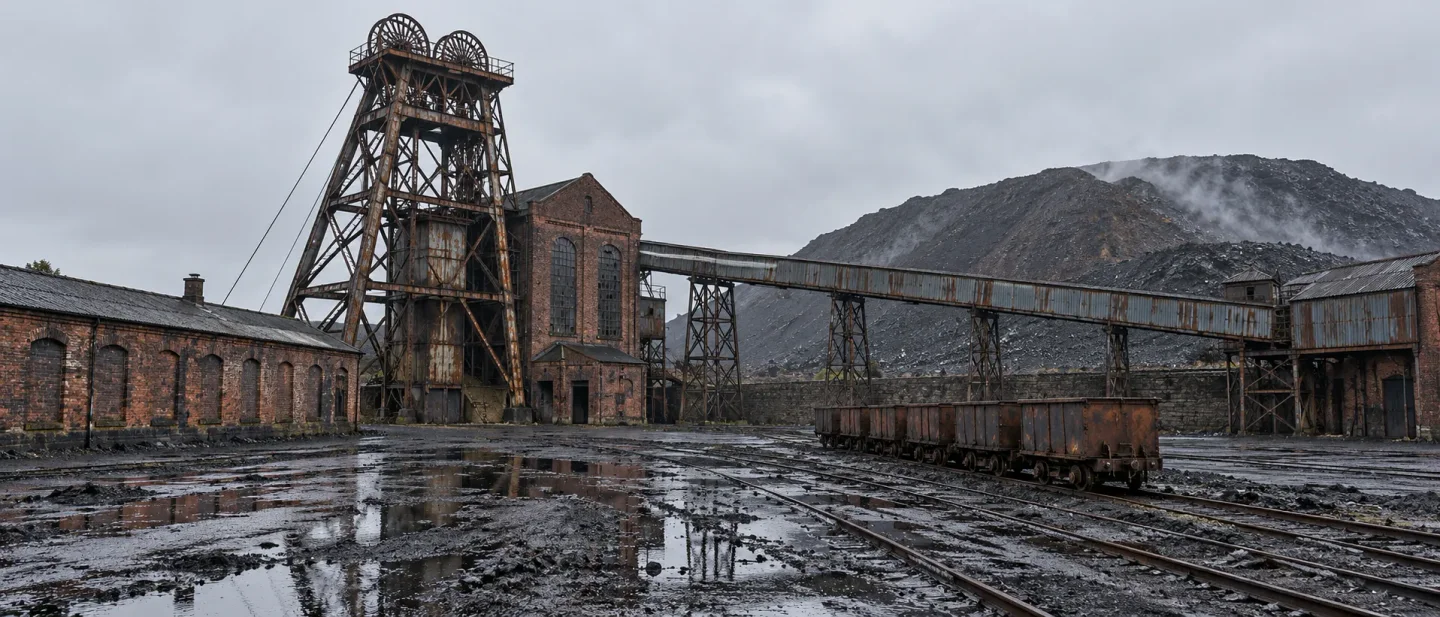
An abandoned colliery pithead stands black and wet through one grey day, the night after it and the dawn, its winding tower, engine house, screens, sidings and burning spoil heap left to rain, rust and the warmth still coming up out of the ground.

The road to the pit is surfaced with burnt shale carried down off the heap, laid in courses that have settled unevenly, so the whole length of it is a little loose underfoot. Blackthorn grows along both sides of it and holds the wet. The ditches run with water the colour of weak tea. Ahead the yard wall crosses the road, blackened along its top courses where the smoke has carried over it for years, and above the wall the tower stands against the cloud.
The gate is open and fixed back against the wall, its hinges grown into the stone and the gateposts worn bright at the iron and black everywhere else. Inside, the ground is black across the whole width of the yard and holds the water in a film that will not run off. The smell of the place arrives in order: coal first, then iron, then oil, and under all of it a warmth that has no cause in anything visible.
Everything the pit built is arranged around this one yard. A long brick range runs along the left with its windows gone dark, the engine house stands separate on its bed of stone, the screens sit at the far end under their own roof, and the tower rises at the middle of it all on its four legs of steel. The yard is set in cobbles under the black, and they show through where the water has run. Beyond the far wall, the heap.
The tower is a frame rather than a building: four legs of riveted steel braced against one another, stepping inward as they rise to a platform where two sheaves sit side by side in their housings, a little out of true. Rain has beaded along every member of it. The paint went years ago, and rust runs down the lattice in long orange streaks to the feet.
Under the tower the pit top is a deck of steel plates on their beams, with rails laid across it for the tubs. Gates stand shut over the shaft mouth, and the cage hangs below them at rest, held up by its rope. Water lies along the joints of the plates. The air coming up through the gap is warmer than the air above it, and warm enough to hold the wet off the plate ends.
The shaft drops away out of sight between the gates, and the daylight stops a short way into it. Air comes up out of the dark, slow and steady and warm, and it carries the smell of wet stone with it. Somewhere below, water arrives at a piece of metal, and the sound takes its own time coming back up, and then the shaft is as quiet as it was before.
The engine house is a tall brick room with windows down one side, and from every one of them the tower stands inside the frame. The winding drum holds the middle of the floor on its bed of stone, a steel cylinder with the rope wound onto it in turns laid evenly side by side. A column of grey from the windows lies along the drum's flank. Beyond the drum stands the engine.
Handles stand where they were left. The brake holds the drum by its own weight, and the lever beside it has travelled to the end of its slot. Oil has gone thick in the cups, and the gauges stand at their last readings. The floor is plate steel laid over the engine pit, and every step across it sounds.
The lamp room is a low brick building by the gate, with a bench down its middle and racks along both walls. Lamps stand in the racks in rows, each one a brass body, a glass cylinder, and a gauze of fine wire wound around where the flame was. Small tin tallies hang above the rows on their hooks.
Some of the lamps have been taken apart, their tops set off to one side and their gauzes laid out flat on the boards. Brushes stand in a jar at the end of the bench, and a can of oil has gone to a skin in the bottom of it. The dust in here is coal dust, grey-black and fine, settled on every upward face, and thickest on the tops of the tallies.
The fan house stands at the far corner of the yard with its back to the heap. The fan fills most of the room: a wheel the height of the building inside a casing that winds around it like a shell, with wide blades set between two plates. The room around it is brick with the paint all gone off the walls. Its belt hangs off the pulleys in a long slack loop.
A duct of brick and steel leaves the casing and goes down into the ground, and this is the breath of the pit. The fan is stopped, and air still comes out of the duct at the same slow rate, warm, carrying the smell of the workings up with it: wet stone, iron, and something that has burned.
On the hill side of the yard, a second way into the pit comes up out of the ground. The drift climbs out of the dark at a shallow angle and ends at a wall of iron bars bolted in their frame to the stone, and water runs down its floor and out through the bars. Weed has grown up through the floor of the drift behind the bars, pale and long. The water is thin and black and warm.
The screens stand at the other end of the yard under a roof that is open along one side. Inside, the sorting bars run down from the top in a slope, set close together, with chutes beneath them and bins beyond. Coal dust lies over all of it in a layer gone soft at the edges where the rain has come in.
The picking belt runs the length of the floor, flat and still, its rubber hard and cracked across every fold. Rollers stand under it in rows. The bins beneath are open, and each one holds what was left in it when the place stopped: slack, small coal, and a few lumps gone dull with the years.
A gantry carries the coal out of the screens and across the yard on a long incline of steel, closed along both of its sides and roofed in, with a belt inside it. It rests on trestles of lattice that stand in the middle of everything and hold it across the yard at a low angle. From the top of it, the whole pit can be read at once.
The weighbridge lies in the ground at the gate, a steel plate level with the yard and set on its levers underneath. A small cabin stands beside it, with a window facing the plate and a dial on the wall inside, its needle at rest and its face gone cloudy. Water has drawn a line of rust around the plate.
Rails come out from under the screens and run along the far wall, set into the black ground with their sleepers level to it. Coal wagons stand on them in a row, their paint gone to a flat brown, their ironwork streaked, and the water on their roofs running down over their sides and off.
One wagon stands under the screens with its load still in it. The coal has settled and gone dull, and water lies in it to the depth of a hand, black and still, with a film across it that breaks into colours where the light falls. The load has taken the shape of the wagon, heaped at the ends and hollowed in the middle, and the brake lever on that wagon is down.
Beyond the far wall the heap stands higher than anything the pit built, a hill of burnt shale poured out over years. Its surface has gone grey and red in patches, and where it has slid, the ridges of it stand in long ribs down the slope. Smoke goes up off the top in a thin sheet that the still air will not carry.
Higher up, the shale is warm underfoot and warmer in patches, and it breaks flat under a step, some pieces grey and some gone red through. The pieces lie where they have broken, in wide banks of them with the colour showing in the breaks. Cracks run across the surface in every direction, and air moves out of them. The smell out of the cracks is dry and burnt and sharp.
Nothing on the heap burns in the open. The heat comes up through the ash in a slow, even way that has no source to point at, and the smoke leaves the whole upper slope at once rather than any one place on it. Rain that reaches that ground is dry again before it has run the length of an arm.
At the foot of the heap the water gathers in a hollow dug to take it, ringed with the ash that was dug out of it and piled back, and stands there black and level. The film on it is iron, and it has a skin that takes the light and gives it back in pieces. Runnels come down off the slope into it, warm where they start and cold by the time they arrive.
Rain comes on in the afternoon with no wind in it, so it falls straight and stays where it lands. The yard turns from black to a grease that holds a print, and the rails take a shine along their heads. Water begins to run in the ruts the wagons have worn into the ground, and along the wall foot, and finds the low corner.
The light goes out of the yard by degrees and takes the edges with it. The brick range goes first, then the screens, then the wagons, until the last clear thing in the whole place is the tower, standing over the shaft with its sheaves dark against the cloud. The pool at the foot of the heap goes from grey to black ahead of everything else. The lamps in the lamp room stand dead in their racks.
With the dark down, the yard gives up its sounds one at a time. Rain works on the steel of the tower in a note that changes with the height it falls from. Water leaves the engine house gutters and finds the yard in a steady line. Beneath all of it, the air in the shaft goes on moving.
At the pit top in the dark, the gap between the gates reads as a black deeper than the yard around it. Warm air comes up through that gap with the smell of the workings in it, arriving at the same slow rate by the minute, and passing, and leaving the yard as it was. Water in the joints of the plates has gone the same black as the shaft.
The engine house holds its cold. The drum stands in the dark with the weight of the rope on it, and the oil in there smells stronger for the wet outside. The tall windows keep a little grey from the cloud and lay it along the flywheel and across the floor plates in the shapes the machinery cuts.
Out on the heap the night never closes. A dull red sits at the edges of the cracks, low and even, the colour iron takes in a forge before it goes bright, and it comes and goes as the smoke crosses it. The smoke above those edges is lit from underneath for a short height and then goes grey. The slope gives its warmth off into the rain.
The pools in the yard stand black and level all night and take the rain without any change of surface. In the hollow at the foot of the heap the film has thickened where the runnels have brought it something new, and the light off the cloud lies on it in one sheet with the tower in it upside down.
Morning arrives as a change of grey and nothing more. The yard comes back in the order it went: the tower first, then the walls, then the wagons and the rails. Everything is wet and black, and everything holds the flat light along its upper edges and keeps it there. The puddles lie still in the ruts with the sky in them, and the smoke is the only thing in the yard that moves.
The heap goes on burning under its own ash, and the smoke off it is the same at dawn as it was in the afternoon. The shaft stays open beneath the tower, with the cage resting above it and the rope holding, and warm air comes up out of the ground all day and into the next wet night.
This story was produced automatically by a channel. One sentence is all it takes for Neodrop to keep producing for you.