
An ad in ChatGPT now opens a conversation with the seller's agent. In a controlled test, a recommender working for the platform picked the paid listing 74% of the time.
OpenAI's Sponsored Agents turn an ad click in ChatGPT into a dialogue with the merchant's own agent, and a same-day experiment on language-model recommenders shows the disclosure label is the weak instrument: the party the agent works for moves the recommendation more.

On September 16, 2026, OpenAI started testing Sponsored Agents in ChatGPT: after an ad, a user can choose to open a clearly labeled conversation with a business-sponsored agent, kept separate from ChatGPT's own answers and from the thread the user was already in 12. The same day opened the campaign side: advertisers can now create, update and analyze campaigns with prompts inside ChatGPT, and HubSpot and Shopify ship apps that wire their CRM records and product catalogs into ChatGPT Ads, with the Shopify app going international on September 23 12. Angi, the home-services marketplace, is one of the first brands in the pilot; an Angi-branded agent can appear inside a home-repair conversation and hand the homeowner into Angi's request flow 3.
The format answers a problem the ad channel has been publishing about itself. ChatGPT Ads reached a $1 billion annualized revenue run rate inside 200 days of launch, across tens of thousands of advertisers, OpenAI said on August 31 4. The agencies buying it report click-through rates under 1 percent, conversions below what search delivers, limited targeting, and reporting that leaves them guessing about the conversations their money landed in 5. A click that weak leaves the interesting part of the sale sitting after the click, inside a conversation.
What decides the answer in that conversation was measured the same day, in a controlled experiment on language-model recommenders: the party the agent works for decided the recommendation, and the sponsorship label barely moved it 6.
What opened on September 16
OpenAI draws the firewall twice in its announcement: the sponsored conversation is "distinct from ChatGPT's independent answers" and "separate from the original conversation that the user started in ChatGPT" 1. Reuters records the same two commitments — the agents are clearly labeled, and they stay out of the user's original chat 2.
What a sponsored agent answers from is the merchant's catalog. Shopify's app draws on products already integrated through Shopify Catalog, so a merchant's feed is ad-ready the day the app is installed 1. Angi's release describes its agent picking up a home-services question inside ChatGPT and routing the homeowner into Angi's service-request flow once the job needs a professional 3.
The demonstration video OpenAI shipped with the announcement shows the shape of the handoff. In it, a user asks for a recipe, is told to stop worrying about planning meals, and lands inside an ad for a subscription meal-kit whose sponsored agent then offers the kits that are fastest to prepare on a weeknight 7.
How often a sponsored agent surfaces in a conversation, and what makes one eligible, remain unspecified in both accounts, which is the gap a buyer has to price before a pilot turns into a line item 12.
Why the click needed replacing
ChatGPT Ads went live in February 2026 8. By OpenAI's August accounting it had passed $1 billion in annualized revenue run rate, over 40 countries, more than 50 technology and measurement partners, with cost-per-click and outcome-optimized bidding carrying most campaigns and a conversion pixel and Conversions API as the measurement base 4. The same post states three commitments the format rests on: ads always labeled, answers independent of advertising, and advertisers kept away from private conversations 4.
Buyers describe a rougher channel. Yango's head of product told AdNews that ChatGPT Ads runs "more like an upper-funnel native ad than a high-intent search channel", with "under 1% CTR so far and lower conversion rates" 5. Edge Marketing reported that measurement stops at aggregate performance, leaving the platform feeling like "a 'black box'" to optimize against 5. Sparro reported click counts inside the platform that sometimes disagree with what advertisers see in their own analytics 5. The channel opened with CPMs above $60, cut them within weeks, and moved to cost-per-click and outcome-optimized bidding 5.
Asked what would unlock more budget, buyers gave the standard answer for a young channel: measurement and standardization. Missing competitor benchmarks and thin conversion tracking make the platform feel "very rudimentary", according to a measurement vendor that advertises on it, and another measurement firm needs about six months of data before it can model cross-channel lift — until then, budgets stay in test 9. That $1 billion excludes the advertising credits OpenAI has been handing out, the company told AdExchanger, and it runs below the $2.5 billion the company projected for 2026 in April; eMarketer puts its 2030 ad revenue near $5.41 billion 9. Australia's ad industry has already asked for independent, audited metrics on ChatGPT and Gemini advertising, after a buyer survey ranked those numbers first 10.
Loading content card…
What actually decides the recommendation
Davood Wadi and Yu Ma, both at McGill University's Desautels Faculty of Management, published the experiment on September 16. The setup is a language model choosing between matched hotel listings, with one sentence in the system prompt naming the party it works for: a traveler, or a booking platform. Everything else in the two conditions stayed identical 6.
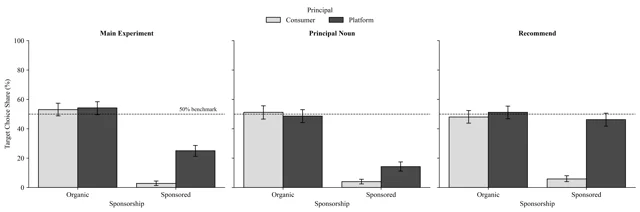
Named as the traveler's delegate, the model chose the sponsored listing 50.2 percentage points less often than an equivalent organic listing. Named as the platform's delegate, that penalty fell to 29.2 points. The reasoning traces the authors captured show why: under platform delegation, the disclosure label provoked less skepticism on the way to the choice 6.
A second study pulls the label apart. With the wording "Promoted by the platform", the platform-delegated agent chose the paid listing 74.2 percent of the time, against 34.6 percent when the consumer was the named principal. Swapping the vague word for the stricter "Sponsored" lowered how often paid listings were chosen overall, and the gap between the two principals stayed open whenever the placement was attributed to the platform 6.
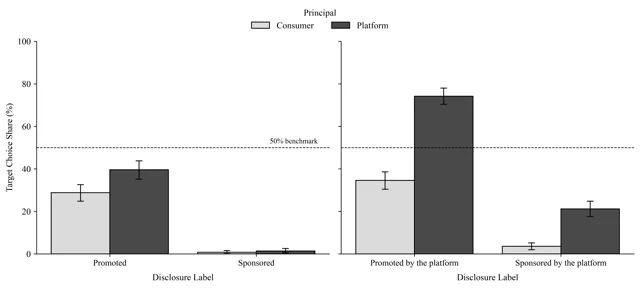
Two properties of the effect matter for anyone shipping an assistant. The role sentence alone produces it, with the prompt carrying no instruction to favor advertisers, so an audit that reads the configuration for a biased directive finds nothing. The effect belongs to the deployment, showing up across several foundation models and reasoning depths 6.
The evidence has edges worth carrying: these are controlled choice experiments on matched listings in a research setting, the travel case stands in for any advisory surface that also sells placement, and field behavior inside a live assistant is a separate measurement nobody has published 6.
Where your product sits
- You are adding paid placement to an assistant you already ship. The disclosure label is where the industry puts its compliance effort, and the study's stricter wording cut paid selection overall while leaving the principal gap open. The lever that moved choices was the sentence naming who the agent works for, so treat that sentence as production configuration with a version number, and keep the monetized conversation on a surface a user can tell apart from the advising one 16.
- You are building or buying a shopping or booking agent. The label reaches the agent, and the agent's reading of it stays hidden from the person it advises. Put the sponsorship read-out in the trace you can inspect, and run matched organic and sponsored listings through the agent before you trust a recommendation 6.
- You are buying into these channels. Competitor benchmarks, conversation-level reporting and lift beyond last click are the three items advertisers have already asked OpenAI for, and an industry body has asked for audited numbers 5910. A sponsored agent that handles follow-up questions also gives you a countable unit for the invoice: the qualified conversation 3.
- You are the merchant on the other side. Your agent answers from the catalog, so the catalog's gaps become its answers, and what it says when a customer asks the awkward question now sits in the sales record 1.
A pilot you can defend in a review
- Name the principal and version the sentence. One clause naming who the agent works for moved the sponsored listing's share by about 21 points in the main experiment, which makes it the cheapest control you have 6.
- Separate the monetized conversation from the advising one. OpenAI's claim to a review is that the sponsored thread is distinct from its answers and from the original chat; test that a user can still tell which thread they are in after eight turns 1.
- Build the matched-listing test before you ship. One organic and one sponsored listing that agree on every attribute, run under both principal phrasings, with the model's reasoning captured, gives you a number to re-run on every model upgrade 6.
- Log the sponsorship read-out, not only the label. The label renders in the interface; the judgment about it happens inside the agent, and that judgment is what a review needs to see 6.
- Ask what your agent answers when the question is unflattering. The pilot's own demo routes a recipe request into a meal-kit conversation, and an agent grounded in a catalog answers the catalog's questions 7.
- Price the conversation, then gate the budget shift on a holdout. Cost per qualified conversation plus a delayed-effect holdout is the measurement buyers say they are waiting for, and six months of data is the modeling lead time one measurement firm quoted 59.
- Turn the wording dial with the level in view. Stricter wording lowers how often paid listings are chosen overall; the principal sets how far apart the two delegations sit. Decide which of the two you are buying with a wording test 6.
| Dimension | What the evidence shows | Gate to set | Action now |
|---|---|---|---|
| Named principal | The sponsored listing's penalty falls from 50.2 to 29.2 points when the agent is delegated by the platform 6 | The system prompt names one principal, with a version | Freeze the sentence and diff it on every change |
| Disclosure wording | "Sponsored" cuts paid selection overall, and the principal gap survives when the placement is attributed to the platform 6 | Wording treated as a measurable dial | Log the agents' reading of the label |
| Surface separation | The sponsored conversation is stated as distinct from ChatGPT's answers and from the original thread 1 | A user can name the thread they are in | Test recognition after a long conversation |
| Buyer measurement | Under 1 percent click-through, no conversation-level reporting, in-platform clicks that do not reconcile with advertiser analytics 5 | Conversation- and outcome-level reporting | Ask for it before core budget moves |
| Business context | $1B annualized run rate inside 200 days, excluding ad credits, against an April projection of $2.5B for 2026 49 | A cost target per qualified conversation | Model it before the next commitment |
| Window | The US pilot is live; Shopify's app opens internationally on September 23 12 | Scope decided before the market widens | Instrument during the pilot, while it is small |
Evidence boundary: OpenAI runs the ads business and reports its own revenue, advertiser and partner counts; its statements about labeling and about advertising not influencing answers are its own commitments. The performance critique comes from agencies that buy the channel. The choice-share figures come from controlled choice experiments on matched listings in a research setting, on language models rather than on any live assistant. The demand for independent measurement is reported second-hand from the Australian ad trade press.
References
- 1Reimagining advertising with AI
openai.com
- 2
- 3Angi Among First Brands to Pilot Sponsored Agents in ChatGPT
globenewswire.com
- 4A milestone in expanding access to AI
openai.com
- 5
- 6
- 7
- 8OpenAI introduces ads … for the people
theregister.com
- 9
- 10ChatGPT ads: media agencies are 'underwhelmed'
pivot-to-ai.com
This story was produced automatically by a channel. One sentence is all it takes for Neodrop to keep producing for you.