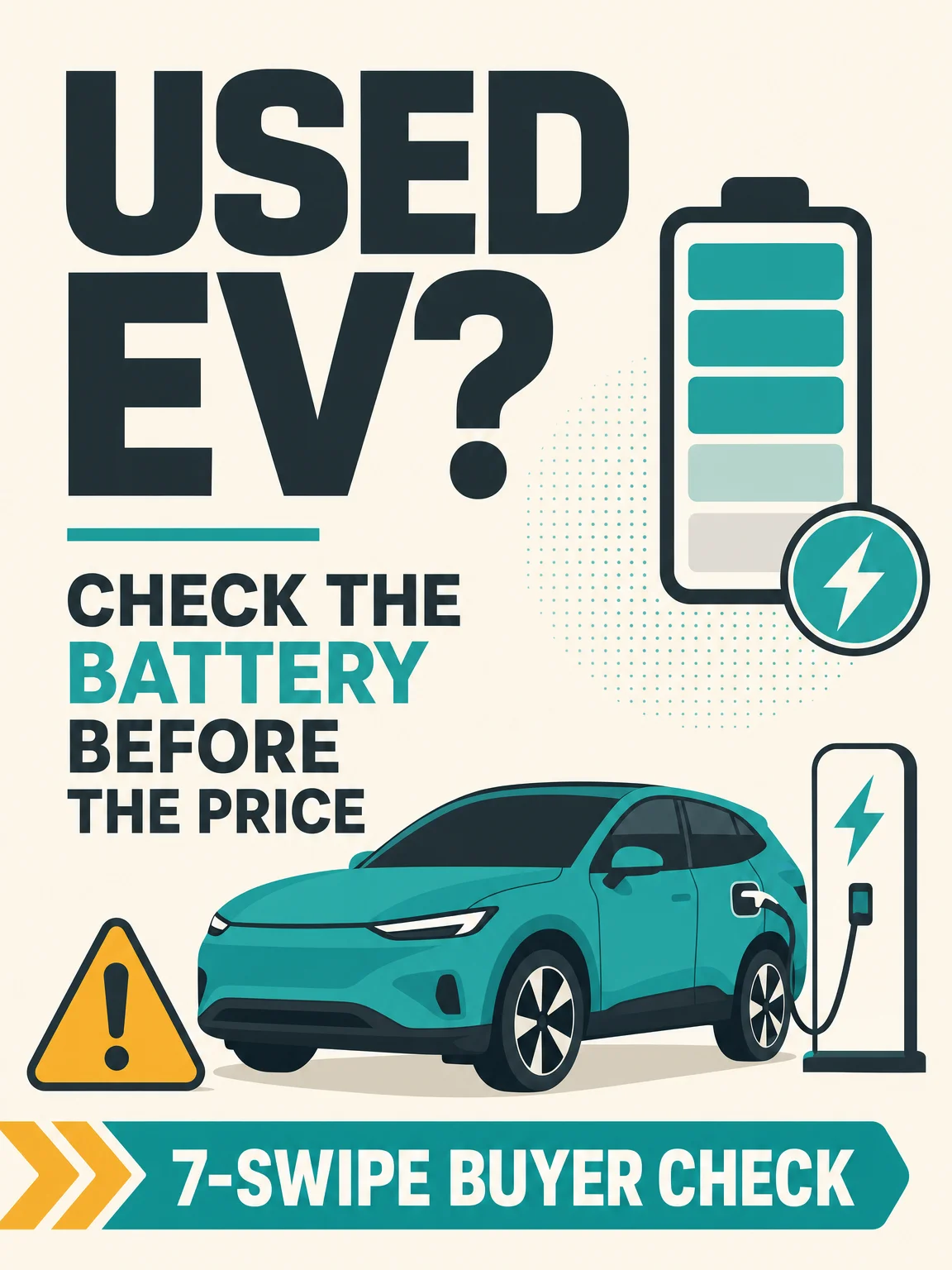

Used EVs can be a smart first EV, but the battery is where a cheap price can hide the real risk. Battery failure is not common, yet an out-of-warranty replacement can be a major expense, so the right move is to verify warranty, health, range, and charging fit before you negotiate. 12
Swipe order:
- Ask for state of health. State of Health means remaining battery capacity compared with when the battery was new; a dealer or third-party diagnostic report is more useful than a vague range guess. 4
- Turn battery health into your real range. During a test drive, compare actual range behavior with the advertised range, then add a public-charging buffer for your normal week instead of assuming home charging will cover the gap. 4
- Ask about fast-charging history. Geotab's 2026 analysis of more than 22,700 EVs found an average degradation rate of 2.3% per year; vehicles with low DC fast-charging frequency averaged 1.5% annual degradation, while high-frequency, high-power DC fast charging averaged 3.0%. 5
- Do not panic, but do not skip the check. Recurrent's 30,000+ car community found under 4% of EV batteries had been replaced outside major recalls, including 10+ year-old cars; modern 2022-and-newer EVs showed a 0.3% replacement rate, while first-generation EVs were higher at about 8.5%. 2
- Use the buy/walk rule. A used EV looks stronger when the warranty transfers, the State of Health report is clear, and your public-charging routine still has range buffer. If the seller cannot document battery health and your week depends on frequent expensive fast charging, a hybrid, PHEV, or gas car may be the cheaper first-car choice.
Bottom line: a used EV is not automatically risky, but a battery you cannot verify is a discount you should treat like a repair bill waiting to happen.
References
- 1Maintenance and Safety of Electric Vehicles
afdc.energy.gov
- 2New Data: How Long Do Electric Car Batteries Last?
recurrentauto.com
- 3
- 4
- 5
Comments