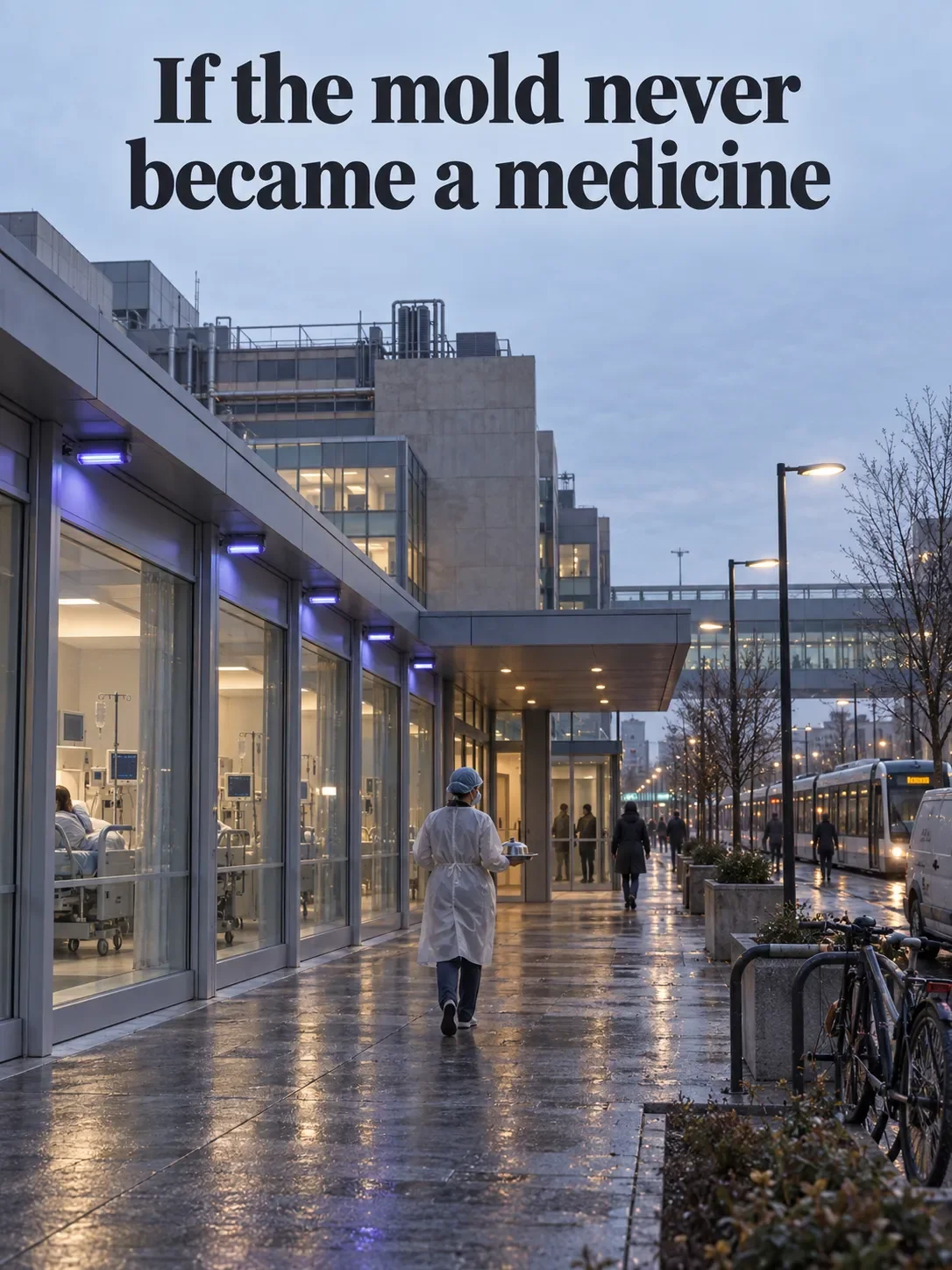

Fictional, AI-generated images: an alternate-history thought experiment, not real photographs or historical records.
London, 1928. Alexander Fleming sees that a stray mold has killed the bacteria around it in one of his culture dishes, and names the juice it makes penicillin. In this imagined 2026 that juice stays a laboratory curiosity: Fleming cannot stabilize it, the Oxford team never carries it to the clinic, and the wartime plants that turned it into a cheap, plentiful drug are never built. Sulfa tablets, sera and vaccines remain what medicine has against infection, so hospitals are organized around air and distance instead — sealed wards, filtered corridors, and a sanatorium that never closed.
The documented history: Fleming published his findings in 1929 but could not purify penicillin. Howard Florey and Ernst Chain took up the problem at Oxford a decade later, and on 12 February 1941 a policeman named Albert Alexander became the first patient to receive the drug; he improved, the supply ran out, and he died. American fermentation plants lifted production from 21 billion units in 1943 to more than 6.8 trillion in 1945, and by 15 March 1945 penicillin was on the corner pharmacy shelf. 1 The physician Charles Fletcher, who gave the first injection at Oxford's Radcliffe Infirmary, described the old wards: every hospital had a septic ward "filled with patients with chronic discharging abscesses, sinuses, septic joints, and sometimes meningitis." 2 The sulfa drugs that survive in this 2026 reached medicine in the 1930s, when Gerhard Domagk showed that the dye Prontosil cured streptococcal infection in mice. 3
Reddit's r/HistoryWhatIf keeps returning to the question. Without antibiotics, one commenter writes, simple infections lead to death or amputation far more often, tuberculosis stays a major killer, and hospitals take sterilization far more seriously. 4 A second thread keeps the superbugs out of the picture and imagines bacteriophage therapy developed in the antibiotic's place. 5
The mold and the medicine it became are documented history. The 2026 around them is the thought experiment.
References
- 1
- 2
- 3Prontosil, Encyclopaedia Britannica
britannica.com
- 4
- 5
Comments (1)