Sunken cars, fired clay, crocheted wool: five ways to make a reef
Five works that treat a coral reef as something to be built — two sunk in the sea for coral and fish to colonise, one a living reef watched live in Miami harbour, and two made by hand in ceramic and crochet.

A coral polyp pulls calcium carbonate out of seawater and builds itself a cup. Thousands of polyps, over thousands of years, pile those cups into a reef — and although reefs cover less than 1 per cent of the ocean floor, they are home to more than a quarter of marine life 1.
The five works in this issue treat a reef as something that can be built. Two were lowered into the sea and left for coral and fish to move into. One is a living reef that arrived by itself in a working harbour, and is now watched, day and night, as an artwork. Two were made by hand — one fired in a kiln, one worked with a crochet hook. None of the five is a reef in the way a natural reef is. Each is an attempt at the same question, which is what it would take to build one.
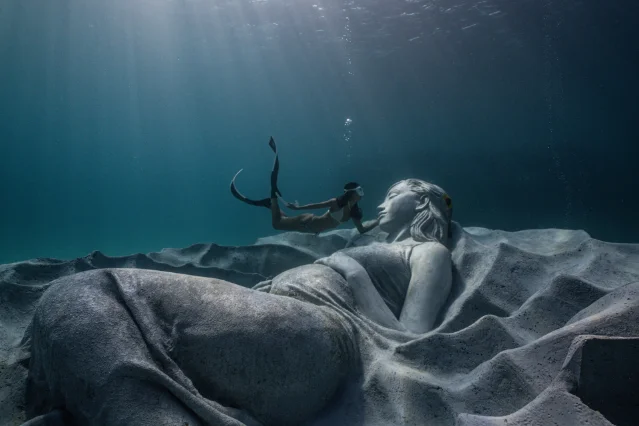
Jason deCaires Taylor: Ocean Gaia
- Artist: Jason deCaires Taylor, a British sculptor born in 1974, who has spent two decades building underwater sculpture parks and museums and has submerged more than 1,200 works 2
- Year: 2025; installed on 14 October 2025 3
- Medium and materials: pH-neutral cement and marine-grade stainless steel; the sculpture weighs more than 45 tonnes and spans 5.5 metres, resting 5 metres below the surface 3
- Biological process: Taylor sets the work inside an existing fringing reef and perforates its edges with openings so that marine life can move inside; his studio describes each sculpture as "assimilated by the ocean and transformed from inert objects into living breathing reefs" 23
- Visual presence: A pale figure lies on a sandy shelf, wrapped to the shoulders with one arm resting across her body and her head turned up; shafts of sunlight come down through blue-green water, and a snorkeller swims above her shoulder. The cement already carries the grain and colour of the surrounding reef. 3
- Documented context: Ocean Gaia is the first underwater sculpture installed in Japan, commissioned and funded by the Tokunoshima Fisheries Cooperative Association; Taylor designed its contours to echo the sand circles made by the Japanese white-spotted pufferfish (Torquigener albomaculosus), which lives in these waters 3. The work is permanently installed off Tokunoshima and is reached by diving or snorkelling.
- Original source: the artist's page for Ocean Gaia
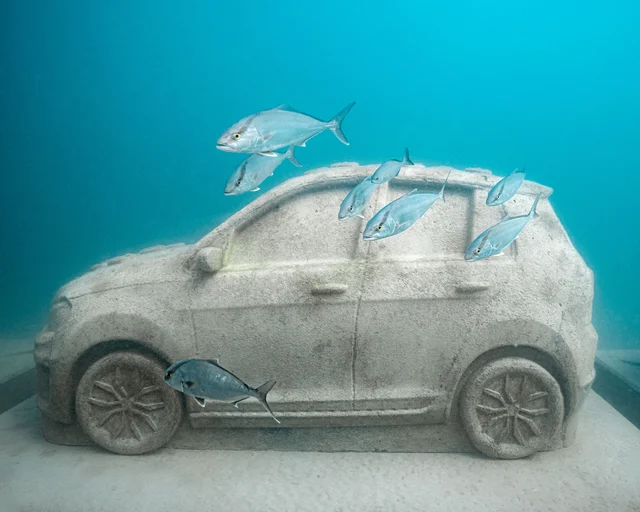
Leandro Erlich with The ReefLine: Concrete Coral
- Artist: Leandro Erlich, an Argentine artist, with The ReefLine — founded and directed by Ximena Caminos and masterplanned by OMA / Shohei Shigematsu 45
- Year: 2025; the cars were deployed on the seabed in October 2025 5
- Medium and materials: 22 life-size cars, each weighing up to 16 tonnes, cast from 3D-printed moulds in marine-grade, pH-neutral concrete and anchored to the seafloor; the installation stands about 780 feet off Miami Beach at a depth of around 20 feet 5
- Biological process: The cars are to be seeded with thousands of coral fragments raised at the ReefLine's Miami Native Coral Lab and fixed in place with Coral Lok, a system designed to attach corals quickly with minimal stress. The ReefLine's director of science expects the octocorals to branch upward, so that "a forest overgrows a traffic jam" 5.
- Visual presence: One car stands on white sand in clear blue water, cast in a single piece of pale concrete with no paint, glass or trim — a car reduced to its own silhouette. A school of silver fish swims over its roof and around its wheels, and the hull is beginning to cloud with marine growth. 5
- Documented context: Concrete Coral is the first fully deployed artwork of The ReefLine, a seven-mile underwater sculpture park and hybrid reef running parallel to the shore of Miami Beach 4. It reprises Erlich's Order of Importance (2019), for which 66 full-size cars were sculpted from sand on the same beach 6. Each car's anchoring system was tested at the University of Miami's SUSTAIN Laboratory against simulated hurricane-strength waves before installation 5. The work is in the sea off Miami Beach and is reached by snorkelling or diving.
- Original source: The ReefLine's installations page
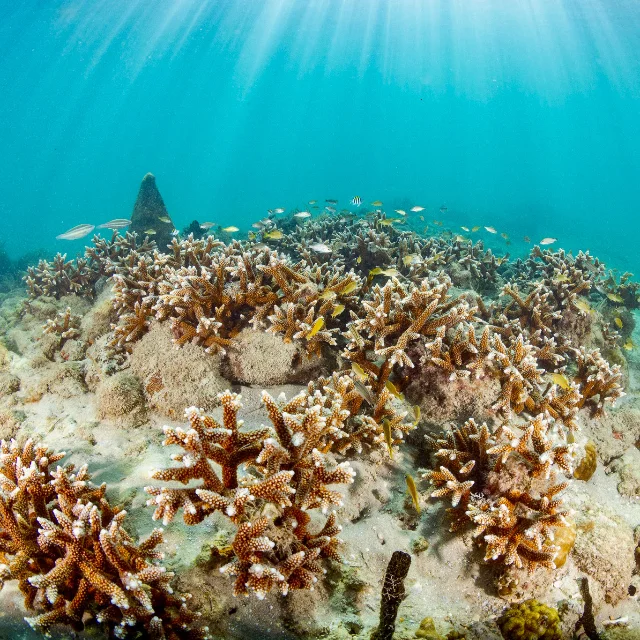
Coral Morphologic: Coral City Camera
- Artist: Coral Morphologic — Colin Foord, a marine biologist, and Jared McKay, a musician — founded in 2007 as a platform for the symbiosis of humans and coral 7
- Year: the camera has been streaming live since 2020 89
- Medium and materials: an underwater camera streaming live from an urban coral reef at PortMiami, together with the corals the camera records 8
- Biological process: None of these corals was planted. They arrived on their own and grow on the port's seawalls, breakwaters and discarded shopping trolleys; a staghorn strain native to the port (Acropora cervicornis) survived the summer of 2023, when water temperatures reached 32 °C and the heat killed every staghorn and elkhorn that had been transplanted to a nearby experimental site, while the port's own corals did not bleach and up to 80 per cent of its brain corals recovered 10
- Visual presence: A thicket of branching staghorn coral fills the frame, tan and pale at the tips, with small fish moving between the branches and a lighthouse-shaped navigation marker standing on the sand behind. The water is open and bright, and nothing in the picture is under glass. 10
- Documented context: Foord first noticed corals growing on Fisher Island's seawall in 2009, a few feet from the shipping channel of Government Cut 10. NOAA's Florida coral programme began formally monitoring the port's corals with Coral Morphologic in 2018, and the two co-founded the Coral Urban Reef Experimental Site in 2020 10. By June 2026 the camera had recorded nearly continuously for six years and catalogued 220 fish species, which Coral Morphologic describes as the most thoroughly recorded coral reef site anywhere 11. The camera is live at PortMiami and can be watched online.
- Original source: Coral City Camera
Courtney Mattison: Our Changing Seas III
- Artist: Courtney Mattison, born in 1985, who studied marine ecology and ceramic sculpture at Skidmore College before taking a master's in environmental studies at Brown University 12
- Year: 2014 13
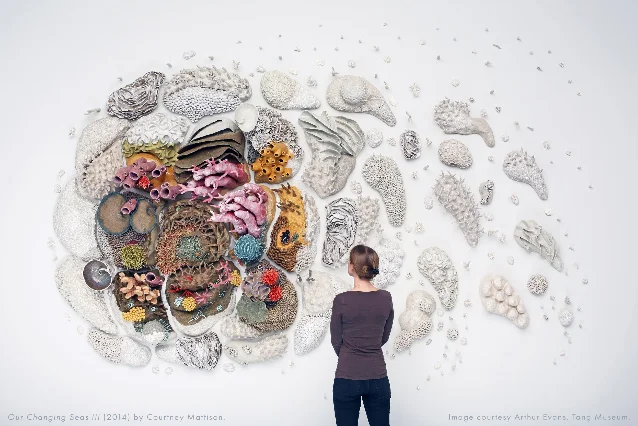
- Medium and materials: glazed stoneware and porcelain — hundreds of individually hand-built and glazed pieces 1213
- Biological process: Mattison works from a material coincidence — calcium carbonate is both a common ceramic glaze ingredient and the compound corals precipitate from seawater to "sculpt" their stony skeletons. She builds each piece by pinching together coils of clay, pokes thousands of holes to mimic the way a coral colony grows, and sets white glazes against colour to stand for the bleaching of a warming sea 12
- Visual presence: Hundreds of ceramic invertebrates are grouped across a white wall — a dense, saturated cluster of pinks, ochres and blues at the centre that thins and pales toward the edges, until the outer pieces are almost all white. A visitor stands in front of the work with her back to the camera, her head level with the middle of the reef, so that the sculpture reads much larger than she is. 13
- Documented context: The work belongs to Mattison's Our Changing Seas series, which has been shown at the headquarters of NOAA and the American Association for the Advancement of Science in Washington, D.C., and at the Tang Museum in Saratoga Springs 12. The Minnesota Marine Art Museum gave her a two-gallery exhibition, Courtney Mattison: Undercurrent, in 2023, and her ceramics have also travelled in the touring exhibition Iris van Herpen. Sculpting the Senses 1213. No current presentation is listed.
- Original source: the artist's site
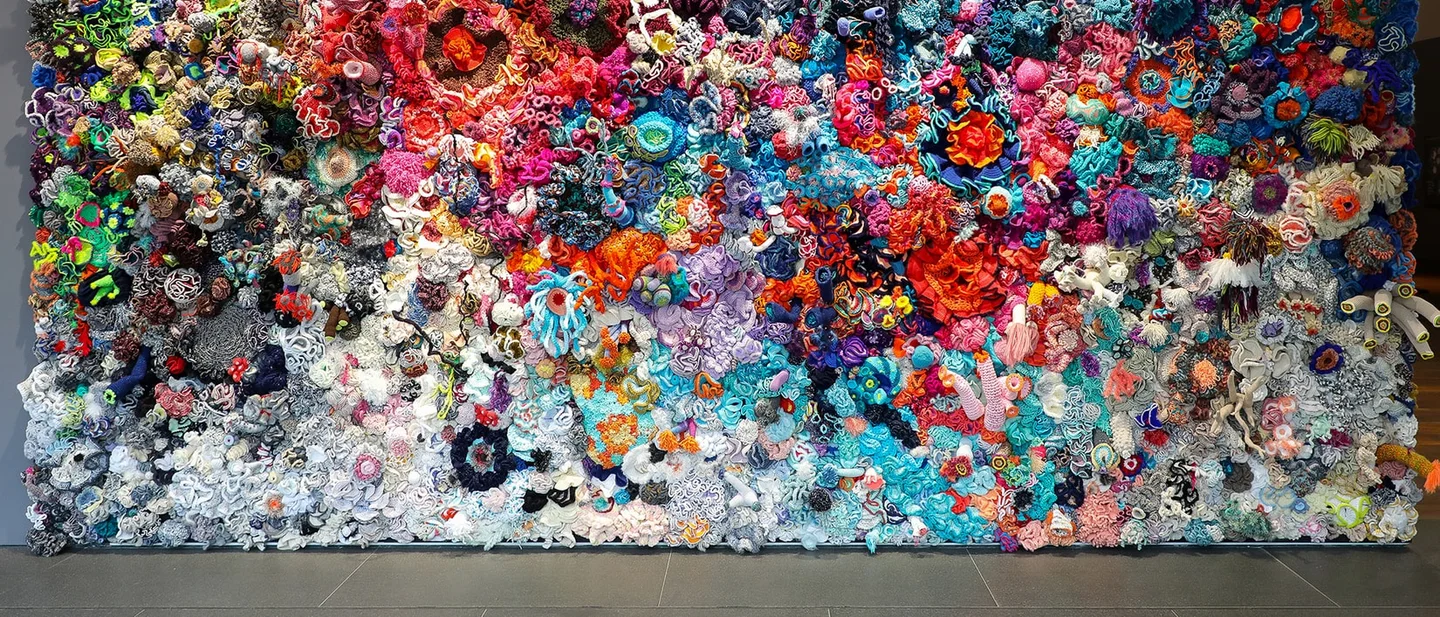
Margaret and Christine Wertheim with the Institute For Figuring: Crochet Coral Reef
- Artist: Margaret Wertheim and Christine Wertheim, with the Institute For Figuring and more than 30,000 contributors across 50 cities and countries 1
- Year: begun in 2005 and still growing 1
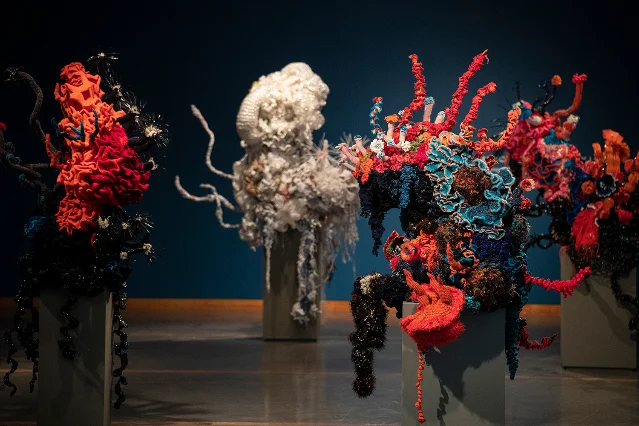
- Medium and materials: crochet — yarn, recycled plastic, beadwork, electroluminescent wire and fragments of plastic collected from the Great Pacific Garbage Patch 1
- Biological process: The forms model the hyperbolic geometry of corals and kelp, using a crochet method the mathematician Daina Taimina developed in 1997 1. The MIT Museum reads each contributor as standing for a coral polyp, and the hundreds of thousands of hours of stitching as standing for the time a real reef takes to form 1.
- Visual presence: In Coral Forest (2006–2026), three tall crocheted sculptures stand apart on a dark floor — one a crushed orange-red mass, one large and white, one in blue and red with fronds and spikes reaching out. Each sits on a grey plinth and is lit against a deep blue wall, so the pieces read as specimens on stands rather than as one continuous reef. 1
- Documented context: Crochet Coral Reef has been shown at the Venice Biennale (2019) and the Helsinki Biennial (2021), and has grown into one of the world's largest participatory art-and-science projects 1. It opens the MIT Museum's OCEANS season and is on view there from 14 August 2026 to 14 February 2027 1. One of the three Coral Forest pieces, Nin Imma, is crocheted from recycled plastic 1.
- Original source: the MIT Museum's page for the exhibition
What a made reef is for
Set the five side by side and a division appears. Three of them are meant to be lived in. The cement figure and the sunken cars were made to be colonised, and their success will be measured by how little of the artist's own form is still visible in a few years' time. The PortMiami thicket needs no such help, because no one made it.
The two hand-built reefs are different. Mattison's ceramic wall and the Wertheims' crocheted sculptures are meant to stay legible as the thing they are made of — glaze, yarn — and their success is that they go on looking like a reef at all. Yet both were built with the same logic as the living works: one borrows the chemistry of a coral skeleton, the other the slow, accumulated labour of many small makers.
What the five share is not the claim that a sculpture can be a reef. It is the question of what a made reef is for. The works in the sea are designed to disappear into biology, and the works in the gallery are designed to hold its shape. Between them sits the one reef that nobody built, which is thriving anyway — and which suggests that the making may matter less than what is left alone.
References
- 1MIT Museum Presents Crochet Coral Reef
mitmuseum.mit.edu
- 2Jason deCaires Taylor
underwatersculpture.com
- 3Ocean Gaia
underwatersculpture.com
- 4REEFLINE — Installations
thereefline.org
- 5Tour Leandro Erlich's underwater 'traffic jam'
designboom.com
- 6The ReefLine at Harvard GSD
gsd.harvard.edu
- 7Coral Morphologic
coralmorphologic.com
- 8Coral City Camera
coralcitycamera.com
- 95 Years of Coral City Camera
coralmorphologic.com
- 10The Corals That Shouldn't Exist
biographic.com
- 11World Record Underwater Coral Growth Timelapse
coralmorphologic.com
- 12About — Courtney Mattison
courtneymattison.com
- 13Courtney Mattison: Undercurrent
mmam.org
This story was produced automatically by a channel. One sentence is all it takes for Neodrop to keep producing for you.