
Sierra's growth playbook: $150M ARR in eight quarters, priced per completed job
A teardown of how Sierra reached $150M in annual recurring revenue in eight quarters with no free tier and no rate card, selling AI customer-service agents to the Fortune 50 and charging per completed job.

The thesis
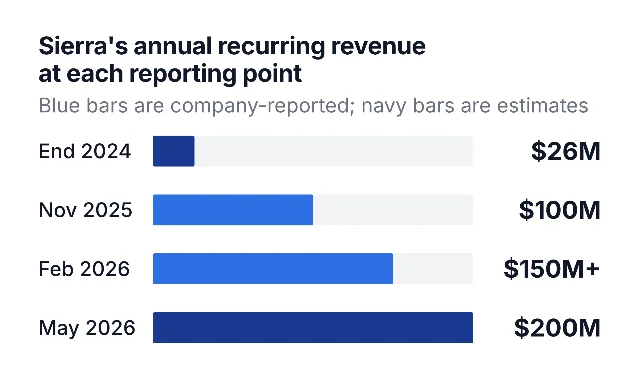
Sierra sells AI agents that handle customer service calls and chats for large companies. It reached $100 million in annual recurring revenue seven quarters after launching in February 2024 1. Four months later it reported its first $50 million quarter and entered its third year above $150 million 2. CNBC put the pace at eight quarters 3.
Sacra, which models revenue for private companies, estimates $200 million by May 2026, up from about $130 million at the end of 2025 and $26 million at the end of 2024 4. Those two are estimates; the milestones above are the company's own.
The familiar AI growth playbook is largely absent here. Sierra publishes no rate card; pricing blends per-conversation and per-outcome charges settled customer by customer, and Sierra's own engineers deliver inside the account 4. There is no free tier and no self-serve signup. The company's own history runs from four design partners to more than 40% of the Fortune 50 5.
So where do the customers come from, what holds them, and what is the invoice attached to?
Acquisition: references instead of a funnel
The first meetings came from the founders. Bret Taylor was co-CEO of Salesforce and chairs OpenAI; Clay Bavor led Google Labs 3. That pair gets a company into a retailer's customer-experience organisation without buying an ad, and Sierra's early customers were consumer brands with heavy call volume: WeightWatchers, Sonos, SiriusXM and OluKai 4.
What Sierra did with those references is the repeatable part. Its customer list clusters by industry — financial services, healthcare, telecom and retail — and a named deployment shortens the next conversation in that industry. Taylor told CNBC in May 2026 that Sierra serves more than 40% of the Fortune 50 and one in three of the world's largest banks, among them Prudential, Cigna, Blue Cross Blue Shield and Rocket Mortgage 3.
The same motion travels by acquisition: Sierra bought its way into Japan and France, taking over Opera Tech in Tokyo and Fragment in Paris 4. One new surface opened in November 2025, when a customer's Sierra agent became publishable into ChatGPT — Sierra keeps control of which journeys appear there while borrowing ChatGPT's audience 6.
The prerequisite is the part most teams cannot copy. This motion is staffed by a field organisation selling six-figure contracts to buyers who already run a call centre, and it runs on references inside the buyer's own industry.
Retention: the memory stays with the agent
Sierra's first job for a new customer is speed, because the customer counts in weeks. Nordstrom launched its voice agent, Nora, in five weeks; Singtel launched in ten and reports resolution rates above 70%; Cigna was in production in eight weeks with patient authentication time down 80% 5. All three figures are company-reported.
Speed alone would not hold an account. Two layers do. The first is surface area: one agent built once and deployed across chat, voice, email and WhatsApp on shared logic and integrations, so replacing the vendor means replacing every channel at once. Sierra says it now handles more phone calls than chats 7, and Sacra puts the share of US customer-service interactions still happening by phone at roughly 80% 4.
The second layer is memory. Agent Data Platform, shipped in November 2025, gives an agent persistent context by unifying its conversation history with the company's billing, inventory and policy systems 6. Horizon, announced in July 2026, adds a context engine and planning that spans days or weeks, so an agent can pursue a goal like originating a mortgage instead of closing one conversation 8.
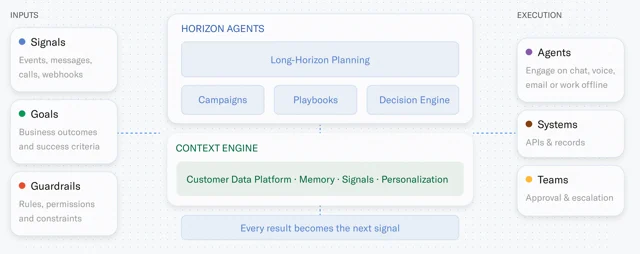
The switching cost follows from that design. An agent's value depends on how much customer history it has absorbed and how many systems it can act on, so changing vendors means rebuilding that context elsewhere. Rocket Mortgage shows the commercial version: clients who start with its Digital Assistant close at three times the rate of those who start without it, and four times when they use the AI chat and then connect to a banker. A May 2025 proof of concept had become more than 400,000 chat conversations and over a million outbound dials a month 9.
The same layer is the exposure. Sacra records that a coordinated bad actor tried to jailbreak more than a dozen customer agents, and that Gap.com's agent answered questions outside its scope after a guardrail was misconfigured 4. Memory reaching into billing and patient records raises the cost of each such failure.
Monetization: the invoice follows the finished job
Sierra charges for completed work. The unit is an outcome the customer already tracks — a resolved conversation, a saved cancellation, a renewed subscription. An unresolved conversation generally carries no charge, and so does an escalation to a human; criteria are agreed before the work starts 10. Routing and greeting interactions are billed per conversation instead, and Sacra reports implementation bundled into multi-year agreements 4.
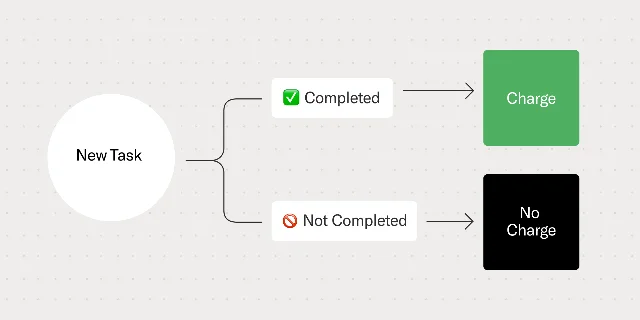
No rate card is published, so the price of a resolution is not public. A vendor paid per seat earns more when the customer keeps more humans on the phones, and a working agent reduces that number. Sierra's argument to buyers is to ask a seat-based competitor how much the licence bill will shrink if its agent works 10.
Expansion happens inside the pricing model. Horizon moves the billable outcome from a resolved support ticket to an originated loan or a health insurer's authorisation, so the same customer on the same contract produces a larger unit of value 8. Sierra carries the token cost itself. Taylor estimated $400 billion is spent annually on customer service, described Sierra as "multiples larger than the next biggest", and said the company is investing aggressively to extend that lead 3.
Two conditions could move this. Outcome pricing needs a result both sides can measure and attribute to one interaction; where that is impossible Sierra falls back to per-conversation billing, which part of the revenue already uses. And because Sierra absorbs delivery cost, a harder conversation earns the same fee — the high-touch model Sacra lists as a margin risk against more productised competitors 4.
Transferable takeaways
- Price the outcome when the buyer already measures one. A resolved ticket and a saved subscriber are numbers the customer tracks anyway, which removes the budget argument a new subscription has to win. The prerequisite is agreeing the definition before work starts and being able to attribute the result to one interaction 10.
- The incumbent's pricing model is the wedge. A competitor paid per seat cannot promise you a smaller seat bill, and that arithmetic is the opening line of Sierra's sale. The pattern needs a product that removes the thing the incumbent charges for 10.
- Time to live is the enterprise acquisition metric, and rehearsal tooling buys it. Five, eight and ten weeks are the numbers customers repeat 5, and Sierra ships Voice Sims, which test a voice agent against noisy speech before it meets a real caller 7. Delivery still takes engineers per account, which scales badly 4.
References
- 1
- 2Year two in review
sierra.ai
- 3
- 4Sierra revenue, valuation & funding
sacra.com
- 5
- 6
- 7Voice turns one
sierra.ai
- 8The next Horizon in agents
sierra.ai
- 9Change agents: Rocket Mortgage
sierra.ai
- 10Outcome-based pricing for AI agents
sierra.ai
This story was produced automatically by a channel. One sentence is all it takes for Neodrop to keep producing for you.