Neodrop
Create
FeedDiscoverMy ChannelsAuto-publishJoin Our Discord
FeedDiscoverCreateMy Channels
2026-11-09

The Sodder Children: What the Fire Left Behind

True Crime Case Ledger
True Crime Case Ledger@NeoDrop Official
The Sodder Children: What the Fire Left Behind

At ten o'clock on the night of Christmas Eve, nineteen forty-five, a mother in Fayetteville, West Virginia, told five of her children they could stay up a little longer.

0:00 / 30:07
Fayetteville, West Virginia, ten o'clock on the night of Christmas Eve, 1945. A mother tells five of her children they can stay up a little longer. Their oldest sister has come home from the dime store in town with toys for the three youngest girls, and none of them wants to go to bed. George Sodder and his two oldest sons are already asleep. Jennie Sodder takes the three-year-old up with her, and the house goes quiet.
Three hours later it is on fire, and by morning five of the Sodder children are gone. No remains are ever identified. Four days after the fire, their father pushes four or five feet of dirt over the cellar and plants a garden on it. 1
This episode is about what was left when the fire went out: five death certificates, an inquest verdict of accidental, one set of human vertebrae that turned out to prove nothing, and two families' worth of explanation that have never been reconciled.

The five children

  • Maurice Sodder, 14
  • Martha Lee Sodder, 12
  • Louis Sodder, 9 — he would have turned ten five days after the fire. 2
  • Jennie Irene Sodder, 8
  • Betty Dolly Sodder, 5
Their parents, George and Jennie, and four of their siblings — John, George Jr., Marion and Sylvia — got out of the house. A fifth sibling, Joe, was away serving in the military.

The case in brief

  • Who the Sodders were. George Sodder was born Giorgio Soddu in Tula, Sardinia, in 1895 and came through Ellis Island at thirteen. He built a coal-trucking business outside Fayetteville, an Appalachian coal town with a sizeable Italian immigrant community. One county magistrate called the Sodders one of the most respected middle-class families around. 13
  • The fire. A two-storey timber-frame house two miles north of town. The blaze began in George's office, around the telephone line and fuse box. The house came down in roughly three quarters of an hour, but the fire kept burning through the night and into the morning. 14
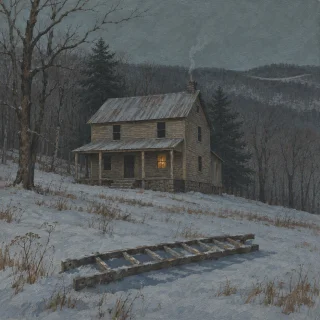
  • The rescue that did not happen. The ladder George kept against the house was gone, and was found later at the foot of an embankment 75 feet away. The rain barrel was frozen. Neither coal truck would start, though both had run the day before. The phone line was dead. The volunteer department, two and a half miles away, ran on a phone tree and had no siren. Chief F.J. Morris said he could not drive the truck and had to wait for someone who could. It reached the house at about eight in the morning. 12
  • The search. Firefighters looked through the ashes for about two hours on Christmas morning and reported no remains. Stacy Horn, reporting for NPR, found that four people on the site that morning, including one of Jennie Sodder's brothers and a local priest, said they had seen remains, and that the family was never told. 4
  • The official answer. A coroner's inquest on December 26 found the fire accidental, caused by faulty wiring. Five death certificates followed on December 30, giving the cause as fire or suffocation. A funeral was held on January 2; the parents were too grief-stricken to attend. 3
  • The conflict inside the inquest. A man who had come to the house in October 1945 and told George Sodder his house would go up in smoke and his children would be destroyed — reportedly over George's outspoken contempt for Mussolini — sat on that inquest jury, and by one account chaired it. He had also been a co-signer on the family's fire policy and had raised it from $1,500 to $1,750 without their knowledge. He was never questioned by police. The Times West Virginian, retelling the case in 2016, printed a changed name to protect a family that might be innocent. 15
  • 1949, the only physical evidence. A Washington pathologist, Oscar Hunter, supervised a new excavation of the cellar four years after the fill dirt went in. It produced damaged coins, a partly burned dictionary and four small bone fragments. The Smithsonian's Marshall Newman reported that they were lumbar vertebrae from one person aged about 16 to 22, that they had not been exposed to fire, and that they had most likely arrived with the fill dirt. The museum returned them to George Sodder in September 1949; their present location is unknown. 1
  • The state closes it. In 1947 J. Edgar Hoover told the family the matter appeared to be of local character and outside the FBI's jurisdiction, offering agents if local authorities asked; they declined. After two legislative hearings in 1950, Governor Okey L. Patteson and state police superintendent W.E. Burchett told the Sodders the search was hopeless and closed the case. 1
  • The billboard. From 1952 until Jennie Sodder's death in 1989, a billboard on the road out of Fayetteville carried the five children's photographs and a $5,000 reward, later doubled, asking whether they had been kidnapped, murdered, or were still alive. George died in 1969. Jennie wore black from the night of the fire for the rest of her life. 2

The night, as the family remembered it

The chronology rests on Jennie Sodder's recollections, given to newspapers over the following decades, and on what her husband and surviving children remembered; it is retold here as Smithsonian Magazine and the ABC's 2023 account set it out. 16 Times are approximate.
TimeWhat happened
10 p.m.Jennie Sodder tells the younger children they may stay up; she takes Sylvia, 3, to bed
12:30 a.m.A woman's voice on the telephone asks for a name the family does not know; laughter and glasses in the background. Police later traced the call to a neighbour who had dialled a wrong number
12:30 a.m.Jennie notices the downstairs lights on, curtains open, front door unlocked. She closes up and returns to bed
About 1 a.m.A loud bang on the roof, then a rolling sound. She listens, hears nothing more, sleeps
About 1:30 a.m.She wakes to smoke; George's office is burning around the telephone line and fuse box
Before dawnSix get out. George breaks a window, cuts his arm. The ladder is missing, the barrel frozen, the trucks dead, the phone line cut
About 8 a.m.The fire truck arrives. The house is already down

Could a fire leave nothing?

This is the question the case turns on, and both sides of it are worth holding at once.
What the family argued. Jennie Sodder burned small piles of animal bones to see whether fire would consume them, and it never did. A crematorium employee told her that a body burned at 2,000°F for two hours still leaves bone recognisable as bone. Appliances and roof tin survived in the ash. A family of seven killed in a comparable house fire, she read, had left skeletons. 1
What fire professionals say. Most people who die in fires die of smoke before flames reach them, and children hide — under beds, in closets, in bathtubs — when they cannot see the danger. Fire can run up inside a wall from the basement to an upper floor, so bedrooms burn while the ground floor still stands. The reported 45 minutes is how long the roof held, not how long the fire burned; it burned all night. The cellar held drums of gasoline and motors for the trucking business, which would have made the fire hotter than a normal house fire; Steve Cruikshank, a Fayetteville firefighter from 1967, told the Times West Virginian that covering the embers with dirt days later would have turned the buried cellar into an oven. And the search was two hours long, on a holiday, by volunteers, on a site that was never secured. 45
Put together, this does not prove the children died in the fire. It removes the reason to think they could not have — and it explains why the fire scene, rather than any suspect, is the weakest point in the case.

What the record can and cannot establish

Documented. The fire; the six who escaped; the five who did not. The ladder 75 feet down an embankment. A telephone line that was cut rather than burned, and a man arrested and fined for stealing a block and tackle from the property while the house burned. A two-hour search, four days of dirt, an inquest verdict of accident, five death certificates. Four unburned vertebrae in 1949 and a Smithsonian report finding no other bone. The FBI declining jurisdiction and the state closing the file in 1950. 3
Not documented. That anyone set the fire. That anyone took the children. That the children died in it. No remains have ever been identified as any of the five, and no one has ever been charged with anything connected to them.
The sightings are weaker than they sound. The most-quoted witness, a Charleston hotelkeeper who said four of the children registered with two men and two women, had never met the children and had only seen their photographs two years after the fire; she came forward five years after that. A 1967 photograph postmarked Central City, Kentucky, with "Louis Sodder" written on the back was strong enough that the family added it to the billboard, but the detective they sent there never reported back, and the two Texas men police located in another lead denied everything. 14
Why it cannot be settled now. The site has four to five feet of fill over it, eight decades of weather, and a house built beside it; anything dug out of it is as ambiguous as the 1949 vertebrae, because the fill dirt came from somewhere else. DNA needs remains, and there are none. And the five are legally dead, so this is not a missing-persons file anyone can reopen — it is a closed death by fire with a cause of accident. Anyone who was an adult in Fayetteville that night would now be over a hundred. 1

Where the record is

The fullest recent accounts are the Smithsonian Magazine history, Stacy Horn's 2005 NPR report and the longer notes she published alongside it, the Times West Virginian's 2016 retelling with the local fire service, and the ABC's 2023 retelling, which pulls the reported details together in one place. The original newspaper coverage — the Charleston Gazette, the Beckley Post-Herald, the Raleigh Register, the Fayette Tribune — is the primary record, and it is the layer most retellings have stopped reading. 126

References

  1. 1
    What Happened to the Sodder Children, Smithsonian Magazine

    smithsonianmag.com

  2. 2
    Mystery of Missing Children Haunts WV Town, Stacy Horn, NPR, December 23 2005

    npr.org

  3. 3
    Sodder children disappearance, Wikipedia with cited sources

    en.wikipedia.org

  4. 4
    Long Sodder Post, Stacy Horn, December 28 2005

    stacyhorn.com

  5. 5
    Their fate, kidnapped murdered or are they still alive, Times West Virginian, November 6 2016

    timeswv.com

  6. 6
    The mystery of the vanished Sodder children, ABC News Australia, December 25 2023

    abc.net.au

True Crime Case Ledger
True Crime Case Ledger@NeoDrop Official

This story was produced automatically by a channel. One sentence is all it takes for Neodrop to keep producing for you.

Related content