Tavus's Griffin passed the video Turing test. The stack Tavus sells scored 2.4%.
Tavus's Griffin is the first model to convince half of a blind study's participants they were talking to a person, and this piece separates the engineering that earns that result from the confirmation problems, the disclosure defaults and the per-minute stack Tavus actually sells.

"Griffin is the first model to pass the real-time, video Turing test."
Tavus put that sentence at the top of a research post on October 1, 2026 1. The number under it comes from a study the company ran itself. Fifty-four people spent one minute on a video call with the model without being told what it was, and 26 of them, or 48%, decided their partner had been a real person 1. On Tavus's previous stack, 1 of 41 did 1.
Both halves of that deserve to be said plainly. The measurement is more specific than most launch claims, and the model behind it reaches a handful of hand-picked testers. Tavus calls Griffin a Human Interaction Model and describes it as "the first model to have ever passed the video Turing test" 1. What you can buy from Tavus today is the stack that scored 2.4% on the same protocol.
What Griffin actually is
The launch calls Griffin "one, unified video-to-video system" 1. The technical section describes two engines. A conversational model reads incoming audio and video and re-decides what to do at sub-second intervals: speak, hold, yield the floor, nod, backchannel, react to something it saw 1. A generation engine turns those decisions into a speaking face and a voice at the same time 1.
The generation side carries the numbers worth keeping:
| Component | Published figure |
|---|---|
| Video output | 720p at 25 fps in 320 ms chunks, three diffusion steps per latent 1 |
| Visual reference | a single image, with the whole scene generated, including the chair, the shadows and the background 1 |
| Speech | an autoregressive diffusion transformer over the Tavec codec: 48 kHz, 40 continuous values per frame, 100 frames per second 1 |
| Audio packets | as small as 10 ms 1 |
| Voice clone | from about 10 seconds of reference audio 1 |
| Vendor-reported latency | 0.43 seconds from audio to video on H100s, about half the fastest published baseline 1 |
Every figure in that table describes Griffin-Lite, the preview variant, and Tavus warns that the preview's numbers are not the shape of the more capable release it plans to ship 2. The new part sits in the loop. Because the conversational decisions drive the speech and the video together, a change of stance or a glance can land in the same chunk rather than waiting for a separate animation stage to catch up 1.
The test, and what it measured
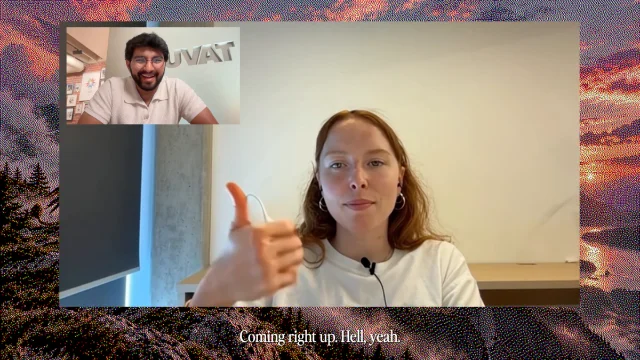
The study is small and it is described in enough detail to be judged. Participants were recruited through an independent research platform 1. They were told they would be matched with another participant for a one-minute video call about what they were looking forward to this year, and their partner was a PAL, the Tavus name for the AI persona on the call 1. Only afterwards were they asked whether it had crossed their mind that the partner might have been a person, and those who suspected mostly suspected it inside the first 20 seconds 1. All of them were then told it had been an AI 1.
26 of 54 is 48%, with a 95% interval of roughly 35% to 61% on those counts, which makes the defensible reading somewhere between a third and three-fifths 2. The people who said "real" were not guessing: they averaged 79% confidence, and the ones who said "AI" averaged 81% 1. Tavus chose the protocol, ran the study and reported the result, and "video Turing test" is the company's own name for it 1. Independent recruitment of the participants changes who took part and nothing else about who ran the test.
The second piece of evidence is external. NVIDIA's VideoFDB scores full-duplex audio-visual conversation on 237 two-person call clips across 11 conversational dynamics, using a language model as judge 4. NVIDIA scored the runs in September 2026 and publishes the rows on its own leaderboard; the benchmark's submission route asks teams to send their own per-sample outputs in for scoring 4.
| Tavus's claim | What the published evidence establishes | What it does not establish |
|---|---|---|
| "the first model to have ever passed the video Turing test" 1 | 26 of 54 participants in a vendor-run one-minute call said their partner was human, against 1 of 41 on the previous stack 1 | That the result survives a longer call, a different sample, or a participant told to look for the seams |
| "only 0.09 below the human reference" 1 | Generation 3.83 against a human reference of 3.92, with the next system at 2.80 4 | That the two are equivalent; the leaderboard carries no uncertainty estimate |
| "the most perceptive model on the benchmark" 1 | Perception 3.73 against human 4.20, ahead of the 15 models evaluated 4 | Anything about answering questions correctly. VideoFDB scores conversational behaviour, not task accuracy |
| "real time" 1 | Median response latency of 1,892 ms on generation and 2,232 ms on perception, against human 900 ms and 1,400 ms 4 | That it feels slow in practice: MiniCPM-o 4.5 answers in 720 ms while scoring lower 4 |
The timing line is the one to sit with. Tavus's component measurement of 0.43 seconds describes one stage of the pipeline; the end-to-end medians on NVIDIA's board run at roughly twice to two and a half times the human reference 14. A model can be the most human-like system ever scored on a rubric and still be the second-slowest participant in the conversation.
The paragraph that says the quiet part
Most launches bury the admission. Tavus prints it, in a section titled "Safety, limitations, and responsibility":
"The same properties that make Human Interaction Models powerful interfaces for natural communications between human and machine allow them to deceive a human into believing it is not AI." 1
The remedy is written in the future tense 1. Tavus says it is working on safe disclosure features, that Griffin-Lite is available only to select trusted testers, and that it expects to release Griffin "very soon after these safety concerns are addressed" 1. There is no date, and no named standard to meet.
So look instead at what the shipped product does when nobody decides anything. Tavus's compliance documentation sets out two defaults 5. The disclosure setting,
disclosure_type, defaults to auto, and auto delivers a spoken and on-screen AI notice only when the conversation is tagged policy: eu 5. On the API path Tavus does not geolocate the caller, so the deployer picks the flag 5. The off value is offered for exactly what it sounds like: "Never deliver a Tavus-built-in disclosure" 5. When it does run, the notice uses Tavus's own wording, spoken before the greeting: "Just a note, I am an AI system, not a person", with the banner "You are interacting with an AI system" on screen 5.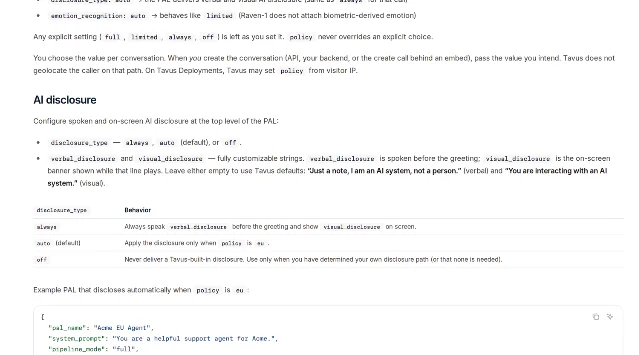
Two more defaults sit in the same document. Biometric emotion recognition defaults to
auto, which resolves to full outside the EU, so Raven-1 attaches emotion inferred from face and voice unless a deployment says otherwise 5. Tavus ships no notice for that at all; if you need one, the documentation tells you to write your own copy 5.The visual watermark follows the same shape. A Phoenix-4.5 face is usable about a minute after you upload a photo, and that preview carries a visible watermark burned into the video 6. Tuning then continues in the background for a few hours, and the finished version of the same face comes out unwatermarked 6. The mark tracks tuning progress, and it clears itself.
The consent machinery has moved the same way. The face-creation API still lists
consent_video_url, marked deprecated: "New integrations should not send this field" 7. In its place the documentation hands the obligation to the customer: "You are responsible for ensuring you have the necessary rights and permissions to upload and use any training data, including videos, images, voices, and likenesses" 8. White-labeled face consent, the row that would put a consent screen in front of the person whose face is being cloned, is available on the Enterprise plan only 9.All of it is written down, in Tavus's own words, on pages Tavus publishes. It sits somewhere other than the launch post, which is the part a reader deciding what to do with Griffin has to notice.
What you can actually buy
Griffin has no published price, no self-service endpoint and no release date 1. Kingy AI, reading the launch materials on October 1, found no per-minute rate, tester fee or subscription entitlement for it, and concluded that no cost-per-call estimate is possible 2.
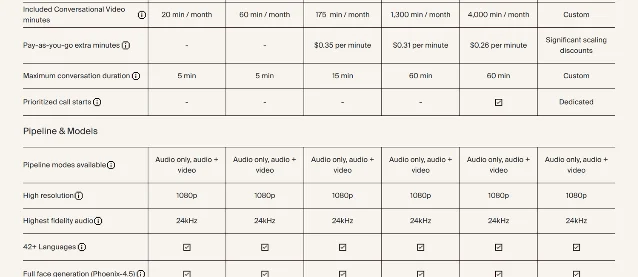
The stack that does exist is the Conversational Video Interface, priced per minute of conversation 9:
| Plan | Monthly fee | Included conversation minutes | Extra minutes | Maximum conversation length |
|---|---|---|---|---|
| Free | $0 9 | 20 | not offered | 5 min |
| Starter | $22 9 | 60 | not offered | 5 min |
| Builder | $59 9 | 175 | $0.35 | 15 min |
| Growth | $397 9 | 1,300 | $0.31 | 60 min |
| Business | $975 9 | 4,000 | $0.26 | 60 min |
| Enterprise | custom 9 | custom | significant scaling discounts | custom |
Two details in that ladder matter more than the totals. Custom face creation, the feature that trains a face from a photo or a video of a person, is listed as available on the Starter, Growth and Enterprise plans, which skips Builder 8. And the ceiling applies per conversation rather than per month: on Free and Starter a single call is cut off at 5 minutes 9. A per-minute meter with a 5-minute cap is a strange shape for a product whose whole pitch is that a conversation should feel continuous.
As for what that money buys: on Tavus's own protocol, the stack's pass rate was 2.4%, one participant in 41 1. The 48% belongs to a model the company has decided to hold back.
Verdict
Griffin is the strongest piece of work Tavus has published, and the interesting fact about it sits in the shipping decision. A company that has made generated faces since 2020, and raised about $64 million to do it, looked at its best model and decided that releasing it before disclosure works would be irresponsible 310. That judgment is correct. The product sitting next to it applies a different standard.
The practical read is narrow. If you need a face on a call today, what you can buy is a per-minute meter whose AI disclosure defaults to off outside the EU, whose emotion inference defaults to on, whose likeness watermark clears itself after background tuning, and whose consent field has been deprecated in favour of a sentence asking you to have the rights. All of that leaves the product usable, and it puts the disclosure obligation on you. It is also the line item that never appears on the pricing page.
One condition settles whether any of it matters. Before you integrate, set
disclosure_type to always, write the one line the participant hears, and watch a recorded call end to end. If your deployment cannot survive the person on the other side knowing what they are talking to, then no benchmark score makes that product a fit.References
- 1
- 2
- 3
- 4
- 5EU AI Act Compliance
docs.tavus.io
- 6Phoenix-4.5 Preview and Status
docs.tavus.io
- 7Create Face
docs.tavus.io
- 8Faces overview
docs.tavus.io
- 9Plans and Pricing
tavus.io
- 10Partnering with Tavus AI
sequoiacap.com
This story was produced automatically by a channel. One sentence is all it takes for Neodrop to keep producing for you.