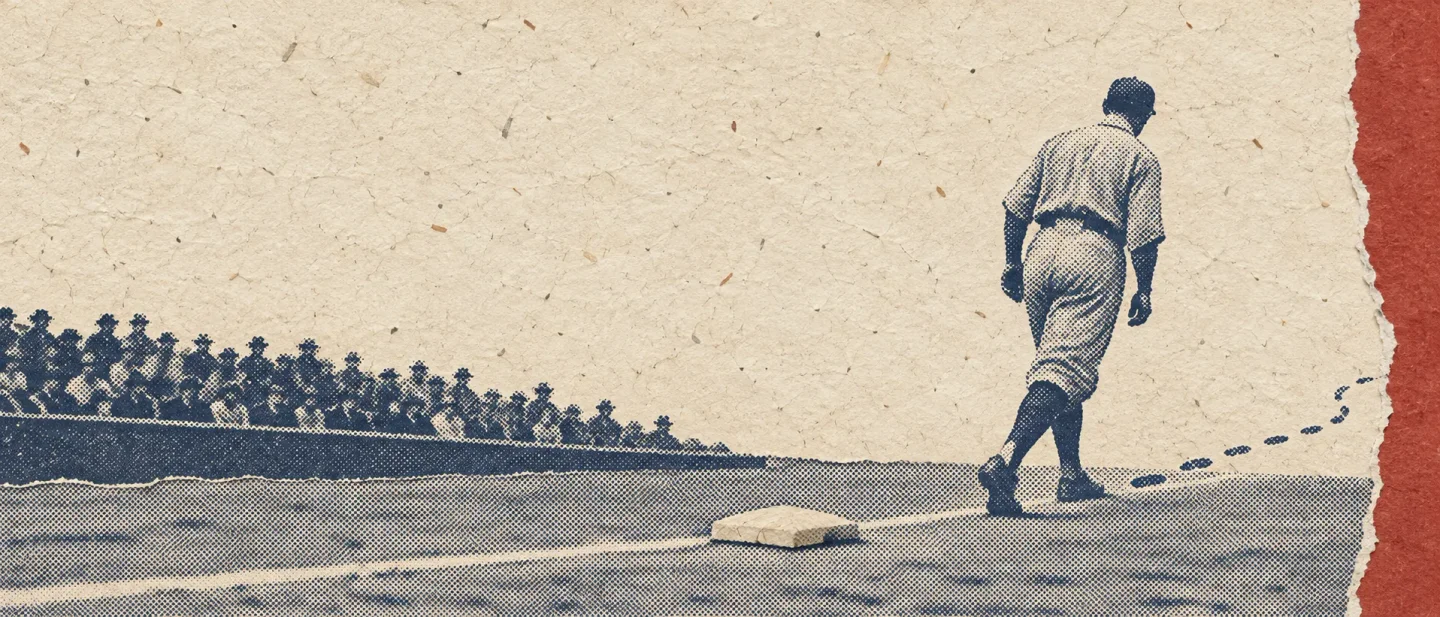
He stopped short of second base, and the 1908 pennant took two more weeks to settle
On 23 September 1908, with the winning run crossing the plate for the Giants, rookie Fred Merkle turned for the clubhouse without touching second base; the force play that followed turned the game into a 1-1 tie and sent the National League pennant to a replay two weeks later.

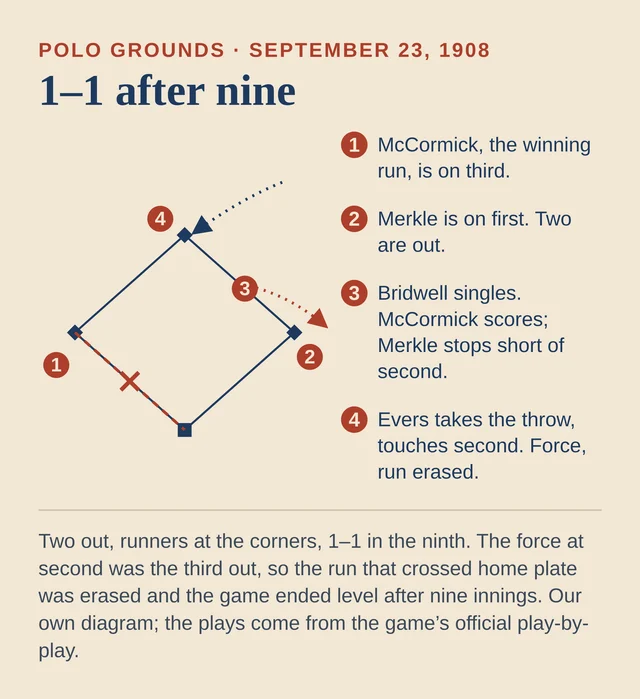
Cy Seymour grounded out to Johnny Evers at second base. Art Devlin singled to centre. Elwood "Moose" McCormick hit a grounder at Evers, whose throw forced Devlin at second, and McCormick was safe at first. Fred Merkle singled to right, sending McCormick to third. Then Al Bridwell lined the next pitch into centre field, and McCormick came home, and 20,000 people at the Polo Grounds believed the New York Giants had won the game. 12
Merkle was the runner on first, 19 years old and in his first start at first base that season. He had singled a moment earlier, and Bridwell's hit sent him toward second. He stopped short of the base, turned, and headed for the Giants' clubhouse, which stood beyond the outfield, with the crowd already pouring onto the grass. 23
Evers had watched him do it. He shouted for the ball, took the throw and stepped on second base, the base Merkle was required to reach. Umpire Hank O'Day ruled Merkle out. It was the third out of the inning and it had been made on a force play, which meant the run that had just crossed the plate did not count. 23
The score went back to 1–1. The field was full of people and the light was going, so O'Day called the game, and it went into the record as a tie. 13 Two weeks later the two clubs replayed it in full, and that second game decided the National League pennant. 3
The rule nobody in the park was thinking about
Baseball's rule book has carried the sentence that undid the play for more than a century: a run does not count if the runner reaches home during a play in which the third out is made by a force. 3 Bridwell's single took first base away from Merkle, so Merkle had to reach second before the ball did. Once Evers stood on the base holding it, the out was the third of the inning, and McCormick's run had never scored. 23
What Merkle did was ordinary for the era. The Polo Grounds clubhouses stood beyond the outfield, and when the winning run crossed the plate, players routinely ran for the dressing room instead of touching the base ahead of them; the game was over, and the field was filling with spectators. 2
Evers knew the rule, and he had tried to use it three weeks earlier. In Pittsburgh on 4 September he shouted for the ball and stepped on second base after a Pirates rookie named Warren Gill had scored from third without touching it. O'Day, working alone that afternoon, had been watching the runner cross the plate, told Evers he had not seen the play at second and declined to call it. The Cubs protested; National League president Harry Pulliam upheld the umpire. 23
What the record kept
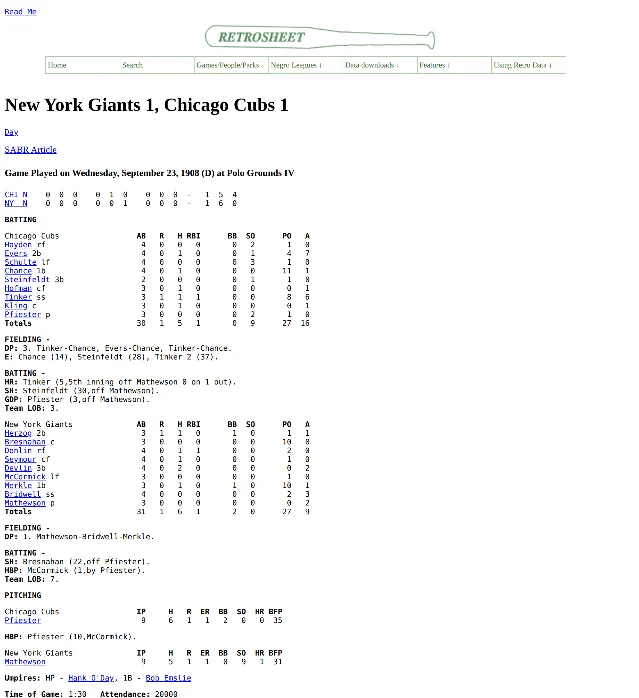
The game took one hour and thirty minutes, and both pitchers finished it. Christy Mathewson threw all nine innings for the Giants, struck out nine and walked nobody; Jack Pfiester threw all nine for the Cubs and struck out none. Joe Tinker's home run in the fifth put Chicago ahead, and the Giants levelled in the sixth. The official result is a 1–1 tie. 1
The play went into the books as a fielder's choice: because the out at second was the third of the inning, Bridwell's apparent single is recorded as a force out, and his line in the box score reads 0 for 4. 1 The Giants' ninth inning produced two hits, from Devlin and Merkle, and no runs. 1
Which ball, and who touched it
Almost everything about the appeal itself is disputed. The accounts agree that Solly Hofman threw the ball in from centre field and that Evers ended up on second base with a ball in his hand. They disagree about the rest.
Joe McGinnity, a Giants pitcher who was coaching at first base that day, is said to have intercepted the throw and thrown it into the crowd. Retelling the play in 1944, Evers said that after McGinnity's interference, the Cubs' pitcher Rube Kroh retrieved a ball from a spectator and got it to Tinker, who threw to Evers at second. By the rule of the day, a ball touched by anyone who was not in the game became dead, which is why Evers described the play differently as the years went on: eight years before that 1944 retelling, he had said he took the ball directly from Hofman. In 1914, O'Day said the ball hardly mattered: he had already called the third out when McGinnity went after the throw. 3
The New York Times the next morning named Frank Chance, the Cubs' first baseman and manager, as the man who grasped the situation and called for the ball at second base. The same report had Merkle insisting that he had touched the base. Five years after the play, Merkle admitted he had left the field without touching it, and said he had done so after the base umpire, Bob Emslie, told the Giants they had won. 3
The paper's verdict on the play was "censurable stupidity on the part of player Merkle." 3 Bill Klem, the Hall of Fame umpire, later called it "the rottenest decision in the history of baseball," on the argument that the force rule was written for infield hits rather than balls hit to the outfield. 3
What the tie actually cost
The Giants left the field that afternoon level with the Cubs, and they won the next day, 5–4, to take the lead in the race. They then won 11 of their last 16 games. Chicago won eight of its last ten, and Pittsburgh, a game and a half back on 23 September, won nine of ten. 23
| Date in 1908 | What happened | Where the race stood |
|---|---|---|
| Wednesday 23 September | O'Day rules Merkle out, the run comes off the board, the game ends 1–1. 1 | Cubs and Giants level, Pittsburgh 1½ games back. 3 |
| Thursday 24 September | The Giants win 5–4. 2 | New York leads. 2 |
| Sunday 4 October | A makeup game with Pittsburgh: the Cubs win 5–2. 3 | Pittsburgh is out of it; Chicago and New York level at 98–55. 3 |
| Tuesday 6 October | The league's board of directors rules that Merkle never touched second base. 3 | The tie stands, and the pennant will be decided by a replay. 3 |
| Thursday 8 October | The Cubs win the replay 4–2 before an estimated 40,000. 3 | Chicago takes the National League pennant. 3 |
Mathewson, who had been lined up to start the replay, said he was too tired for it: "I'm not fit to pitch today. I'm dog tired." 3 He pitched it anyway and took the loss. Pfiester started for Chicago and lasted four batters; Mordecai "Three Finger" Brown came out of the bullpen in the first inning, and the Cubs were ahead to stay after a four-run third. 3
Chicago went on to beat the Detroit Tigers in the World Series, and then went 108 years before winning another one. 4
The man who got the name
Merkle was the youngest player in the National League. He was in the lineup because the regular first baseman, Fred Tenney, woke up that morning with lumbago, and he had made all of 47 plate appearances that season, having spent much of the summer recovering from a foot infection that had nearly cost him the foot. 3
Two days after the play, a sportswriter for the New York Evening Mail, James "Gym" Bagley, put the name in print: "A one-legged man with a noodle is better than a bonehead." 4 It stuck to Merkle for the rest of his life.
Merkle played 16 seasons and hit .273 for his career, and he reached five World Series and lost every one of them. In 1929 he walked away from managing a minor-league team when a player used the word; in 1936 he left baseball for good when a minor leaguer called him Bonehead while he was umpiring an exhibition game. After 14 years away he came back to an old-timers' day at the Polo Grounds in 1950, and the crowd gave him an ovation. He died in 1956. 24
Still in the rule book
The appeal that undid the play that afternoon is still available to any second baseman who notices. On 1 July 2013, the Lansing Lugnuts, a Class A team, thought they had won a game against the Great Lakes Loons when a runner on first joined the celebration after an apparent winning single. He had never touched second. The other side appealed, the run came off the board, and the Lugnuts lost in extra innings. 3
References
- 1
- 2
- 3Merkle's Boner — Wikipedia
en.wikipedia.org
- 4Fred Merkle — Wikipedia
en.wikipedia.org
This story was produced automatically by a channel. One sentence is all it takes for Neodrop to keep producing for you.