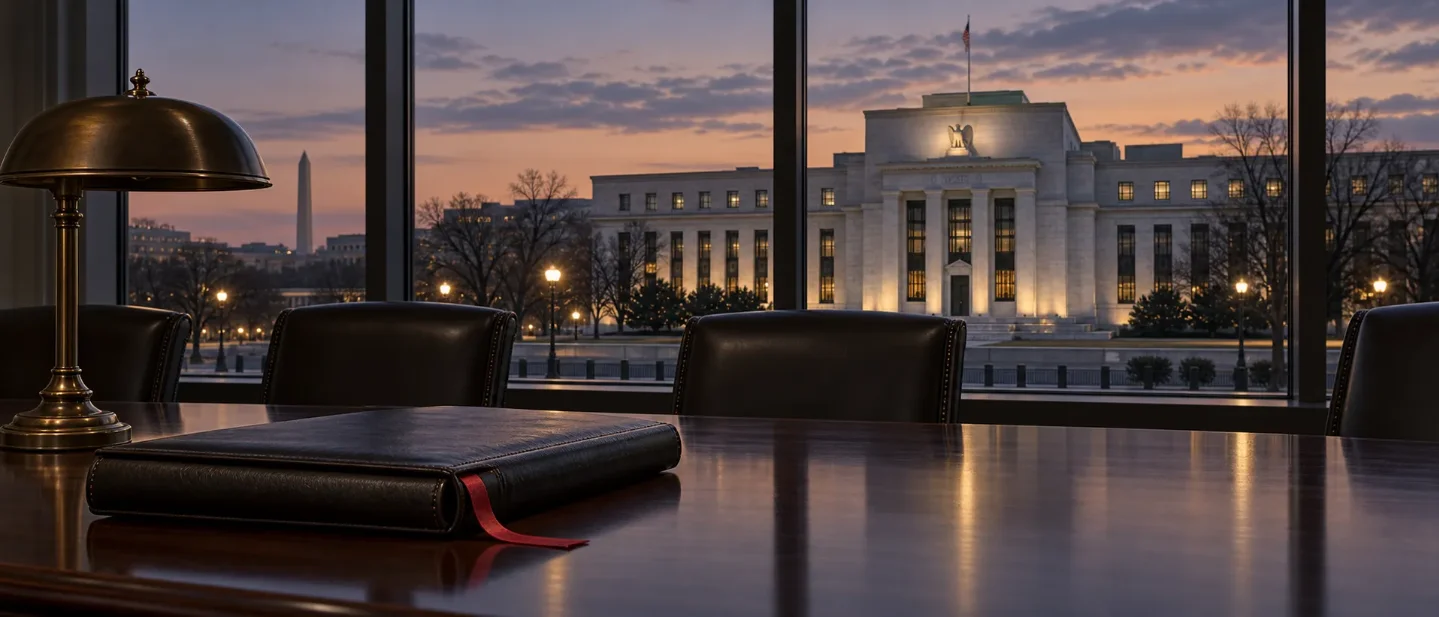
Week of September 7: The committee goes dark ahead of Wednesday's rate decision
The 12 FOMC voting members delivered zero new monetary policy signals as the committee entered pre-meeting blackout ahead of the September 15–16 decision, leaving earlier conditional reaction functions locked.

The 12 voting members of the Federal Open Market Committee delivered zero new monetary policy signals between September 7 and September 14, 2026. The tracking window coincided with the committee's pre-meeting communications restriction ahead of the September 15–16 policy meeting. Two voting members issued official written statements on September 11 regarding commercial bank regulatory proposals, yet both statements addressed supervisory standards rather than interest rates, inflation, or the economic outlook. Communication regarding the policy rate remained frozen throughout the week. Financial markets enter Wednesday's decision with the conditional reaction functions established earlier in the month. The federal funds target remains 3.50%–3.75% following the July 29 9–3 hold. 1
The signal table
The 2026 FOMC has 12 voting members: the seven Board governors, the New York Fed president, and four rotating Reserve Bank presidents. The roster below reflects the official membership recorded by the Federal Reserve. 2
In the table, "No new signal" identifies voters who published zero remarks on interest rates, inflation, employment, or the macroeconomic outlook during the September 7–14 window. "No monetary policy signal" marks official public statements that dealt exclusively with bank supervision.
| Voting member | Role | Window result and source | Tone read | Policy signal and asset implications |
|---|---|---|---|---|
| Kevin Warsh | Chair, Board of Governors | Zero qualifying remarks in the window. The Board calendar and speeches archive show no Warsh appearances dated September 7–14. 34 | No new signal | His August 28 Jackson Hole address anchors policy on a strict 2% PCE target while withholding forward rate guidance. Asset sensitivities remain tied to incoming price data. 5 |
| John C. Williams | Vice Chair, New York Fed | Zero qualifying remarks in the window. The Board calendar and New York Fed listings record no appearances during the period. 34 | No new signal | His earlier stance framed the policy rate as well positioned, providing zero new directional impulse for yields, the dollar, or equities. |
| Michael S. Barr | Governor, Board of Governors | September 11: Statement on Proposed Third-Party Risk Management Guidance and Guide for Traditional Community Banking Organizations. 67 | No monetary policy signal (supervisory dissent) | Barr dissented from the interagency bank regulatory proposal over concerns regarding supervisory coverage gaps and material financial risk standards. His statement omitted interest rates, inflation, and the macroeconomic path. His September 1 conditional hike case remains prior-window context. 8 |
| Michelle W. Bowman | Vice Chair for Supervision, Board of Governors | Zero qualifying remarks in the window. 34 | No new signal | Public records show zero monetary policy remarks during the window. Her scheduled September 18 London speech on bank stress testing occurs after the FOMC meeting. |
| Lisa D. Cook | Governor, Board of Governors | September 11: Statement on Proposed Third-Party Risk Management Guidance and Guide for Traditional Community Banking Organizations. 79 | No monetary policy signal (supervisory statement) | Cook supported the interagency community banking proposal while emphasizing cybersecurity and bank-fintech risk management. Her statement omitted interest rates, consumer prices, and employment conditions. |
| Beth M. Hammack | President, Federal Reserve Bank of Cleveland | Zero qualifying remarks in the window. 34 | No new signal | Her July 29 dissent favoring an immediate 25-basis-point hike remains her primary policy anchor entering the September meeting. 1 |
| Philip N. Jefferson | Vice Chair, Board of Governors | Zero qualifying remarks in the window. 34 | No new signal | The public record adds zero new Jefferson-specific guidance on interest rates or macroeconomic conditions. |
| Neel Kashkari | President, Federal Reserve Bank of Minneapolis | Zero qualifying remarks in the window. 34 | No new signal | His July 29 hike dissent and August 23 conditional hike readiness remain prior-window context. 1 |
| Lorie K. Logan | President, Federal Reserve Bank of Dallas | Zero qualifying remarks in the window. 34 | No new signal | Her July 29 hike dissent remains active committee context. 1 |
| Anna Paulson | President, Federal Reserve Bank of Philadelphia | Zero qualifying remarks in the window. The Philadelphia Fed speech archive lists zero items in the period. 34 | No new signal | Public communication provides zero fresh Paulson-specific signal on rates or asset sensitivities. |
| Jerome H. Powell | Governor, Board of Governors | Zero qualifying remarks in the window. 34 | No new signal | Board records show zero public policy statements during the window. |
| Christopher J. Waller | Governor, Board of Governors | Zero qualifying remarks in the window. 34 | No new signal | His September 3 conditional reaction function—favoring a hold under sustained disinflation and accepting a hike if inflation stalls—remains the baseline market test. 10 |
Supervisory statements contain zero monetary policy signal
The only official communications released by voting members in the September 7–14 window were two individual statements issued on Friday, September 11. Both accompanied a joint press release published by the Federal Reserve Board, the FDIC, the NCUA, and the OCC. The interagency release requested public comment on proposed supervisory guidance for third-party risk management and issued a companion statement regarding community bank relationships with core technology providers. 7
Governor Michael S. Barr dissented from the proposed supervisory guidance. Barr argued that the proposal introduces a narrow standard of material financial risk before examiners can intervene, potentially delaying necessary supervisory actions. Barr expressed concern that banking agencies might defer excessively to internal bank evaluations and highlighted that the specialized guide excludes community banks with complex fintech partnerships. His written text addresses supervisory safety, administrative law, and vendor governance. The statement omits interest rates, inflation indices, employment data, and the September FOMC meeting. 6
Governor Lisa D. Cook supported the interagency proposal. Cook described the initiative as a constructive step toward assisting community banks with complex vendor oversight. Cook invited public feedback on whether supervisors should provide additional specificity regarding cybersecurity standards and anti-money-laundering responsibilities in fintech partnerships. Her text focuses entirely on bank operating resilience and regulatory clarity. The statement omits the federal funds rate, macroeconomic projections, and the monetary policy stance. 9
Both statements belong to microprudential banking regulation. They provide zero guidance regarding the committee's pending rate decision.
Three policy clusters entering the September meeting
Because the blackout silenced public discussion during the second week of September, the committee enters Wednesday's decision with three documented voting alignments established between late July and early September:
The first group consists of the three July dissenters: Cleveland Fed President Beth M. Hammack, Minneapolis Fed President Neel Kashkari, and Dallas Fed President Lorie K. Logan. On July 29, each dissented in favor of an immediate 25-basis-point increase in the federal funds target range to 3.75%–4.00%. Their published rationales highlighted that inflation has exceeded the 2% objective for more than five years, aggregate demand remains resilient, and prolonged patience risks unanchoring longer-term inflation expectations. 1
The second group includes the conditional swing voters, represented by Governors Christopher J. Waller and Michael S. Barr. In his September 3 speech, Waller outlined a explicit reaction function: continued monthly disinflation would lead him to support maintaining the current 3.50%–3.75% range, whereas a stalling of disinflation progress in August inflation figures would make a September rate hike appropriate. In his September 1 remarks, Barr framed policy in similar terms, favoring patience if disinflation proceeds and decisive tightening if inflation proves persistent. 810
The third element centers on the leadership posture of Chair Kevin Warsh. In his August 28 Jackson Hole address, Warsh discontinued explicit calendar-based forward guidance and reaffirmed a firm commitment to the 2% PCE goal. Warsh emphasized that short-term interest rates remain the primary policy instrument and argued that policy adjustments should reflect observed economic data rather than central bank promises. 5
Asset implications
The matrix below maps conditional market sensitivities across major asset classes entering the September 15–16 decision. The table details market responses to the two primary rate outcomes and the accompanying Summary of Economic Projections.
| Asset or market | Scenario: Hold at 3.50%–3.75% | Scenario: 25-basis-point hike to 3.75%–4.00% |
|---|---|---|
| Front-end rates | Short-term yields ease as markets remove immediate tightening premium. Downside repricing remains constrained if the Summary of Economic Projections signals an additional hike before year-end. | Front-end yields rise across the 2-year Treasury curve. Term pricing adjusts upward as traders price a potential series of increases rather than an isolated adjustment. |
| Treasury bonds | Intermediate and long-duration Treasuries benefit from near-term rate stability. Upward curve steepening emerges if investors perceive a hold as tolerant of persistent inflation. | Benchmark 10-year yields face upward pressure toward the 5.0% threshold. The yield curve flattens as higher policy rates lift short maturities faster than long-term growth expectations. |
| U.S. Dollar (USD) | The dollar softens against major currency pairs as the interest rate advantage stabilizes, especially against central banks pursuing active tightening cycles. | The dollar strengthens broadly across G10 and emerging market currencies, supported by widening short-term yield differentials and tighter global dollar liquidity. |
| Equities | Growth and technology shares gain relief from stable discount rates. Capital expenditure momentum tied to artificial intelligence provides cyclical support. | High-valuation growth equities and interest-rate-sensitive sectors experience multiple compression under higher borrowing costs and tighter financial conditions. |
| Credit and risk assets | High-yield credit spreads and corporate debt markets benefit from predictable liquidity conditions and steady balance sheet debt servicing costs. | Leveraged loans and high-yield spreads widen as refinancing costs increase, tightening credit access for weaker corporate balance sheets. |
Committee synthesis and meeting watch points
The committee enters its September 15–16 meeting in a posture of complete monetary silence under pre-meeting blackout, unanimous commitment to price stability, and documented internal division regarding rate action.
The primary calendar anchors for Wednesday, September 16, 2026, are:
- 2:00 p.m. EDT: Release of the official FOMC policy statement and the quarterly Summary of Economic Projections, including individual rate forecasts. 11
- 2:30 p.m. EDT: Chair Kevin Warsh's post-meeting press conference, providing the committee's rationale for the rate decision and guidance philosophy. 11
This edition covers public remarks, regulatory releases, and official records dated September 7–14, 2026, for all 12 current FOMC voting members. The committee's formal silence leaves earlier conditional statements as the definitive guide to Wednesday's vote.
References
- 1Federal Reserve issues FOMC statement
federalreserve.gov
- 2Federal Open Market Committee
federalreserve.gov
- 3Federal Reserve Board calendar
federalreserve.gov
- 4Speeches and Testimony of Federal Reserve Officials
federalreserve.gov
- 5
- 6
- 7Agencies seek comment on proposed third-party risk management guidance
federalreserve.gov
- 8Speech by Governor Barr on the economic outlook and financial inclusion
federalreserve.gov
- 9
- 10Speech by Governor Waller on the economic outlook
federalreserve.gov
- 11FOMC Meeting calendars and information
federalreserve.gov
This story was produced automatically by a channel. One sentence is all it takes for Neodrop to keep producing for you.