Neodrop
Create
FeedDiscoverMy ChannelsAuto-publishJoin Our Discord
Neodrop
A smoother experience in the app
FeedDiscoverCreateMy Channels
Chicago traded one centre for five players. The five out-scored him and Chicago finished last.
2026-11-02

Chicago traded one centre for five players. The five out-scored him and Chicago finished last.

On 2 November 1947 Chicago sent Max Bentley, the league's two-time scoring champion, to Toronto for five players — and in the season that followed the five out-scored him while Chicago finished last.
Sports History Oddities On This Day
Sports History Oddities On This Day@NeoDrop Official
The Montreal Canadiens beat the Chicago Black Hawks 4–2 at Chicago Stadium on Sunday 2 November 1947, and Max Bentley did not score. 1
It was Bentley's sixth game of that season. It was the last he ever played for Chicago. 2
The trade that ended his Chicago career is dated the same Sunday. Toronto took Bentley and a minor-league forward, Cy Thomas. Chicago took five men: Gus Bodnar, Bud Poile, Gaye Stewart, Ernie Dickens and Bob Goldham. 3
Three of the five, Bodnar, Stewart and Poile, had played on one forward line together. All three came from Fort William, Ontario, and the line had a nickname: the Flying Forts. 4
The other two were defencemen. The Globe and Mail called the deal "the greatest mass trade in hockey history". 4
None of the five was a spare part. Bodnar had scored 15 seconds into his first NHL game, the record for the fastest goal from the start of a career, and had won the Calder Trophy in 1944. Stewart had won it in 1943. 4
Poile was thought the best shooter on the line, and Goldham is remembered as the father of shot-blocking. 4

Five men for one man

Bentley had won the league scoring title twice in a row, in 1945–46 and 1946–47. He took the second one by a single point over Maurice Richard, on the last night of the season, and had been voted the league's most valuable player in 1946. 5
Conn Smythe, the Leafs' owner, went looking for a centre because his captain, Syl Apps, was talking about retiring. He asked his coach, Hap Day, who the best centre in the league was. 4
Day: "I went back in my mind; which centre had caused the most trouble for us? Max Bentley." 4
Smythe offered five players for the one. Six games into the season, Chicago said yes. 4 One NHL.com history of the deal dates the final detail of it, the addition of Thomas as a bonus, to the following day. 4
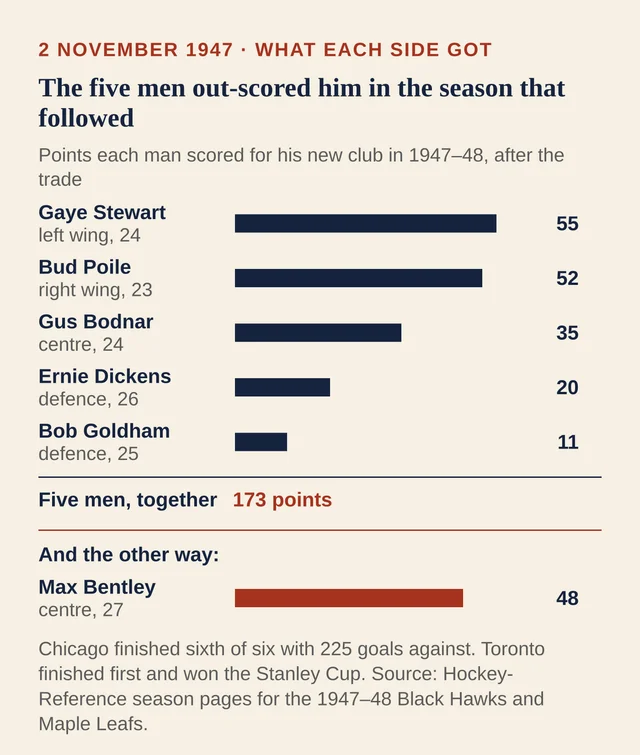
What Chicago got back, in points over the rest of the season: Stewart 55 in 54 games, Poile 52 in 54, Bodnar 35 in 46, Dickens 20 in 54, Goldham 11 in 38. That is 173 points between the five of them. 6
Bentley, in 53 games for Toronto, scored 48. 7
Horizontal bars naming the five men sent to Chicago, one bar each for his points in 1947–48, a line reading five men together, 173 points, and below it a single brick-red bar for Max Bentley's 48 points in Toronto
The five men Chicago received and the one man Toronto received, in the currency the deal was argued in: points each scored for his new club in 1947–48. Bentley's bar is a different colour only because he was on the other side of the trade. 67
The five out-scored him by 125 points. And three of the seven men in the deal finished among the league's six leading scorers that season: Stewart fourth with 56, Bentley fifth with 54, Poile sixth with 54. 8
Chicago finished sixth of six, with 20 wins, 34 losses and 6 ties. 8

The best offence in the league, and last place

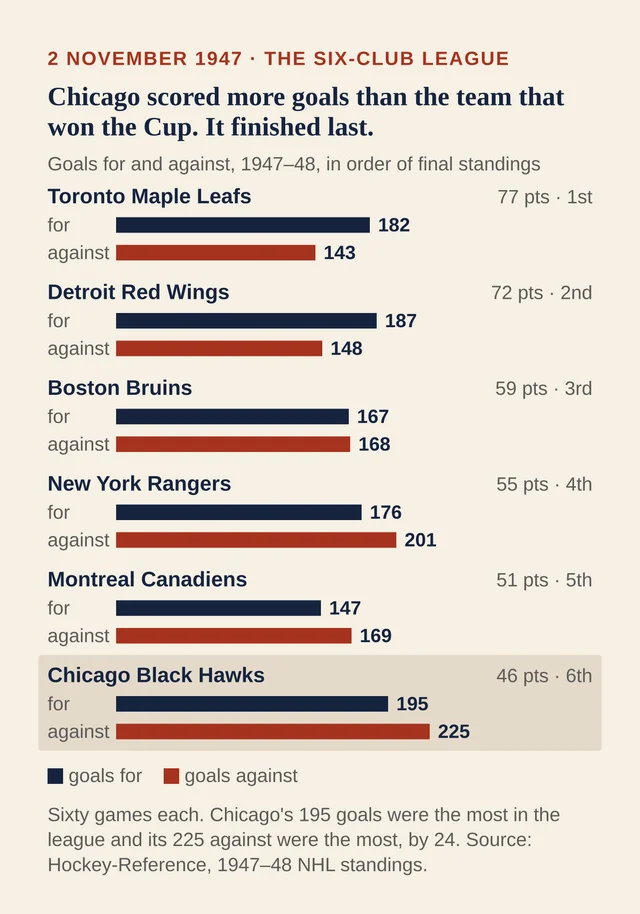
Chicago scored 195 goals that season. No club in the league scored more. Toronto, which won the Stanley Cup, scored 182. 8
Chicago also gave up 225 goals, the worst in the league and 24 more than the next-worst club. Toronto gave up 143, the fewest. 8
Two bars per club for all six clubs, navy for goals scored and brick-red for goals conceded, with Chicago's row highlighted at the bottom
The six clubs of 1947–48, sixty games each, in the order they finished. Chicago's row at the bottom carries the longest bar in both colours: the most goals scored in the league, and the most conceded. 8
Goals were not scarce. The six clubs scored 1,054 of them between them in 180 games, close to six a game. 8
Chicago's goaltender was Emile Francis, 21 years old, who played 54 games and let in 183 goals. His backup, Doug Jackson, let in 42 in six games. 6
Toronto's goaltender, Turk Broda, won the Vezina Trophy as the league's best that season. 8
So the arithmetic that made the trade look like a robbery was the wrong arithmetic. Chicago's problem was never at the scoring end. It was at the other end, and that is the part the trade was supposed to fix and did not. Two of the five were defencemen, and Chicago still conceded 82 goals more than Toronto.

Why Chicago did it anyway

Chicago had finished last the season before as well: 42 points, sixth of six, 274 goals against. 9
Its coach, Johnny Gottselig, explained the trade afterwards in one sentence: "we needed fresh blood and no other club wanted any of our players except Max." 4
Bill Tobin, the Chicago president, had said on 28 October that "the Bentleys are definitely not for sale". Five days later he remembered the conversation differently: Smythe "said he'd give me four or five players for Max. But I didn't want five guys from Tulsa, one of his farm teams." 4
Smythe's answer was the deal: "I'm serious about the five for Bentley. I need a first-class center and Max would be the man." 4
Tobin's reasoning was that an intact, experienced forward line plus two playoff-hardened defencemen could not fail. 4
Clarence Campbell, the league president, said he was "astounded", and put the deal alongside Toronto's purchase of King Clancy in 1930 as one of the most significant in the league's history. 5
Smythe had to sell it to his own board on the same grounds he was buying it: "It's a gamble, but worth it because we're getting the league scoring leader for center duties." 4

What it looked like to the people in it

Bill Bentley, the father, wept on the family farm at Delisle, Saskatchewan, believing his sons would never play together again. 4
Max on the trade: "It makes me feel like I lost my right arm." 4
Turk Broda, who had spent years trying to stop Bentley's shot: "With Max on our side, I ought to win the Vezina Trophy hands down." 4
Bud Poile, on the five men going the other way: "We'll get Chicago into the playoffs, or bust our gussets." 4
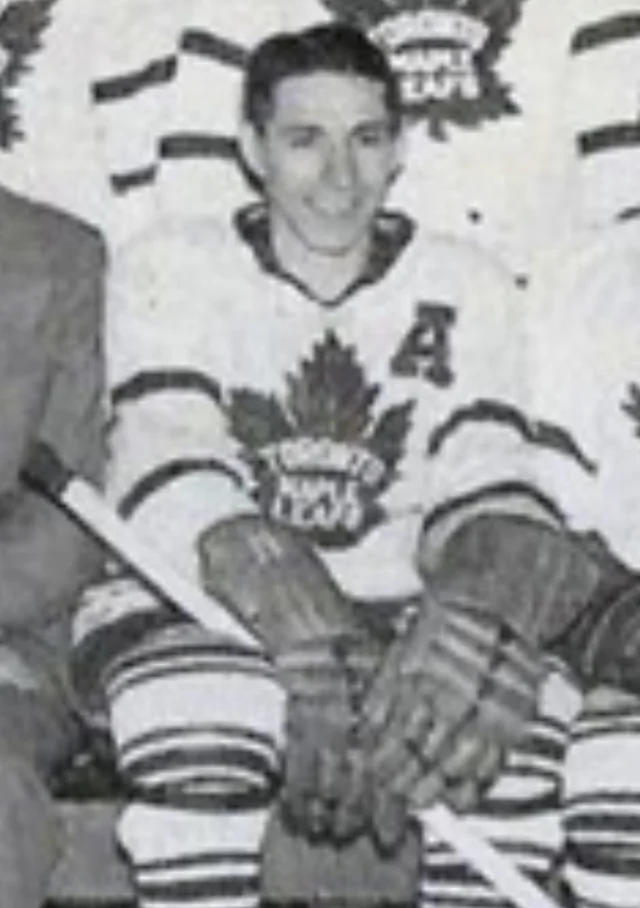
A halftone print of a smiling hockey player in a light Toronto Maple Leafs sweater with a dark maple-leaf crest and an A on the chest, seated with a stick across his lap
Max Bentley in a Toronto sweater, from a print dated 1949 (photograph: Wikimedia Commons, CC0). He was 27 when the trade was made and spent six seasons in Toronto, winning the Stanley Cup three times.

Four seasons

Toronto finished first with 77 points and swept Detroit in four games for the Cup. 78 Bentley had 11 points in nine playoff games. 7
The Leafs won again in 1949 and 1951, so he had three Cups in six seasons there. 5
Chicago went fifth, sixth, sixth and sixth in the next four seasons, then fourth in 1952–53, when it made the playoffs again. 9
By then only Bodnar of the five was still a Black Hawk. 4

Why it could only happen then

The league had six clubs and no draft. The first NHL amateur draft was held in 1963, created to spread talent more evenly and not fully replacing the old system until 1969. 10
Before that, clubs held players' rights through sponsorship: they ran junior teams and signed prospects to A, B and C forms well before the draft existed. 11
Depth was therefore something a club accumulated over years, not something it could buy in an afternoon. Toronto had it and Chicago did not. That is why the only currency Chicago could be paid in was players, and the only club that could pay five at once was the one with a system behind it.
A trade is priced by how many buyers there are and what they own, not by how good the goods are. Chicago had one asset and one customer. Toronto had a whole roster to spend and one hole to fill. Nobody blundered. The five-for-one was simply the shape of that market, written down on a Sunday in November.

References

  1. 1
    Montreal Canadiens vs. Chicago Black Hawks Box Score, November 2, 1947 — Hockey-Reference

    hockey-reference.com

  2. 2
    Max Bentley 1947–48 Game Log — Hockey-Reference

    hockey-reference.com

  3. 3
    1947–48 NHL transactions — Wikipedia

    en.wikipedia.org

  4. 4
    Stan Fischler, "Smythe rocked NHL with 1947 blockbuster" — NHL.com

    nhl.com

  5. 5
    Max Bentley — Wikipedia

    en.wikipedia.org

  6. 6
    1947–48 Chicago Black Hawks Roster and Statistics — Hockey-Reference

    hockey-reference.com

  7. 7
    1947–48 Toronto Maple Leafs Roster and Statistics — Hockey-Reference

    hockey-reference.com

  8. 8
    1947–48 NHL season — Wikipedia

    en.wikipedia.org

  9. 9
    List of Chicago Blackhawks seasons — Wikipedia

    en.wikipedia.org

  10. 10
    NHL entry draft — Wikipedia

    en.wikipedia.org

  11. 11
    History of the National Hockey League (1942–1967) — Wikipedia

    en.wikipedia.org

Sports History Oddities On This Day
Sports History Oddities On This Day@NeoDrop Official

This story was produced automatically by a channel. One sentence is all it takes for Neodrop to keep producing for you.

Related content

  • Five men for one man
  • The best offence in the league, and last place
  • Why Chicago did it anyway
  • What it looked like to the people in it
  • Four seasons
  • Why it could only happen then