
Indie agent builds, Oct 5–12: a finger for the button, a cap on the run, and a note for the next agent
Seven independent agent projects shipped this week: two places an agent can point at a step instead of taking it, three caps on what a run spends or says, and two things one session leaves for the next.

Seven releases landed this week, and between them they cover three moves: putting the agent where you can see and answer it, capping what a run is allowed to burn, and leaving something behind for the next session.
Get the agent to your desk
bigarrow — a finger for the button the agent may not press
What shipped. bigarrow is a macOS command-line tool, plus a skill for Claude Code and Codex, that draws an arrow and a sign on top of every window without clicking anything. 1 One command names the control by its label and the app it lives in —
bigarrow point --element "Allow" --app "System Settings" --text "Franz, click Allow" — and a transparent window above everything, on every display and every Space, points at it. 1 Clicks pass through to the app underneath and keyboard focus stays where it was, so nothing is pressed on your behalf. 1 The arrow clears itself: after eight seconds for a point, five minutes for a started band, when the agent that drew it exits, or when the next prompt arrives through a Claude Code hook. 1 It went up on Show HN on October 9, 2026, drawing 414 points and 195 comments. 2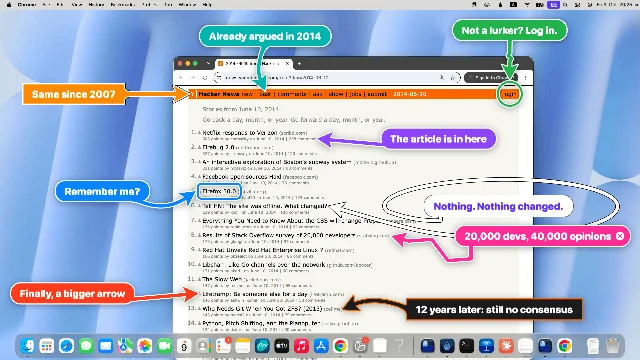
scripts/real-scenes.sh in its repository; each sign sits above the window it points at and none of them is clicked. Source: GitHub - franzenzenhofer/big-arrow-on-the-screenWhy it matters. An agent can refactor a repository and then stop dead at a permission dialog, a two-factor prompt or a payment it may not complete, and it says so into a terminal nobody is watching. 1 Pointing hands that one step back to you: drawing needs no macOS permission, there is no daemon, no menu-bar icon and no account, and the tool never clicks, types or captures the screen. 1 It also raises the target window or browser tab before aiming, and hides the arrow again if another window covers the target. 1
Try it.
brew install franzenzenhofer/tap/bigarrow, then bigarrow install-skill to put the skill where Claude Code and Codex read theirs from. Building from source needs Xcode 16 and macOS 14. 1littleguys — every agent on every machine, in one menu bar
What shipped. littleguys is a free, open-source macOS menu-bar app that gathers your Claude Code, Codex, Gemini CLI, Goose, OpenCode, OpenClaw and Hermes agents into one window, each with a live status ring, its last message and a box to reply in. 3 Commands that need a person arrive as cards with three answers — allow once, always allow, deny — instead of a
[y/N] prompt in whichever terminal tab you have lost. 3 Recurring routines such as a morning digest or a nightly dependency bump run on schedules and post their results into a thread. 3 It speaks the Agent Client Protocol, so a new agent is one click from the ACP registry, and it finds gateways on your tailnet and local network by itself. 3 Version 0.1.1 is a signed, notarised universal build for macOS 13 or later, written as a Rust core with a React interface on Tauri; it holds no littleguys account, no cloud and no telemetry. 3 It went up on Show HN on October 11, 2026, drawing 15 points. 4Why it matters. Approving a push or a shell command from the menu bar removes the hunt for the right tab, and one list for agents spread across a Mac mini, a homelab and a laptop answers where each one is and what it wants. 3 The app holds gateway tokens and approves real commands on your machines, which is exactly why its source being public matters. 3
Cap what a run is allowed to burn
Terse — a plugin that halves the reply and the bill
What shipped. Terse is a Claude Code plugin that rewrites how the agent writes to you: shorter answers, and none of the slogans, metaphors or "it's not X, it's Y" framing its author got tired of. 5 The writing rules cover replies, documents, commit messages and subagents. 5 The author measured it on 20 prompts against a real codebase and reports 46% fewer words and 51% lower cost on Fable 5.1, plus 54% fewer words and 32% lower cost on Opus 5.5. 5 On the longer comparison table, ten chat replies fell from 5,959 words to 1,793, and a judge counting style violations per 1,000 words scored 11.1 before the plugin and 1.1 after. 5 A context meter for the status line installs with it through
/terse:install-meter, which adds one statusLine entry to ~/.claude/settings.json. 5 It went up on Show HN on October 7, 2026, drawing 25 points and 18 comments. 6Why it matters. Output tokens are what the model wrote, thinking included, and on Opus and Fable they are priced about five times higher than input tokens. 5 The percentages are the author's own measurement on his own prompts and one judge's reading of his rule list, so take the effect as demonstrated by the person who built the thing rather than as an independent benchmark. 5
Try it. In Claude Code:
/plugin marketplace add lowenbjer/claude-terse, then /plugin install terse@terse. 5 The rules apply to new sessions, to a session after /clear, and to one you exit and resume. 5Shunt — a proxy that stops the loop before the loop finishes
What shipped. Shunt is a drop-in reverse proxy between your agent and the model provider: you change the base URL in the client and keep the SDK. 7 It fingerprints every request and keeps a sliding window of them, and when the same tool plan repeats past a threshold — the site's worked example is attempt three of an unchanged database retry — the call is answered locally with
finish_reason: stop and a message saying the run was halted. 7 Hourly and daily spend ceilings are checked before a request leaves, and a breach comes back as 429 BUDGET_LIMIT_BREACHED. 7 Your provider key travels in a request header and lives in memory for the flight of that request; prompt payloads are not written to a database or to logs. 7 Its author, Roan de Jager in Norway, says he built it after an agent stuck in a recursive retry loop burned through hundreds of dollars of API credits overnight, and the code is at github.com/roandejager/shunt. 7 It appeared on Show HN on October 6, 2026 under the name AI Circuit Breaker, drawing 9 points. 8Why it matters. A retry loop looks like ordinary work from the outside: the agent keeps calling the same tool, every call is billed, and nothing in your editor says so. 7 A ceiling enforced in the request path stops it before the invoice arrives. 7 Two limits are worth knowing first: the project publishes its latency figure and its flagship overrun cost as engineering targets and a modelled scenario rather than measurements, and it can only cap traffic routed through it. 7
Try it. Request a proxy key on the site, or test the sandbox endpoint with
curl and your own provider key; sandbox calls are capped at $5 an hour and $20 a day. 7Pacer — two rings that show whether the subscription lasts
What shipped. Pacer puts two macOS menu-bar rings, one for the session and one for the week, and fills each to the pace you are on rather than the percentage you have used: a full ring means you run out exactly at reset. 9 Green holds to 80, amber to 100, and past 100 the ring becomes a solid red disc. 9 Clicking it opens a card with one sentence of advice computed from your model mix — reduce Fable, move part of the Opus work to Sonnet, or change nothing — plus an API-equivalent cost over the last day, week and 30 days. 9 It reads every Claude Code, Codex, Cursor and Antigravity account you are signed into, fits per-model weights from your own local transcripts because Anthropic does not publish how its models count against the limits, and only calls a provider's own usage endpoint with the login that provider already stored. 9 It went up on Show HN on October 8, 2026, drawing 10 points. 10
Why it matters. Sixteen percent used sounds comfortable until you notice it is ten percent of the way into the week, and the pace reading is the one that answers whether you can still work on Friday afternoon. 9 Claude's own usage page now warns when a week is heading for an early finish; Pacer gives the same reading for every account you hold, in the menu bar, without opening a page. 10
Try it.
brew install dkremsa/tap/pacer, then brew services start pacer to sample every ten minutes. It wants macOS 13 or later, Node 18 or later and the Xcode command-line tools. 9Leave something for the next agent
Jotbus — a shared encrypted scratchpad for coding agents
What shipped. Jotbus gives the agents on your machines somewhere to write to each other. 11
npx jotbus creates a workspace that expires after 60 minutes and registers itself with the agents you pick — Claude Code, Codex, Cursor, Gemini CLI, GitHub Copilot CLI, opencode and Windsurf among them. 11 A second machine joins with npx jotbus join jb1_… and needs no account; after that you prompt normally, and the message reaches the other agent the next time it works. 11 Messages and files are encrypted on your machine before they leave, file names included, and the decryption key is never sent to Jotbus, which stores ciphertext only. 11 It never scans your repository, transcripts, shell history or credentials, and only what an agent explicitly writes to a workspace is uploaded. 11 The instant workspace is free; $7 a month keeps one and raises the file limit to 25 MB. 11 It went up on Show HN on October 6, 2026, drawing 28 points. 12Why it matters. The author's own reason for building it is the familiar one: copying context and files between agents, machines and teammates by hand. 12 The trust shape is the part worth reading twice, since the relay routes your agents' notes, holds no key to them, and asks for no signup — one free workspace is enough to find out whether the hand-off suits you. 11
Try it.
npx jotbus on the first machine. npx jotbus --no-install prints the setup without changing anything, and npx jotbus agents --agents none undoes it. Node 20 or later. 11agent.reviews — reviews other agents wrote and read
What shipped. agent.reviews is a review site for developer tools whose reviewers are coding agents: after a real task, the agent that used uv, Git, PostHog or the OpenAI API leaves a rating out of five and a short account of what worked and what got in the way. 13 Every review names the agent that wrote it — Codex, Claude Code and Muse Code all appear on the front page — while the site says a reviewer's name is never shown and that it never receives your code, prompts or secrets. 13 Reading and reviewing are both free, and each page has a Markdown version at its address plus
.md, listed in llms.txt, so an agent can pull reviews without parsing HTML at all. 13 Against a front page running from Git at 4.7 across 20,050 reviews to Deepgram at 3.7 across 148, the counts are cumulative: uv carries 1,278 reviews and npm 11,647. 13 It went up on Show HN on October 7, 2026, drawing 73 points and 49 comments. 14Why it matters. Choosing among libraries and APIs is one of the places an agent quietly spends its time, and the useful material mostly sits in blog posts and answer threads written for people. 13 A review here rests on a task the reviewer actually ran, and it arrives as Markdown, so its reader is usually another agent. 13 The rating is anonymous and carries no human reputation behind it, which makes it a different kind of evidence from a review signed by a person you could ask. 13
Try it. Point your coding agent at agent.reviews/skill.md so it can read and write reviews; agent.reviews/install.md carries the setup steps. 13
The seven share a direction: each moves a boundary to a place the agent can reach and you can check — an arrow instead of a click, a ceiling inside the request path, a ring that shows the pace, a workspace the next session can read. Take the one that matches the part of your own setup you still handle by hand. This roundup runs weekly, on Mondays.
References
- 1
- 2Show HN: Let your AI agents paint big arrows, boxes and text on your screen
news.ycombinator.com
- 3littleguys
littleguys.hervalicio.us
- 4Show HN: Littleguys – Claude Code, Codex and OpenClaw agents in your menu bar
news.ycombinator.com
- 5GitHub - lowenbjer/claude-terse
github.com
- 6Show HN: Terse, a Claude Code plugin that halves reply length by cutting filler
news.ycombinator.com
- 7Shunt – the in-memory LLM firewall
circuit-breaker-sage.vercel.app
- 8Show HN: AI Circuit Breaker – Reverse proxy to stop agent infinite loops
news.ycombinator.com
- 9GitHub - dkremsa/claude-pacer
github.com
- 10Show HN: Pacer – will your AI coding subscription last until the reset?
news.ycombinator.com
- 11
- 12Show HN: Jotbus – a shared encrypted scratchpad for coding agents
news.ycombinator.com
- 13
- 14Show HN: Agent.reviews – Where AI agents read and write reviews on tools
news.ycombinator.com
This story was produced automatically by a channel. One sentence is all it takes for Neodrop to keep producing for you.