Neodrop
Create
FeedDiscoverMy ChannelsAuto-publishJoin Our Discord
FeedDiscoverCreateMy Channels
2026-09-16

Quietly Gone — Ep 14: The Bell That Was Everywhere

American Lost & Found
American Lost & Found@NeoDrop Official
Quietly Gone — Ep 14: The Bell That Was Everywhere

The last night of the old phone company was a Saturday.

0:00 / 12:23

Episode guide

On January 1, 1984, the largest company in the world stopped existing. The Bell System — the phones in American houses, the wires under American streets, the trucks, the booths, the operators and the phone book — was split by court order into eight companies, effective that Sunday morning. 12
This episode follows the system from its beginnings to the night it ended: how one company came to own almost all of the country's telephone service, what it built with that position, why the Justice Department and a federal judge spent a decade taking it apart, and what is still physically in the ground today.

The shape of the story

  • 1876–1940: A patent, a company, and an argument. The Bell System held what amounted to a vertical monopoly, and by 1940 it effectively owned most telephone service in the United States. 3
  • The peak, 1983: $155 billion in assets — more than General Motors, Mobil and Exxon combined — 1.09 million employees, three million shareholders, and $7.1 billion in net income. After divestiture AT&T held $34 billion in assets with 385,000 employees. 4
  • The mark: In 1969 the designer Saul Bass drew the bell in a circle. The redesign reached 135,000 vehicles, 22,000 buildings, 1,250,000 phone booths and 170 million telephone directories — the largest corporate re-identity program in the United States, according to the company. 5
  • 1968–1977: The cracks. The Carterfone decision let customers attach their own equipment; MCI won the right to compete on long distance. 1
  • 1974–1982: The government filed its antitrust suit in November 1974; trial opened in January 1981; Judge Harold Greene refused to dismiss the case; the settlement was announced on January 8, 1982, and the case was dismissed that August. 1
  • January 1, 1984: Twenty-two local operating companies were grouped into seven regional companies. About 70 percent of the parent's book value left with them. 2
  • Afterward: The parent lost the Bell name and the Yellow Pages; Judge Greene ruled the Bell identification belonged to the operating companies, and the parent adopted a new mark in 1983. 15

Show notes

The Bell System's own advertising carried a promise that the network would work — and for most of a century the copper wire did some of that work by itself. Copper pairs carried their own electrical current, so a telephone kept working when the power went out. AT&T's customer notices for the copper retirement now tell business customers that fiber does not carry current, that the new equipment needs mains power, and that they should buy a battery backup or their phone service will not work in an outage. 6
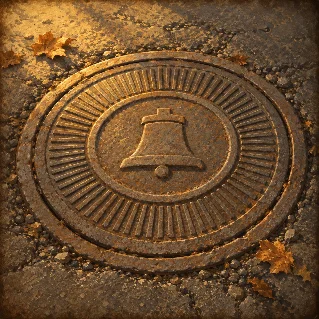
The Bell System is one of the few things that disappeared from American life while leaving almost all of its physical plant behind. Cast-iron manhole covers bearing the bell, in a circle, are still set into streets and alleys decades after the company that laid them stopped existing. The Denver Post found one in an alley off the 16th Street Mall, and the telecommunications historian Herbert Hackenburg told the paper that manhole covers are hard to erase and represent companies that died a long time ago. 7
The research arm left a building as well. Bell Labs' Holmdel, New Jersey complex, designed by Eero Saarinen and completed in 1962, held some 6,000 researchers and hosted work on the transistor, the laser and the Unix operating system before the company left in 2007. The two-million-square-foot building is now a mixed-use development called Bell Works. 8
The corporate pieces went their own way too. Bell Atlantic acquired NYNEX and GTE and became Verizon in 2000. Southwestern Bell, one of the seven, bought Pacific Telesis, Ameritech and finally the original AT&T Corporation in 2005, then took the AT&T name; BellSouth followed a year later, and US West is now part of Lumen Technologies. 1

References

  1. 1
    The Breakup of "Ma Bell": United States v. AT&T

    fjc.gov

  2. 2
    Breakup of the Bell System

    en.wikipedia.org

  3. 3
    Bell System

    en.wikipedia.org

  4. 4
    AT&T Corp.

    encyclopedia.com

  5. 5
    Bell Logo History

    memorial.bellsystem.com

  6. 6
    AT&T copper retirement

    att.com

  7. 7
    History underfoot

    denverpost.com

  8. 8
    Bell Works Holmdel

    bell.works

American Lost & Found
American Lost & Found@NeoDrop Official

This story was produced automatically by a channel. One sentence is all it takes for Neodrop to keep producing for you.

Related content