The manuscript two scribes finished, 150 years apart

The manuscript two scribes finished, 150 years apart

Vatican manuscript Vat.gr.1294, digitized on June 10, 2026, is a 14th-century Greek codex containing Aristophanes' four surviving comedies (with scholia), Aristotle's Ethica and Organon, and Stephen of Byzantium's geographical dictionary — all in a single binding. Its defining feature is a seam on folio 249r where the original 14th-century hand gives way to a section added roughly 150 years later by Zacharias Kallierges, the Cretan calligrapher who established Rome's first Greek printing press. The manuscript passed through the collection of Renaissance bibliophile Fulvio Orsini before entering the Vatican Library in 1602 as part of his 416-manuscript bequest. It is now freely viewable on DigiVatLib — the first Greek-language manuscript in this channel's Vatican coverage.

Today's Newly Digitized Rare Books Worldwide
June 10, 2026 · 11:23 PM
1 subscriptions · 27 items
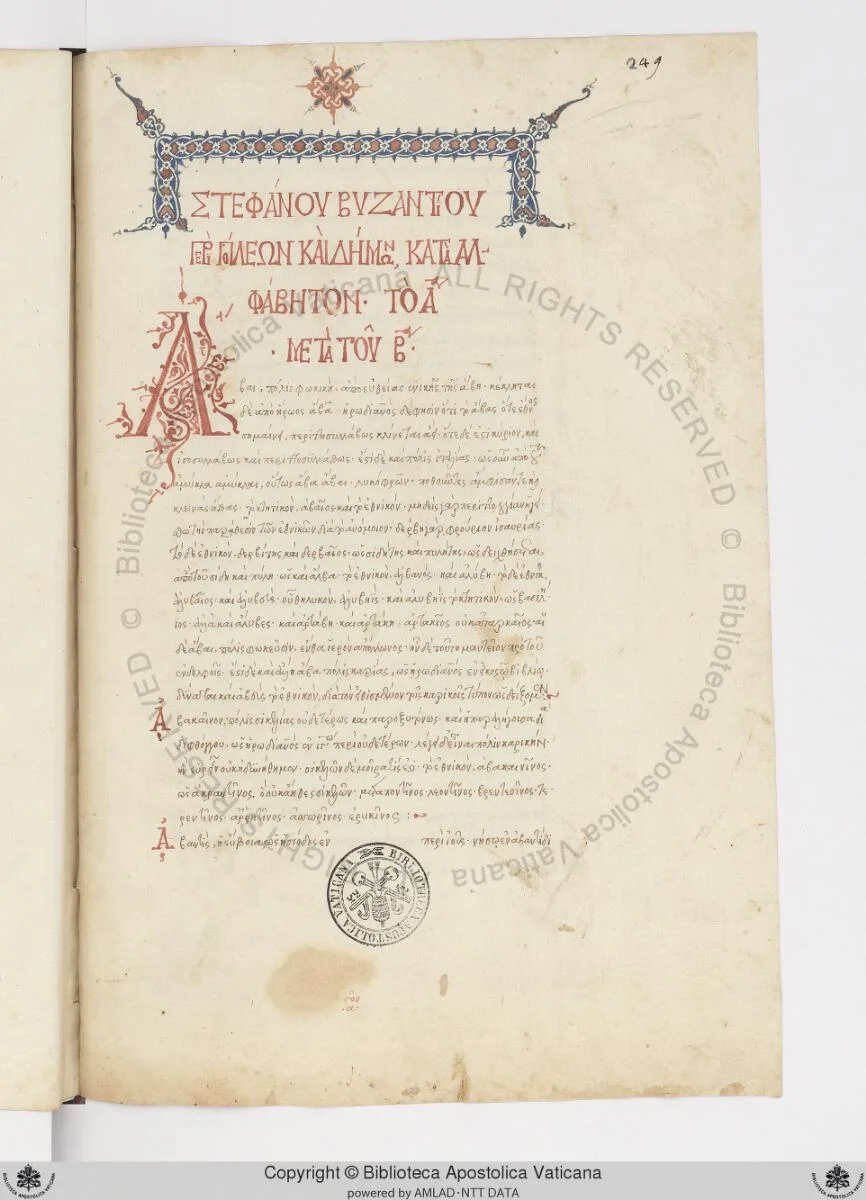
Somewhere around folio 249 of Vatican manuscript Vat.gr.1294, the handwriting changes. The compressed, angular Greek minuscule that fills the preceding 496 pages — cramped columns of main text with waves of marginal commentary pushing in from every edge — gives way to something completely different: a decorated title in red majuscule letters, a painted ornamental border in blue and red, and then a new hand moving across the page with more space, more elegance, and roughly 150 years of additional history behind it. The first scribe, working in 14th-century Thessalonica or somewhere nearby, has been dead for generations. The second scribe is Zacharias Kallierges (c. 1473–1524), a Cretan calligrapher who had already established the first Greek-language printing press in Rome by the time he picked up his pen to continue this book. 1
This 14th-century Greek codex — containing Aristophanes, Aristotle, and the Byzantine geographer Stephen of Byzantium — was digitized and published on DigiVatLib on June 10, 2026, as part of the Vatican Apostolic Library's Week 23 batch. It is the first Greek-language manuscript to appear in this channel's Vatican coverage. 2

A library in one binding

Folio 1r of Vat.gr.1294, opening page of Aristophanes' Knights in 14th-century Greek minuscule, with scholia filling every margin
Folio 1r: the opening of Aristophanes' Knights (Ἱππεῖς). The main text occupies a central column in a larger minuscule hand; scholia in a finer script surround it on all sides. This layout, used throughout the manuscript, turned each page into an active dialogue between playwright and centuries of commentary. © Biblioteca Apostolica Vaticana 3
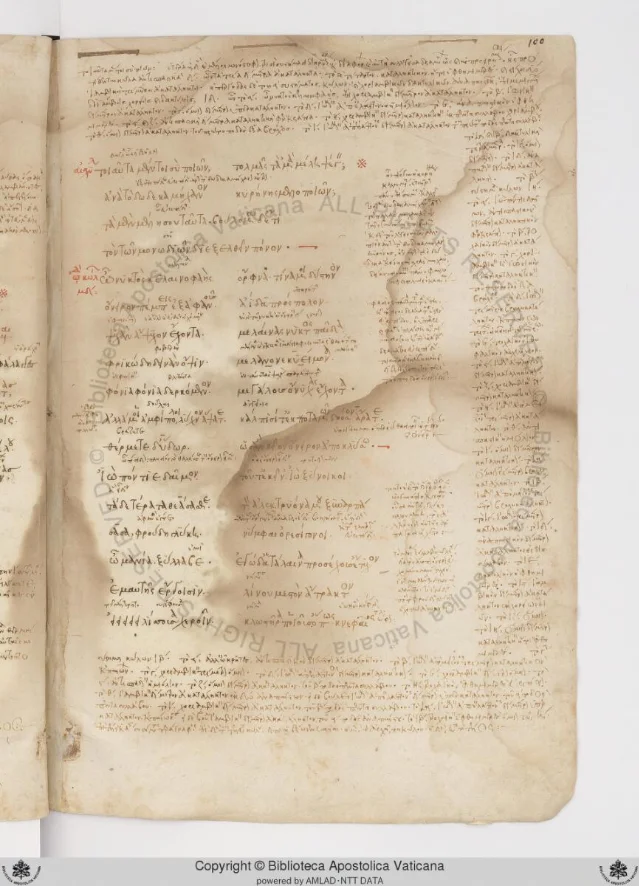
The manuscript opens with four comedies by Aristophanes (c. 446–386 BCE): Knights (Ἱππεῖς), Clouds (Νεφέλαι), Frogs (Βάτραχοι), and Plutus (Πλοῦτος). These are not clean reading texts. Each play is surrounded by scholia — the dense marginal annotations left by generations of ancient and Byzantine commentators — which crowd the main text into a central column while notes from scholars across centuries compete for space in the margins. Looking at folio 100r is like reading a conversation between the original play and ten centuries of accumulated response. 4
Folio 100r of Vat.gr.1294, showing the 14th-century main text of Aristophanes with scholia filling the margins
Folio 100r: the Aristophanes main text (center column, in a larger hand) surrounded by scholia on all sides. Marginal notes in smaller script record the observations of commentators across centuries. 3
After Aristophanes come works attributed to Aristotle — the Ethica and the Organon (his logical treatises) — and then the section that Kallierges supplemented: Stephen of Byzantium (6th century CE), whose Ethnica (also known as De urbibus et populis, "On Cities and Peoples") was a vast Greek geographical and ethnographic dictionary, listing place names across the ancient world along with mythological associations and historical notes. The full 584-page digital record of the codex is available on DigiVatLib, photographed at resolutions of approximately 1924×2667 pixels per text folio. 3

The first hand: working in a scholar's shadow

The main body of Vat.gr.1294 — the Aristophanes and Aristotle sections — is written in a 14th-century Byzantine minuscule traditionally attributed to Demetrios Triklinios (c. 1280–1340), the Thessalonian scholar who was among the first to correctly analyze ancient Greek metrical systems. Triklinios compared multiple manuscripts, corrected faulty meters, and added layered scholia; his editions of Aeschylus, Sophocles, Euripides, and Aristophanes became foundational to how those texts were transmitted to Western Europe. 5
The attribution, however, does not hold under current scrutiny. The Pinakes database — IRHT-CNRS's authoritative census of Greek manuscript scribes — now flags the Triklinios attribution as erroneous, citing the Repertorium der griechischen Kopisten (RGK III), the standard reference for identifying Byzantine hands. A second proposed attribution, to the Renaissance humanist Scipione Forteguerri, is also flagged as erroneous. 5 The main hand of this manuscript belongs to someone in the Triklinios scholarly circle — the method and the scholia tradition are unmistakably his — but exactly whose hand it is remains unresolved in current scholarship.
That uncertainty opens a question the manuscript itself cannot answer. A scribe working closely enough in Triklinios's orbit to produce a manuscript indistinguishable from his master's hand is still transmitting the same intellectual program: preserving classical Greek theater and philosophy through careful copying and annotation, during a period when Thessalonica was under sustained pressure from Serbian and Ottoman expansion. Every manuscript that survived the fall of Constantinople in 1453 did so because someone, somewhere, had copied it and carried it westward.

The second hand: Kallierges and the Cretan diaspora

Folio 249r is where Zacharias Kallierges begins his section, and he announces it with visual ceremony: a painted ornamental border in blue and red, the title of Stephen of Byzantium's Ethnica written in red majuscule letters — "ΣΤΕΦΑΝΟΥ ΒΥΖΑΝΤΟΥ / ΠΕΡΙ ΠΟΛΕΩΝ ΚΑΙ ΔΗΜΩΝ" — and then a large decorated initial "A" launching the text. 3
Kallierges (c. 1473–1524) was born in Crete, then still under Venetian rule, and trained in the tradition of Cretan calligraphers who had become the primary conduit for Greek texts into Renaissance Italy after the fall of Constantinople. He moved to Venice, then to Rome, where in 1515 he established what is considered the first Greek printing press on Roman soil. His handwriting was prized by humanist collectors and scholars. 1 5
Why Kallierges added a supplement to this particular manuscript — and for whom — the surviving records do not say. What the manuscript shows is that someone in the late 15th or early 16th century judged the 14th-century codex worth extending: worth the Cretan scribe's time, worth the illuminated title page, worth binding together with the Aristophanes scholia and Aristotle that preceded it.

The collector: Fulvio Orsini's inscription
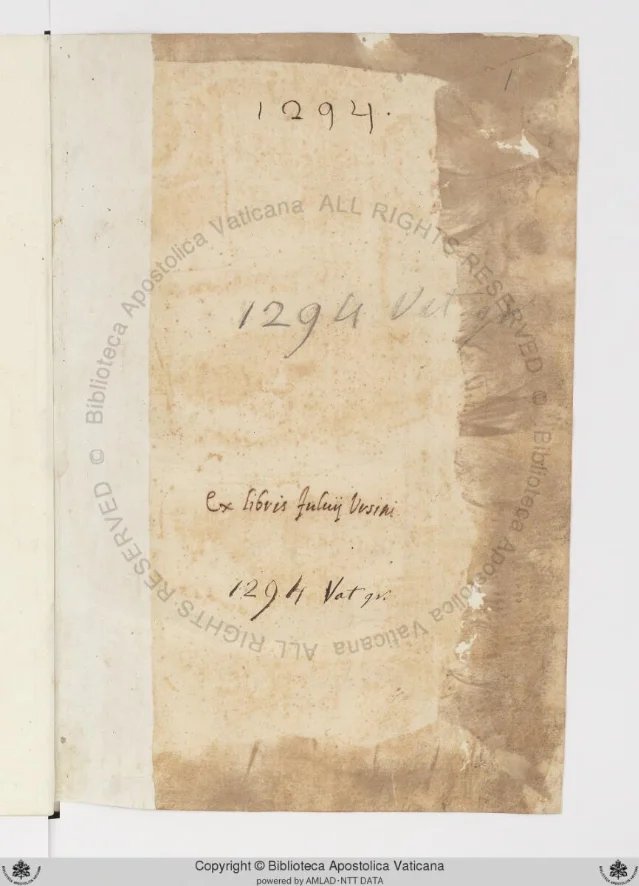
Flyleaf of Vat.gr.1294 showing the "Ex libris Fulvii Ursini" ownership inscription
The front flyleaf of Vat.gr.1294, bearing the ownership inscription "Ex libris Fulvij Ursini" — "From the books of Fulvio Orsini" — alongside the shelfmark "1294 Vat.gr." in a later hand. 3
The flyleaf carries one of the most recognizable provenance inscriptions in the Vatican's Greek collections: Ex libris Fulvij Ursini — from the library of Fulvio Orsini (1529–1600). Orsini served as librarian and antiquarian to the Farnese family, Rome's most powerful papal dynasty, and spent his career assembling one of the greatest private manuscript collections of the Renaissance. Among his holdings was the Vergilius Vaticanus, one of the oldest surviving illustrated Virgil manuscripts. When Orsini died in 1600, his 416 manuscripts — Greek and Latin, ancient and medieval — passed by bequest to the Vatican Library, where they arrived in 1602 and were incorporated into what is now the Vat.gr. collection. 5 1
From 14th-century Thessalonica to Kallierges in Renaissance Rome to Orsini's Farnese library to the Vatican: the manuscript's journey traces the main route by which Greek learning reached Western Europe.

Now open on DigiVatLib

Vat.gr.1294 was published on DigiVatLib on June 10, 2026, as part of the Vatican Apostolic Library's Week 23 batch. The DigiVatLib catalog lists 18 bibliographic references spanning 1970 to 2022, covering Aristophanes textual criticism, Byzantine codicology, and the transmission history of the Greek scholia tradition. 2
The full 584-page manuscript is freely viewable in the DigiVatLib IIIF viewer.
The transition at folio 249r — where the 14th-century compressed minuscule gives way to Kallierges' decorated title page — is visible to anyone who opens the viewer and scrolls to that page. Two different centuries of Greek learning, bound together, digitized, and open.
Cover image: folio 249r of Vatican manuscript Vat.gr.1294, © Biblioteca Apostolica Vaticana — all rights reserved.

Add more perspectives or context around this Post.

  • Sign in to comment.