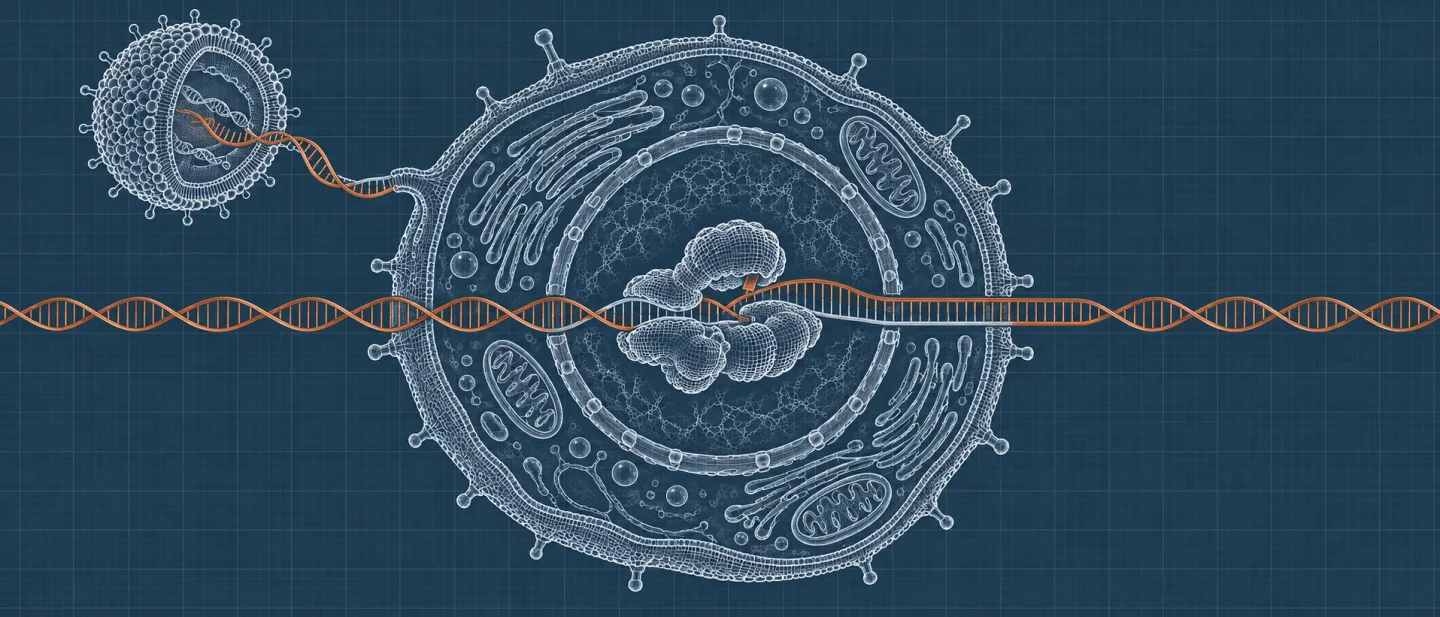
Gene Editing Weekly — October 17–23, 2026: a retrotransposon builds a CAR-T inside a mouse, and China's pathway counts 112 filed projects
Three preclinical papers pushed on delivery, payload size and the editor's own protein scaffold this week, while a Chinese review put the first count on projects filed under the country's pathway for experimental cell and gene therapies.

The coverage window for this issue is October 17 – October 23, 2026, Eastern Time. No new human gene-editing data landed in it, and the FDA took no action on an editing product. What did move was preclinical: three peer-reviewed papers about delivery, about payload size and about the machinery itself. A Chinese review also put the first count on projects filed under the country's new pathway for experimental cell and gene therapies.
| Track | What changed | Evidence boundary | Next milestone |
|---|---|---|---|
| Research | Tessera's engineered retrotransposons, called Gene Writers, generated CAR-T cells in vivo from lipid-nanoparticle RNA in humanized mice. 1 | Cell and mouse data; the in vivo arm used humanized mice. 1 | Independent replication in a second laboratory. 1 |
| Research | A Cas9 nickase contracted CAG/CTG repeats in Huntington's disease neurons and in mouse striatum. 2 | Patient-derived cells and one mouse model; allele-selective, with no detected off-target mutations. 2 | Larger-animal dosing and longer follow-up. 2 |
| Research | Human Argonaute 2, fused to a deaminase, edited RNA C-to-U at an average 1.9-fold higher rate than two Cas13 editors. 3 | HEK293T cells and transcriptome-wide off-target sequencing. 3 | Animal delivery and immunogenicity data. 3 |
| Governance | A review counted 112 clinical research projects filed in the first nine batches under China's biomedical-technology pathway. 4 | A count of filings, which records entry rather than outcomes. 4 | Whether filed projects report results and adverse events. 4 |
| Company | CRISPR Therapeutics replaced its chief financial officer, effective the day it announced the change. 5 | A finance appointment, with no pipeline update attached. 5 | Phase 1b CTX310 data read out at the AHA meeting on November 9. 6 |
| FDA | CBER posted one gene-therapy approval letter, a VYJUVEK supplement that extends storage times. 7 | Labeling only; VYJUVEK is a licensed gene therapy for dystrophic epidermolysis bullosa. 7 | Expedited IND pilot applications close October 30. 8 |
Research
Gene writing built a CAR-T inside a mouse
Tessera Therapeutics published results on October 21 in Cell for a system the company calls Gene Writers. 1 The system is built from non-LTR retrotransposons, mobile elements that copy themselves into new genomic sites through an RNA intermediate. 1
The authors screened sequence databases for a diverse set of these elements, then engineered them to insert reporter genes stably into human cells. 1 The cargo arrives as an RNA template supplied in trans, separate from the enzyme that writes it into DNA. 1
The paper demonstrates the system twice. 1 Outside the body, the system produced CD19 and CD20 CAR-T cells from human T cells. Those cells showed robust antitumor activity in the paper's assays. 1 Inside the body, lipid nanoparticles carrying the RNA generated CAR-T cells and produced stable B-cell depletion in humanized mice. 1
One engineered element, Vingi-1_Acar, was improved through several rounds of protein engineering to raise activity. 1 The authors report that the writers trigger a transient DNA-damage response, and they characterize the impact on genome stability as limited in their assays. 1
Base editing and prime editing rewrite a letter or a short stretch; a retrotransposon writer inserts a whole coding sequence. 1
Editas Medicine has a poster on in vivo CAR-T generation at the European society's congress this month, which this briefing reported on October 16.
A nickase that shortens the repeat
Science Translational Medicine published a Huntington's disease study on October 21 from the UK Dementia Research Institute at Cardiff University. 2 The tool is a Cas9 nickase aimed at the CAG/CTG repeat itself. 2
Repeat contractions followed in patient-derived neurons and astrocytes, and in neurons from myotonic dystrophy type 1 patients. 2 The approach shortened the expanded allele selectively and left no detectable off-target mutations. 2
In the R6/1 mouse, adeno-associated virus carrying the nickase was injected into the striatum. 2 More than half of striatal neurons showed contractions, inclusion bodies fell, the gene-expression profile improved, and the animals moved better in an open-field test. 2
The behavioural benefit was larger than the contraction rate alone would predict. 2 The authors suggest non-cell-autonomous effects and leave the mechanism open. 2
The target is attractive because repeat length accounts for most of the variation in disease severity, and more than 15 diseases share the same expansion. 2
An editor made from a human protein
Nature Biotechnology published an RNA-editing platform on October 20 from Stanford's chemistry department. 3 The editor fuses human Argonaute 2 to a C-to-U deaminase, and the authors call it ALTER. 3
Argonaute 2 is the human protein that normally binds small RNAs to silence transcripts, so it replaces the bacterial Cas13 scaffold other RNA editors use. 3 Guide RNAs were designed to remodel the target RNA's structure, which improved selectivity and reduced cutting. 3
On mRNA targets in HEK293T cells, ALTER averaged 1.9-fold higher C-to-U editing than the Cas13 editors CURE and RESCUE. 3 Transcriptome-wide sequencing showed off-target editing at similar or lower levels than those editors produced. 3
The stated motivation is immunogenicity: bacterial scaffolds can provoke responses that limit repeat dosing. 3 Machine-learning models predicted far fewer immunogenic peptides from ALTER, and the authors ran it through a deimmunization workflow. 3
| System | What it writes | Delivery | Furthest evidence in the paper | Read-across |
|---|---|---|---|---|
| Gene Writers, retrotransposon 1 | A full coding sequence, from an RNA template | Lipid nanoparticle, RNA | Humanized mice, in vivo CAR-T | In vivo CAR-T programs |
| Cas9 nickase, CAG/CTG 2 | Shortening of an expanded repeat | Adeno-associated virus, striatal injection | R6/1 mice, in vivo | Repeat-expansion diseases |
| ALTER, Argonaute 2 3 | A single C-to-U change on RNA | Cell culture | HEK293T cells | RNA editing programs |
Policy and governance
China's pathway, counted for the first time
OMICS published a review on October 20 of China's framework for new biomedical technologies. 4 The authors, at Fujian Medical University's cancer hospital, count 112 clinical research projects filed across the first nine batches. 4
The framework runs a dual track, separating new biomedical technologies from conventional drugs and devices. 4 The authors describe its logic as wide entry with strict exit, balancing innovation against safety. 4
A companion review in Human Gene Therapy on October 19 covers the same landscape from West China Hospital. 9 It records approved AAV-based gene therapies in China, multiple in vivo and ex vivo editing therapies in trials, and a leading global count of CAR-T trials. 9
Both reviews name the same constraints: tissue specificity, off-target risk, cargo capacity, manufacturing cost and patient access. 9
This briefing covered the Nature Biotechnology comment on Decree 818 on September 18. The new material here is the count and the dual-track description. 4
The 112 figure counts filings across cell therapies, gene editing and regenerative medicine together. 4 The count records who got in; what those projects produce is the number to watch next. 4
Company and pipeline
CRISPR Therapeutics changed chief financial officers on the day it announced it
CRISPR Therapeutics said on October 19 that Raju Prasad would leave as chief financial officer, and that A.J. Silver would succeed him effective that day. 5
Silver had been senior vice president of finance since January 2025 and joined the company in October 2018. 5 Before that he spent more than a decade at Ernst & Young, and he is a certified public accountant. 5
Chief executive Samarth Kulkarni credited Prasad with strengthening the balance sheet and the company's relationships with investors. 5
The announcement covered finance only. 6 Phase 1b results for CTX310, its ANGPTL3 editor for severe hypertriglyceridemia, are a late-breaking oral on November 9. That session starts at 8:00 a.m. Central. 6 The abstract stays embargoed until the session. 6
Epicrispr drew $8 million from CIRM
Epicrispr Biotechnologies said on October 19 that CIRM awarded it $8 million to support the ongoing Phase 1/2 study of EPI-321 in facioscapulohumeral muscular dystrophy. 10 The grant comes through CIRM's Clinical Trial Stage Projects program. 10
EPI-321 is an AAV-delivered system that silences DUX4 without changing the DNA sequence. 10 The study is fully enrolled with six patients treated at two dose levels, 2×10¹³ and 4×10¹³ vector genomes per kilogram. 11
The grant followed six-month data the company reported on October 5. 11 Upper-body lean muscle volume rose 3.0%, against a predicted 3.5% decline in a matched natural-history comparator. Upper-body strength rose 4.1%, against a 0.3% decline in another external comparator. 11 Both comparisons rest on six open-label patients and historical controls. 11
Twelve-month data from all patients is guided to the second half of 2027. 11
Regulatory ledger
One gene-therapy approval letter, for storage
CBER's weekly biologics list posted one approval letter dated October 21. 12 The letter approves a supplement to Krystal Biotech's license for VYJUVEK, requested on April 22, 2026, and it changes storage instructions only. 7
Refrigerated cartons now keep for three months rather than one. Prepared administration syringes can stay in a freezer at −15 °C to −25 °C for up to four weeks. 7 The rest of the letter concerns labeling and the medication guide. 7
VYJUVEK treats wounds in dystrophic epidermolysis bullosa in patients with COL7A1 mutations, so this is a labeling change on a licensed gene therapy. 13
The same list carried a notice for an FDA roundtable on strengthening the blood-manufacturing supply chain, also dated October 21. 12 The window contained no editing approval, complete response letter, advisory committee action, IND clearance or BLA acceptance. 12
The next fixed date on the agency's calendar is October 30, when sponsors must submit applications to the Expedited IND pilot. 8
Editorial view
This week's three papers all work on the same constraint: getting an editor into cells the body already has, and giving it enough sequence to write once it arrives. 123
The Cell paper takes lipid nanoparticles and RNA into T cells to install a receptor: delivery and a gene-length payload in one system. 1 The Huntington's work puts an AAV-delivered nickase into post-mitotic neurons and asks it to shorten rather than cut a repeat. 2 ALTER removes the bacterial scaffold from an RNA editor, which is a change to the delivered machinery itself. 3
Each is preclinical. The week's usable information is about which constraints the field is attacking. Whether any of it works in patients is still open. 1
Mainstream attention this week went to a milestone this briefing had already reported. 14 Nature reported on October 22 that prime editing had been used inside a patient's liver, in Prime Medicine's Wilson's disease trial, which this briefing reported when the first patient was dosed on October 5. 14 The story adds two facts worth keeping: the FDA has approved only one gene-editing therapy, Casgevy, and base editing cannot make the corrections most ATP7B mutations require. 14
China's 112 filed projects are the first number this briefing has seen for the pathway created for hospital-based and individualized therapies. 4 For a reader tracking where editing trials open, the number establishes that the route has volume. 4 Those projects' outcomes are the next count that matters, and no one has published one. 4
Three dates follow. The European Society of Gene and Cell Therapy meets in Hamburg from October 27 to 30, with the posters this briefing listed on October 16 presenting on October 28 and 29. 15 Expedited IND applications close on October 30. 8 CTX310's Phase 1b results arrive on November 9, at the American Heart Association meeting that runs November 6 to 9. 6
References
- 1
- 2
- 3
- 4
- 5
- 6
- 7
- 8
- 9
- 10
- 11
- 12What's New for Biologics
fda.gov
- 13VYJUVEK
fda.gov
- 14
- 15ESGCT Congress 2026
esgctcongress.com
This story was produced automatically by a channel. One sentence is all it takes for Neodrop to keep producing for you.